


Integrating CRISPR Engineering and hiPSC-Derived 2D Disease Modeling Systems
- PMID: 32024766
- PMCID: PMC7002154
- DOI: 10.1523/JNEUROSCI.0518-19.2019
Integrating CRISPR Engineering and hiPSC-Derived 2D Disease Modeling Systems
Abstract
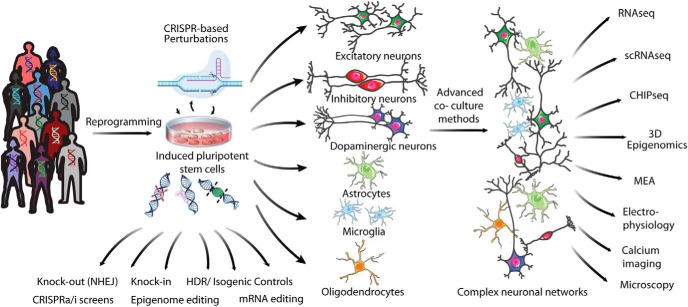
Human induced pluripotent stem cells (hiPSCs) have revolutionized research on human diseases, particularly neurodegenerative and psychiatric disorders, making it possible to study mechanisms of disease risk and initiation in otherwise inaccessible patient-specific cells. Today, the integration of CRISPR engineering approaches with hiPSC-based models permits precise isogenic comparisons of human neurons and glia. This review is intended as a guideline for neuroscientists and clinicians interested in translating their research to hiPSC-based studies. It offers state-of-the-art approaches to tackling the challenges that are unique to human in vitro disease models, particularly interdonor and intradonor variability, and limitations in neuronal maturity and circuit complexity. Finally, we provide a detailed overview of the immense possibilities the field has to offer, highlighting efficient neural differentiation and induction strategies for the major brain cell types and providing perspective into integrating CRISPR-based methods into study design. The combination of hiPSC-based disease modeling, CRISPR technology, and high-throughput approaches promises to advance our scientific knowledge and accelerate progress in drug discovery.Dual Perspectives Companion Paper: Studying Human Neurodevelopment and Diseases Using 3D Brain Organoids, by Ai Tian, Julien Muffat, and Yun Li.
Keywords: CRISPR; Human induced pluripotent stem cells; differentiation; disease modeling; induction; psychiatric genetics.
Copyright © 2020 the authors.
Figures
References
-
- Abud EM, Ramirez RN, Martinez ES, Healy LM, Nguyen CH, Newman SA, Yeromin AV, Scarfone VM, Marsh SE, Fimbres C, Caraway CA, Fote GM, Madany AM, Agrawal A, Kayed R, Gylys KH, Cahalan MD, Cummings BJ, Antel JP, Mortazavi A, et al. (2017) iPSC-derived human microglia-like cells to study neurological diseases. Neuron 94:278–293.e9. 10.1016/j.neuron.2017.03.042 - DOI - PMC - PubMed
Publication types
MeSH terms
Grants and funding
LinkOut - more resources
Full Text Sources
