


Linked Anatomic Kinematic Arthroplasty: A Unique Approach to Balancing in Total Knee Arthroplasty
- PMID: 32025149
- PMCID: PMC6997515
- DOI: 10.1016/j.jor.2020.01.016
Linked Anatomic Kinematic Arthroplasty: A Unique Approach to Balancing in Total Knee Arthroplasty
Erratum in
-
Erratum regarding missing Declaration of Competing Interest statements in previously published articles.J Orthop. 2020 Dec 15;24:291. doi: 10.1016/j.jor.2020.12.004. eCollection 2021 Mar-Apr. J Orthop. 2020. PMID: 33994700 Free PMC article.
Abstract
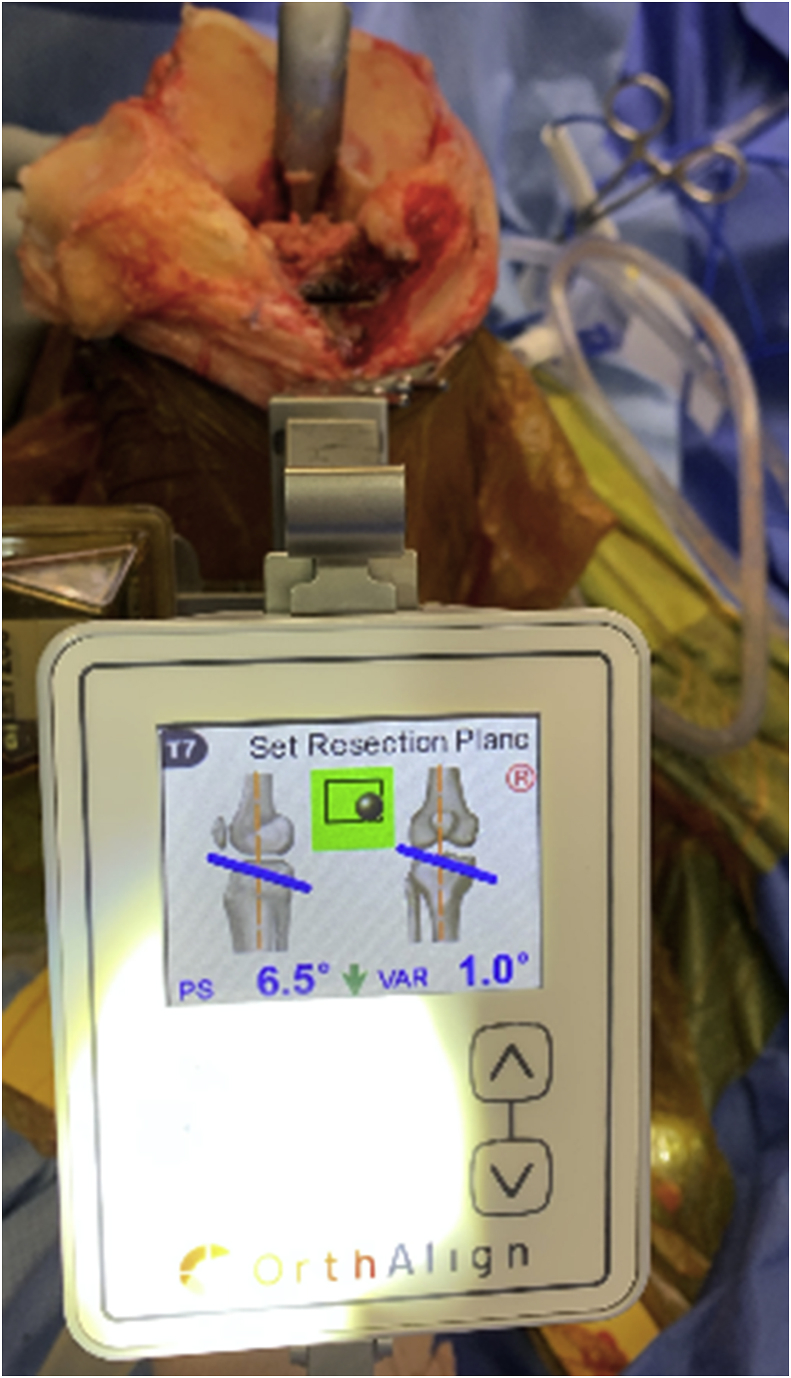
Traditional approaches to total knee arthroplasty (TKA) aim to reestablish a neutral mechanical axis of the lower extremity. However, many studies have shown great variation in normal knee anatomy, suggesting that the ideal alignment may not be identical for every patient. Linked Anatomic Kinematic Arthroplasty (LAKA) offers a novel kinematic approach to TKA. Using computer navigation, LAKA technique can optimize the kinematic alignment while ensuring that coronal alignment is kept within standard mechanical ranges. This article will outline the surgical approach to LAKA and briefly review the outcomes of this approach.
Keywords: Anatomic kinematic knee arthroplasty; Knee replacement; Surgical approach; TKA; Total knee arthroplasty.
© 2020 Professor P K Surendran Memorial Education Foundation. Published by Elsevier B.V. All rights reserved.
Figures




References
-
- Abdel M.P., Ollivier M., Parratte S., Trousdale R.T., Berry D.J., Pagnano M.W. Effect of postoperativemechanical axis alignment on survival and functional outcomes of modern total knee arthroplasties with cement: a concise follow-up at 20 years. J Bone Joint Surg Am. 2018;100(6):472–478. - PubMed
-
- Courtney P.M., Lee G.C. Early outcomes of kinematic alignment in primary total knee arthroplasty: a meta-analysis of the literature. J Arthroplast. 2017;32(6):2028–2032. e1. - PubMed
LinkOut - more resources
Full Text Sources
