


Obesity significantly alters the human sperm proteome, with potential implications for fertility
- PMID: 32026202
- PMCID: PMC7183029
- DOI: 10.1007/s10815-020-01707-8
Obesity significantly alters the human sperm proteome, with potential implications for fertility
Abstract
Purpose: In men, obesity may lead to poor semen parameters and reduced fertility. However, the causative links between obesity and male infertility are not totally clear, particularly on a molecular level. As such, we investigated how obesity modifies the human sperm proteome, to elucidate any important implications for fertility.
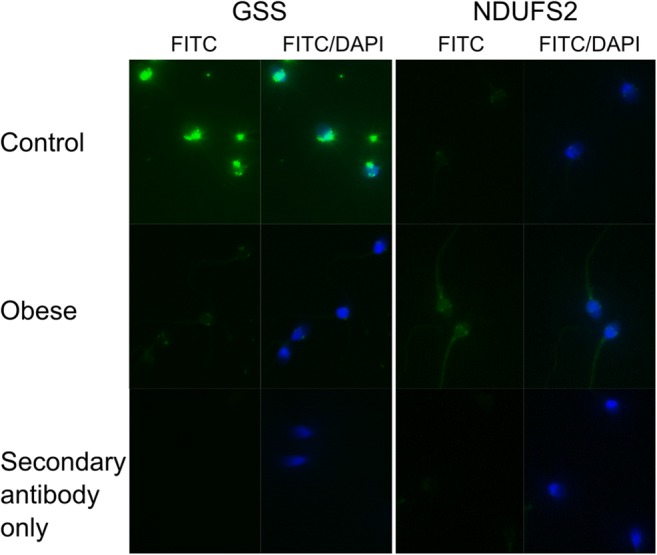
Methods: Sperm protein lysates from 5 men per treatment, classified as a healthy weight (body mass index (BMI) ≤ 25 kg/m2) or obese (BMI ≥ 30 kg/m2), were FASP digested, submitted to liquid chromatography tandem mass spectrometry, and compared by label-free quantification. Findings were confirmed for several proteins by qualitative immunofluorescence and a quantitative protein immunoassay.
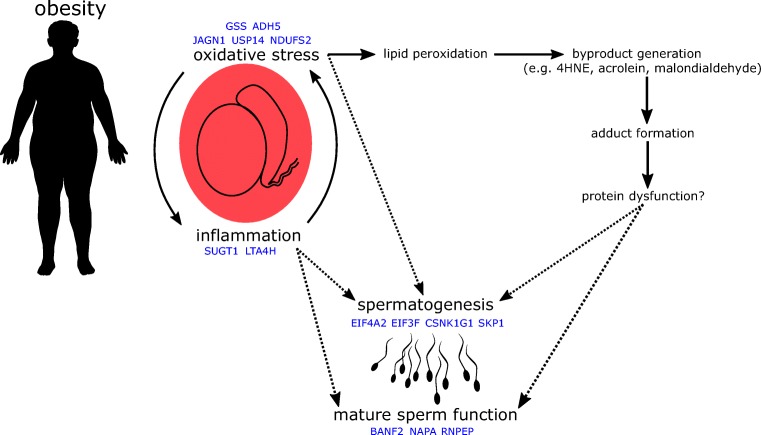
Results: A total of 2034 proteins were confidently identified, with 24 proteins being significantly (p < 0.05) less abundant (fold change < 0.05) in the spermatozoa of obese men and 3 being more abundant (fold change > 1.5) compared with healthy weight controls. Proteins with altered abundance were involved in a variety of biological processes, including oxidative stress (GSS, NDUFS2, JAGN1, USP14, ADH5), inflammation (SUGT1, LTA4H), translation (EIF3F, EIF4A2, CSNK1G1), DNA damage repair (UBEA4), and sperm function (NAPA, RNPEP, BANF2).
Conclusion: These results suggest that oxidative stress and inflammation are closely tied to reproductive dysfunction in obese men. These processes likely impact protein translation and folding during spermatogenesis, leading to poor sperm function and subfertility. The observation of these changes in obese men with no overt andrological diagnosis further suggests that traditional clinical semen assessments fail to detect important biochemical changes in spermatozoa which may compromise fertility.
Keywords: Fertility; LC-MS/MS; Obesity; Proteome; Reproduction; Spermatozoa.
Conflict of interest statement
The authors declare that they have no conflicts of interest.
Figures
References
-
- Organization WH. Prevalence of overweight among adults, BMI ≥ 25, age-standardized, estimates by WHO region. Global Health Observatory data repository. 2017.
-
- Hales C, Carroll M, Fryar C, Ogden C. Prevalence of obesity among adults and youth: United States, 2015–2016: National Center for Health Statistics2017 Contract No.: 288.
-
- Oliveira JBA, Petersen CG, Mauri AL, Vagnini LD, Renzi A, Petersen B, et al. Association between body mass index and sperm quality and sperm DNA integrity. A large population study. Andrologia. 2018;50(3):e12889. - PubMed
-
- Ramaraju GA, Teppala S, Prathigudupu K, Kalagara M, Thota S, Kota M, et al. Association between obesity and sperm quality. Andrologia. 2018;50(3):e12888. - PubMed
-
- Taha EA, Sayed SK, Gaber HD, Abdel Hafez HK, Ghandour N, Zahran A, Mostafa T. Does being overweight affect seminal variables in fertile men? Reprod BioMed Online. 2016;33(6):703–708. - PubMed
MeSH terms
Substances
LinkOut - more resources
Full Text Sources
Other Literature Sources
Medical
Research Materials
Miscellaneous
