Review
. 2020 Sep;33(5):660-670.
doi: 10.1111/pcmr.12870. Epub 2020 Feb 20.

Do innate killing mechanisms activated by inflammasomes have a role in treating melanoma?

Affiliations
Review

Do innate killing mechanisms activated by inflammasomes have a role in treating melanoma?

Abdullah Al Emran et al. Pigment Cell Melanoma Res. 2020 Sep.

Abstract

Melanoma, as for many other cancers, undergoes a selection process during progression that limits many innate and adaptive tumor control mechanisms. Immunotherapy with immune checkpoint blockade overcomes one of the escape mechanisms but if the tumor is not eliminated other escape mechanisms evolve that require new approaches for tumor control. Some of the innate mechanisms that have evolved against infections with microorganisms and viruses are proving to be active against cancer cells but require better understanding of how they are activated and what inhibitory mechanisms may need to be targeted. This is particularly so for inflammasomes which have evolved against many different organisms and which recruit a number of cytotoxic mechanisms that remain poorly understood. Equally important is understanding of where these mechanisms will fit into existing treatment strategies and whether existing strategies already involve the innate killing mechanisms.

Keywords: IL-1β; TCGA; adaptive resistance; inflammasomes; innate killing; melanoma; pyroptosis.


Conflict of interest statement

The authors have no conflict of interest in relation to this work.

Figures
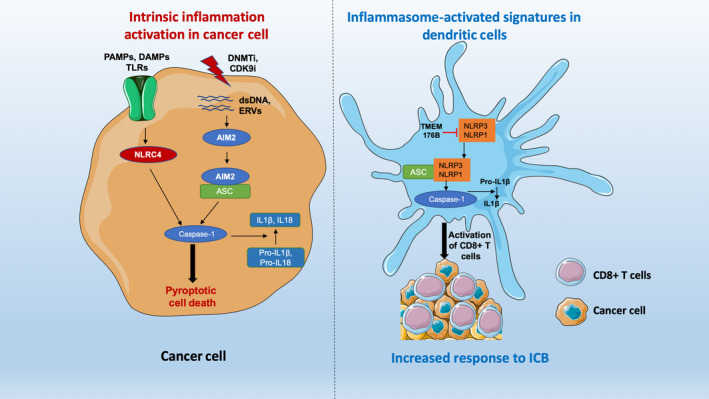
Figure 1
Figure 1
Possible mechanisms of pyroptotic cell death through inflammasome activation. Epigenetic drugs such as DNA methyltransferase inhibitor (DNMTi) and CDK9 inhibitors (CDK9i) can activate ERVs and dsDNA in the cancer cells. Inflammatory protein AIM2 binds dsDNA and subsequently activates caspase‐1 through forming a complex with ASC protein. Whereas, DAMPs, PAMPs binds to TLRs on the plasma membrane and subsequently activate inflammatory sensor NLRC4, which can directly activate caspase‐1. Activated caspase‐1 directs pyroptotic cell death and converts IL‐1β, IL18 from inactive Pro‐IL‐1β, Pro‐IL18 that releases from the cells to drive inflammation (left panel). Intrinsic inflammatory gene signatures in the dendritic cells or macrophages augment response to ICB. TMEM176B is a negative regulator of the inflammatory proteins such as NLRP3 and NLRP1. Blocking TMEM176B by small molecule inhibitor leads to activation of caspase‐1 and IL‐1β. This promotes the recruitment of CD8+ T cells in the tumor microenvironment thus enhancing the therapeutic response of ICB (right panel) (modified from Segovia et al., 2019). DAMPs, damage‐associated molecular patterns; ERVs, endogenous retroviruses; ICB, immune checkpoint blockade; PAMPs, pathogen‐associated molecular patterns; TLR, toll‐like receptor.
Figure 2
Figure 2
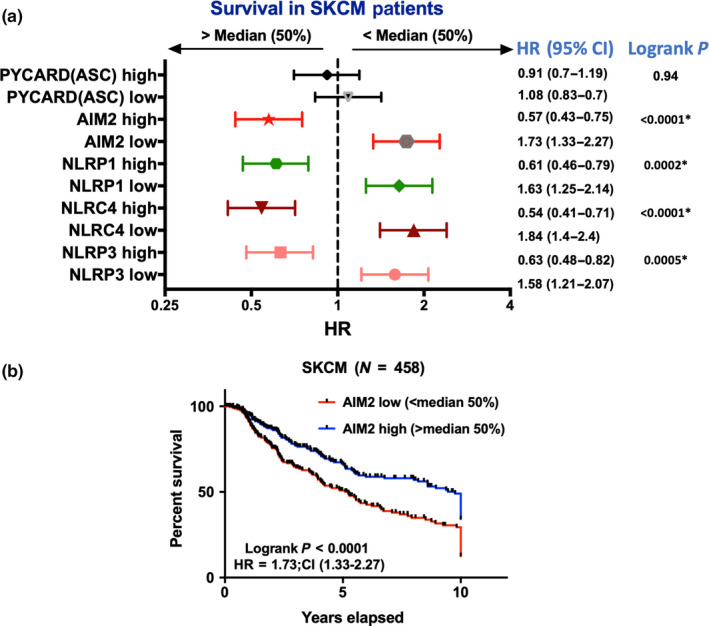
Low expression of inflammasome mediators is associated with poor prognosis in melanoma. RNA‐seq data of skin cutaneous melanoma (SKCM) patients were retrieved from TCGA database (N = 458). Patients were dichotomized based on median expression (>median = high; <median = low) of the corresponding genes. (a) A forest plot was generated based on the computed hazard ratio (HR) and 95% confidence intervals (CI) of survival for each gene. Logrank p value refers to the significance of the overall survival adjusted to 10 years. (b) A KM‐plot is showing overall survival of SKCM patients based on AIM2 median expression
Figure 3
Figure 3
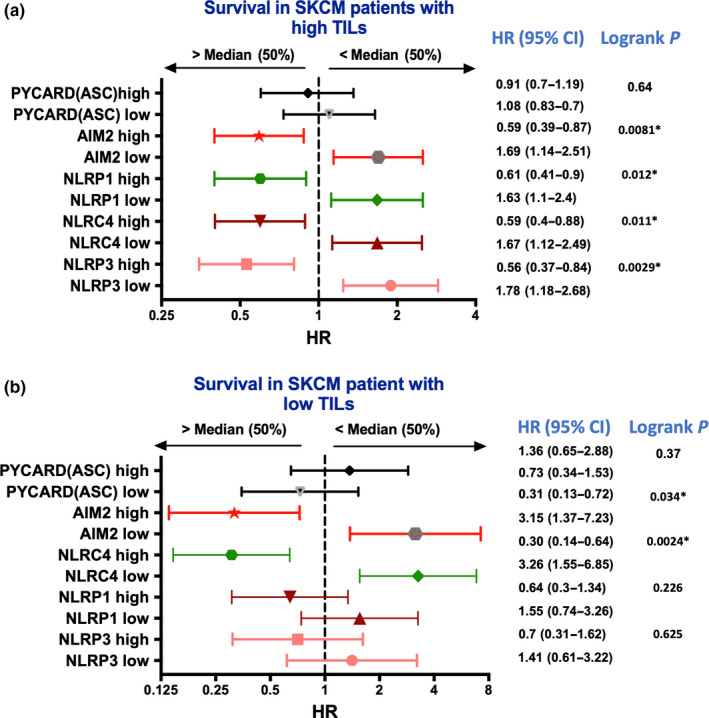
Association of TILs level and gene expression of the inflammasome mediators with overall survival in melanoma. (a) Skin cutaneous melanoma (SKCM) patients were separated based on the median expression of the corresponding gene and the TILs level (>5% refers to high TILs). TILs proportion in the tumor were retried based on deep learning pathology images (Saltz et al., 2018). (b) Similarly, SKCM patients were stratified based on low TILs level (<5% refers to low TILs) and median expression of the selected gene. Forest plot refers to the HR with 95% CI and logrank p value were calculated for overall survival. Statistical analysis was performed in GraphPad prism, and p < .05 refers to significance of overall survival
Figure 4
Figure 4
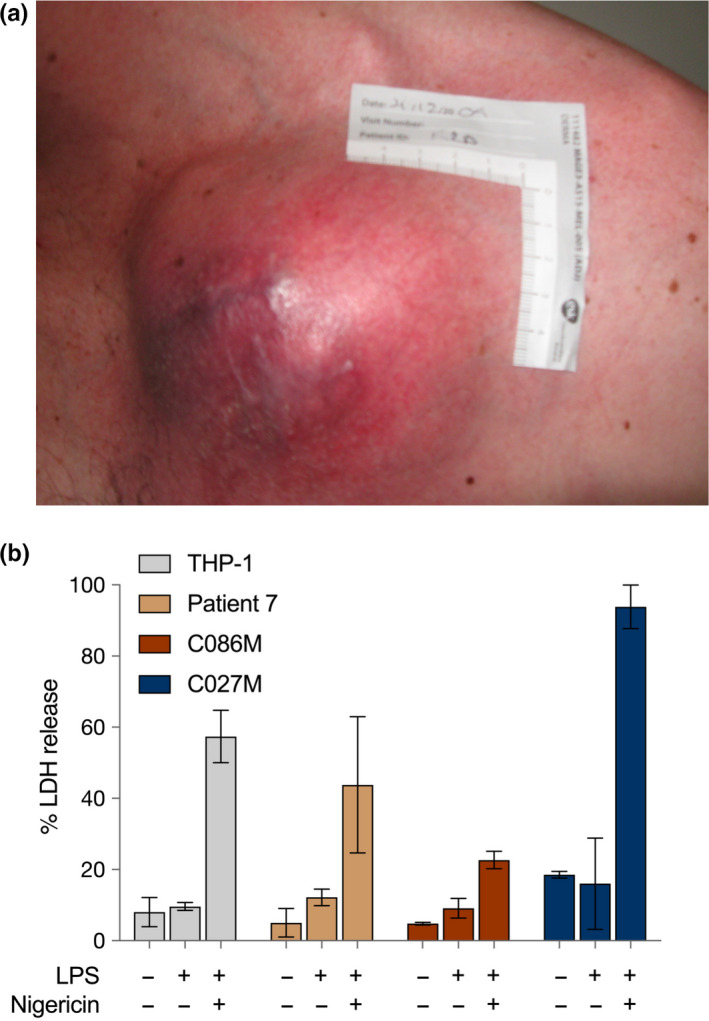
High expression of inflammatory gene signatures induced cell death in patient‐derived melanoma cells. (a) Clinical appearance of melanoma in patient 7. (b) Melanoma with strong inflammasome RNA‐seq signatures (patient 7, C027M) display nigericin‐dependent lytic cell death. The THP‐1 human monocytic cell line was used as a positive control; C086M human melanoma cell line has weaker inflammasome RNA‐seq signatures

References

    1. Adams, S. , Miller, G. T. , Jesson, M. I. , Watanabe, T. , Jones, B. , & Wallner, B. P. (2004). PT‐100, a small molecule dipeptidyl peptidase inhibitor, has potent antitumor effects and augments antibody‐mediated cytotoxicity via a novel immune mechanism. Cancer Research, 64(15), 5471–5480. 10.1158/0008-5472.CAN-04-0447 - DOI - PubMed
    1. Amaravadi, R. K. , Kimmelman, A. C. , & Debnath, J. (2019). Targeting autophagy in cancer: Recent advances and future directions. Cancer Discovery, 9(9), 1167–1181. 10.1158/2159-8290.CD-19-0292 - DOI - PMC - PubMed
    1. Bai, X. , Fisher, D. E. , & Flaherty, K. T. (2019). Cell‐state dynamics and therapeutic resistance in melanoma from the perspective of MITF and IFNgamma pathways. Nature Reviews Clinical Oncology, 16(9), 549–562. 10.1038/s41571-019-0204-6 - DOI - PMC - PubMed
    1. Bent, R. , Moll, L. , Grabbe, S. , & Bros, M. (2018). Interleukin‐1 beta‐A friend or foe in malignancies? International Journal of Molecular Sciences, 19(8), 2155 10.3390/ijms19082155 - DOI - PMC - PubMed
    1. Chatterjee, A. , Rodger, E. , Ahn, A. , Stockwell, P. A. , Parry, M. , Motwani, A. , … Hersey, P. (2018). Marked global hypomethylation mediated changes regulate constitutive PD‐L1 expression in melanoma. iScience, 4, 312–325. - PMC - PubMed

Publication types