Review
. 2020 Jun 11;63(11):5664-5674.
doi: 10.1021/acs.jmedchem.9b01738. Epub 2020 Feb 17.

Two Decades of Successful SAR-Grounded Stories of the Novel Bacterial Topoisomerase Inhibitors (NBTIs)

Affiliations
Review

Two Decades of Successful SAR-Grounded Stories of the Novel Bacterial Topoisomerase Inhibitors (NBTIs)

Anja Kolarič et al. J Med Chem. .

Abstract

The emergence of bacterial resistance against life-saving medicines has forced the scientific community and pharmaceutical industry to take actions in the quest for novel antibacterials. These should not only overcome the existing bacterial resistance but also provide at least interim effective protection against emerging bacterial infections. Research into DNA gyrase and topoisomerase IV inhibitors has become a particular focus, with the description of a new class of bacterial topoisomerase type II inhibitors known as "novel bacterial topoisomerase inhibitors", NBTIs. Elucidation of the key structural modifications incorporated into these inhibitors and the impact these can have on their general physicochemical properties are detailed in this review. This defines novel bacterial topoisomerase inhibitors with promising antibacterial activities and potencies, which thus represent one potential example of the future "drugs for bad bugs", as identified by the World Health Organization.


Conflict of interest statement

The authors declare no competing financial interest.

Figures
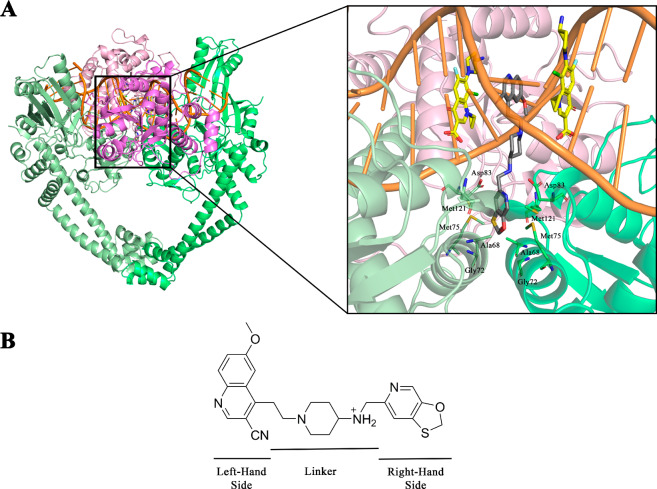
Figure 1
Figure 1
(A) Cartoon representations for comparison of the binding modes of the NBTIs (inset, gray, GSK299423) and fluoroquinolones (inset, yellow, clinafloxacin) within Staphylococcus aureus DNA gyrase (PDB code 2XCS). For the purpose of comparison of the distinct binding sites between fluoroquinolones and NBTIs, clinafloxacin molecules were artificially inserted after superimposing Streptococcus pneumoniae topo IV (PDB code 3RAD) over S. aureus DNA gyrase. The DNA gyrase A subunits are shown in light and dark green, the DNA gyrase B subunits are light and dark violet, and the DNA molecule is orange. (B) Structure of GSK299423 as a representative NBTI, indicating the main important structural fragments: the “left-hand side” (LHS) and the “right-hand side” (RHS) of the molecule (as depicted here) and the central linker.
Figure 2
Figure 2
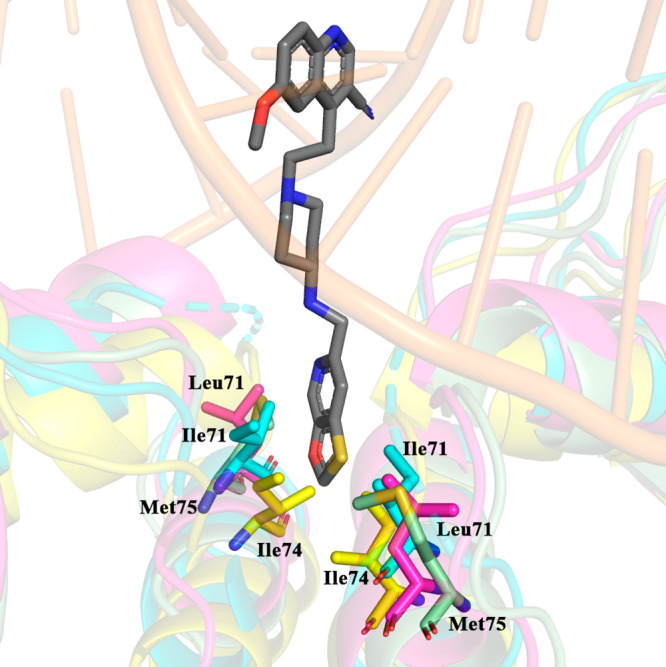
GSK299423 (inset, gray) and Met75 from S. aureus DNA gyrase (inset, green, PDB code 2XCS) in comparison to Ile74 in E. coli DNA gyrase (inset, yellow, PDB code 4CKK), Ile71 in S. aureus topo IV (inset, cyan, PDB code 2INR), and Leu71 in E. coli topo IV assembled homology model utilizing Klebsiella pneumoniae topo IV structure as a template (inset, magenta, PDB code 5EIX). For clarity, the corresponding GyrA and ParC subunits originating from S. aureus and E. coli, respectively, were used for the structural superimposition (see Supporting Information).
Figure 3
Figure 3
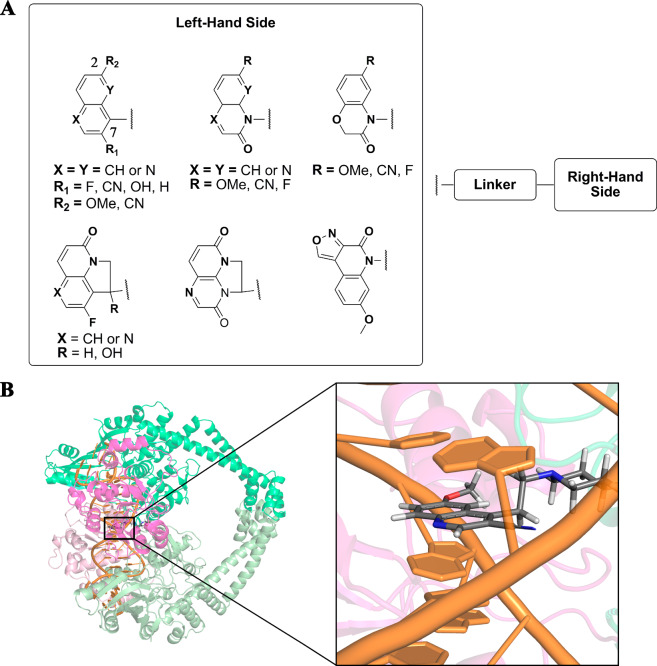
(A) Substitution patterns of the LHS fragments identified as most suitable for DNA intercalation and antibacterial activity. (B) 3D representation of a quinoline LHS (inset, gray, stick representation) intercalated between the central DNA base pairs (inset, orange, cartoon representation; PDB code 2XCS).
Figure 4
Figure 4
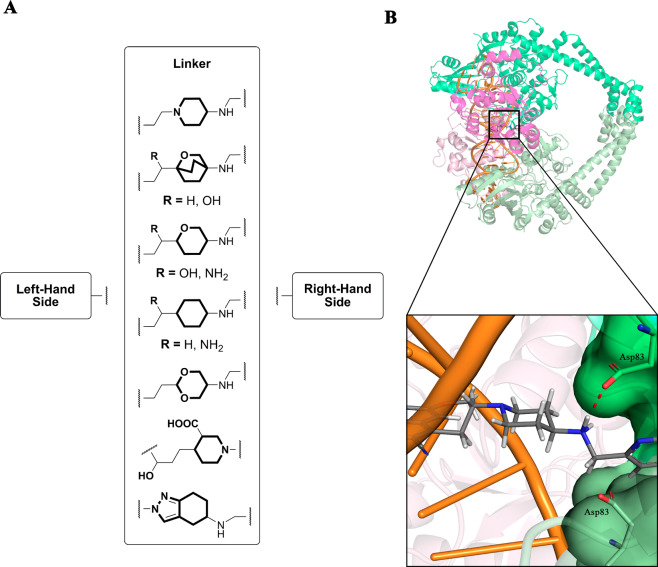
(A) Substitution patterns of the most common NBTI linker fragments. These comprise a representative central unit (linker) and the optimal two-atom linkage. (B) 3D representation of an example aminopiperidine linker moiety (inset, gray, stick representation) and its key ionic interaction (red dots) between the protonated basic amine of the linker and Asp83 of GyrA (inset, green, stick representation; PDB code 2XCS), which is required for correct antibacterial activity.
Figure 5
Figure 5
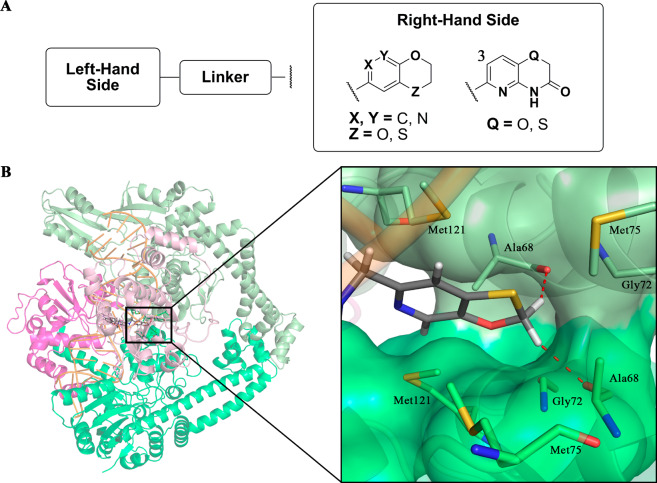
(A) Substitution patterns of the most common RHS fragments identified as most suitable for appropriate interactions with GyrA, to contribute to improved antibacterial activity. (B) 3D representation of an example bicyclic RHS (inset, gray, stick representation) bound into the GyrA hydrophobic pocket (inset, green) with the key amino acid residues (inset, green, stick representation). The unusual H-bonding between RHS −CH2 and the Ala68 backbone oxygens (inset: red dots; PDB code 2XCS) defines the correct positioning and stabilization of RHS within the GyrA binding pocket.
Figure 6
Figure 6
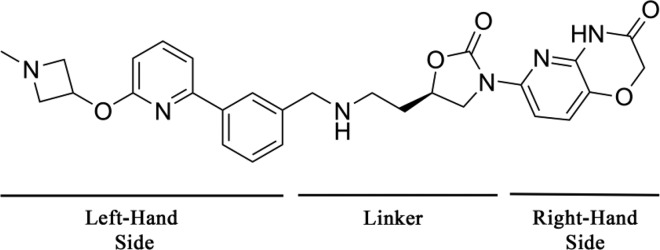
Representative of the latest NBTIs that contain modified LHS and linker fragments with an established RHS, in an approach toward improvement of the Gram-negative activity. This compound showed balanced Gram-positive (S. aureus MIC = 0.25 μg/mL) and Gram-negative (E. coli MIC = 0.25 μg/mL) antibacterial activities.

References

    1. World Health Organization. Antimicrobial Resistance: Global Report On Surveillance 2014. http://www.who.int/drugresistance/documents/surveillancereport/en (accessed Aug 7, 2019).
    1. Coates W. J.; Gwynn M. N.; Hatton I. K.; Masters P. J.; Pearson N. D.; Rahman S. S.; Slocombe B.; Warrack J. D.. Preparation Of Piperidinylalkylquinolines As Antibacterials. Patent WO 1999037635, 1999.
    1. Malleron J.-L.; Tabart M.; Carry J. C.; Evers M.; El Ahmad Y.; Mignani S.; Viviani F.. Quinolyl Propyl Piperidine Derivatives And Theiruse As Antibacterial Agents. Patent WO 200125227, 2001.
    1. Bax B. D.; Chan P. F.; Eggleston D. S.; Fosberry A.; Gentry D. R.; Gorrec F.; Giordano I.; Hann M. M.; Hennessy A.; Hibbs M.; Huang J.; Jones E.; Jones J.; Brown K. K.; Lewis C. J.; May E. W.; Saunders M. R.; Singh O.; Spitzfaden C. E.; Shen C.; Shillings A.; Theobald A. J.; Wohlkonig A.; Pearson N. D.; Gwynn M. N. Type IIA topoisomerase inhibition by a new class of antibacterial agents. Nature 2010, 466, 935–940. 10.1038/nature09197. - DOI - PubMed
    1. Surivet J. P.; Zumbrunn C.; Rueedi G.; Hubschwerlen C.; Bur D.; Bruyère T.; Locher H.; Ritz D.; Keck W.; Seiler P.; Kohl C.; Gauvin J. C.; Mirre A.; Kaegi V.; Dos Santos M.; Gaertner M.; Delers J.; Enderlin-Paput M.; Boehme M. Design, synthesis, and characterization of novel tetrahydropyran-based bacterial topoisomerase inhibitors with potent anti-Gram-positive activity. J. Med. Chem. 2013, 56, 7396–7415. 10.1021/jm400963y. - DOI - PubMed

Publication types

MeSH terms

LinkOut - more resources