. 2020 Feb 6;15(2):e0228417.
doi: 10.1371/journal.pone.0228417. eCollection 2020.

Using referral rates for genetic testing to determine the incidence of a rare disease: The minimal incidence of congenital hyperinsulinism in the UK is 1 in 28,389

Affiliations

Using referral rates for genetic testing to determine the incidence of a rare disease: The minimal incidence of congenital hyperinsulinism in the UK is 1 in 28,389

Daphne Yau et al. PLoS One. .

Abstract

Congenital hyperinsulinism (CHI) is a significant cause of hypoglycaemia in neonates and infants with the potential for permanent neurologic injury. Accurate calculations of the incidence of rare diseases such as CHI are important as they inform health care planning and can aid interpretation of genetic testing results when assessing the frequency of variants in large-scale, unselected sequencing databases. Whilst minimal incidence rates have been calculated for four European countries, the incidence of CHI in the UK is not known. In this study we have used referral rates to a central laboratory for genetic testing and annual birth rates from census data to calculate the minimal incidence of CHI within the UK from 2007 to 2016. CHI was diagnosed in 278 individuals based on inappropriately detectable insulin and/or C-peptide measurements at the time of hypoglycaemia which persisted beyond 6 months of age. From these data, we have calculated a minimum incidence of 1 in 28,389 live births for CHI in the UK. This is comparable to estimates from other outbred populations and provides an accurate estimate that will aid both health care provision and interpretation of genetic results, which will help advance our understanding of CHI.


Conflict of interest statement

The authors have declared that no competing interests exist.

Figures
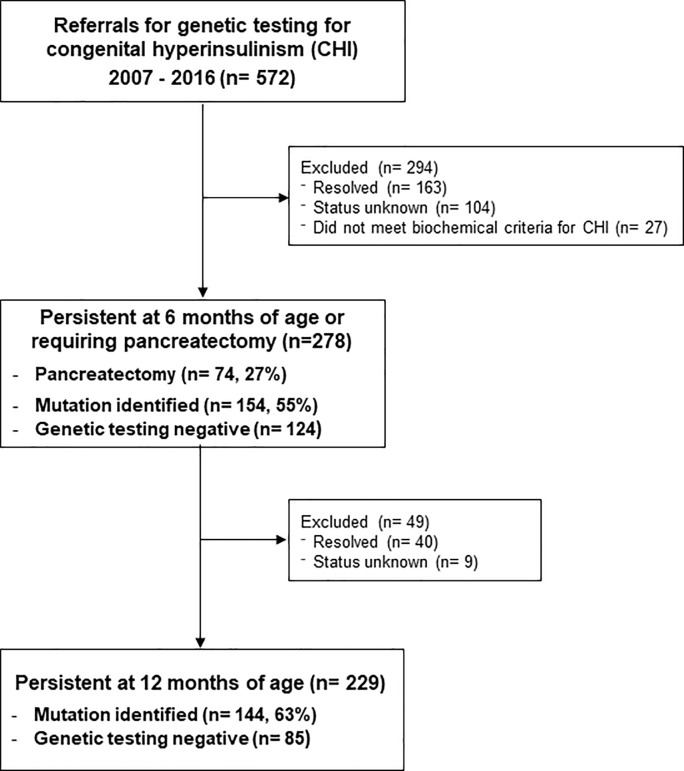
Fig 1
Fig 1. Flow diagram showing the outcomes of referrals for genetic testing for congenital hyperinsulinism.
Fig 2
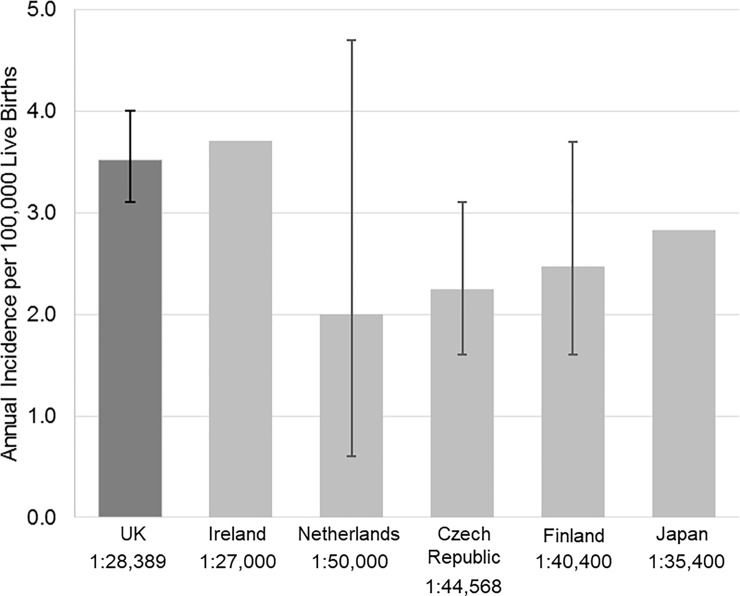
Fig 2. The incidence of congenital hyperinsulinism in the UK compared to other outbred populations.
In the current study, CHI was diagnosed based on a non-suppressed insulin and C-peptide level at the time of hypoglycaemia with persistence beyond 6 months of age or need for pancreatectomy. Incidence is expressed as the number per 100,000 live births with the 95% confidence intervals (CI) provided with each estimate where calculated. The 95% CI could not be calculated for Ireland or Japan as the estimates were based on unpublished or unavailable data, respectively.

References

    1. Hoe FM Thornton PS, Wanner LA, Steinkrauss L, Simmons RA, Stanley CA. Clinical features and insulin regulation in infants with a syndrome of prolonged neonatal hyperinsulinism. J Pediatr 2006; 148(2):207–12 10.1016/j.jpeds.2005.10.002 - DOI - PubMed
    1. Banerjee I, Skae M, Flanagan SE, Rigby L, Patel L, Didi M et al. The contribution of rapid KATP channel gene mutation analysis to the clinical management of children with congenital hyperinsulinism. Eur J Endocrinol. 2011;164(5):733–40 10.1530/EJE-10-1136 - DOI - PubMed
    1. Arya VB, Flanagan SE, Kumaran A, Shield JP, Ellard S, Hussain K, et al. Clinical and molecular characterisation of hyperinsulinaemic hypoglycaemia in infants born small-for-gestational age. Arch Dis Child Fetal Neonatal Ed 2013;98:F356–F358 10.1136/archdischild-2012-302880 - DOI - PMC - PubMed
    1. Snider KE, Becker S, Boyajian L, Shyng S.-L. MacMullen N, Hughes N et al. Genotype and Phenotype Correlations in 417 Children With Congenital Hyperinsulinism. Clin Endocrinol Metab 2013; 98(2):E355–E363 - PMC - PubMed
    1. Rozenkova K, Malikova J, Nessa A, Dusatkova L, Bjørkhaug L, Obermannova B et al. High Incidence of Heterozygous ABCC8 and HNF1A Mutations in Czech Patients With Congenital Hyperinsulinism. J Clin Endocrinol Metab 2015; 100(12):E1540–9 10.1210/jc.2015-2763 - DOI - PubMed

Publication types

MeSH terms