. 2020 Jul;52(7):1456-1469.
doi: 10.1249/MSS.0000000000002294.

Effects of Exercise Training on Anxious-Depressive-like Behavior in Alzheimer Rat

Affiliations

Effects of Exercise Training on Anxious-Depressive-like Behavior in Alzheimer Rat

Chongyun Wu et al. Med Sci Sports Exerc. 2020 Jul.

Abstract

Purpose: This study aimed to examine the effects of treadmill training on anxious-depressive-like behaviors of transgenic Alzheimer rats in the early stage of Alzheimer's disease (AD) and provided evidence of exercise in alleviating fear-avoidance behavior deficits.

Methods: Male 2-month-old TgF344-AD and wild-type rats were divided into wild-type (n = 9), AD (n = 8), and AD + treadmill exercise (Exe) groups (n = 12). After 8 months of exercise, the passive avoidance test, Barnes maze task, novel object recognition test, and object location test were used to measure learning and memory function. The open-field test, elevated plus maze, sucrose preference test, and forced swim test were conducted to determine the anxious-depressive-like behavior of AD rats. Immunofluorescence staining, Western blot analysis, enzyme-linked immunosorbent assay analysis, and related assay kits were used to measure inflammatory cytokines, oxidative stress, amyloid-β production, and tau hyperphosphorylation.

Results: Behavioral tests revealed that 12-month-old animals did not show any spatial learning and memory deficits but did display anxious-depressive-like behavior (open field, center time: P = 0.008; center entries: P = 0.009; line crossings: P = 0.001). However, long-term exercise significantly inhibited anxious-depressive-like behavior in AD rats (center time: P = 0.016; center entries: P = 0.004; line crossings: P = 0.033). In addition, these animals displayed increased amyloid-β deposition, tau hyperphosphorylation, microgliosis, inflammatory cytokines release, and oxidative damage, which were attenuated significantly by long-term exercise training.

Conclusion: Long-term exercise training alleviated anxious-depressive-like behavior and improved fear-avoidance behavior in transgenic AD rats, supporting exercise training as an effective approach to prevent anxiety, depression, and fear-avoidance behavior deficits in the early stages of AD pathogenesis.


Conflict of interest statement

Statement of interest

The authors declare that there is no conflict of interest in the current study. The results of the study are presented clearly, honestly, and without fabrication or inappropriate data manipulation. The results of the present study do not constitute endorsement by ACSM.

Figures

Figure 1.
Figure 1.. Schematic diagram of the experimental design and treadmill exercise protocol.
(A) Animals were subjected to genotyping on postnatal day 10 (P10) followed by separation into three groups: WT, sedentary AD group, and AD animals undergoing 8 months of treadmill exercise (n = 8–12). For the exercise group, treadmill exercise training was initiated at 2 months of age, continuing to 10 months. Behavioral tests were conducted at 12 months. (B) Weights of the rats were measured prior to exercise training, the end of training, and 2 months after the cessation of training. (C) Overview of the genotyping and representative results of PCR genotyping. Samples from AD animals show a 400bp APP Tg product. (D) Two weeks of adaptive training was carried out at the beginning of the exercise program with an initial intensity of 15 min of continuous running at 4 m/min on Monday (Mon, first week), 6 m/min for 30 min on Wednesday (Wed, first week), and 8 m/min for 45 min on Friday (Fri, first week). On the second week, exercise was performed at 8 m/min on Mon, 12 m/min on Wed, and 18 m/min on Fri for 45 min each day. After the adaptive training stage, treadmill exercise was performed at 18 m/min for 45 min, 3 days/week for the duration of the exercise training stage.
Figure 2.
Figure 2.. Treadmill exercise training improve fear-avoidance behavior in TgF344-AD rats.
(A) The passive avoidance task was performed to test fear-avoidance behavior. (a) Schematic diagram of the passive avoidance test apparatus. (b) Latency to enter the dark box during the training phase and test phase was recorded and analyzed. (B) Representative tracking plots of rats on the training days (a-c) and probe trial day (e-g). Escape latency (d) and quadrant occupancy (h) were recorded and statistically analyzed. (C) The novel object test and object location test were performed to assess recognition memory and spatial cognitive ability. (a-c) Representative occupancy plots of animals’ exploration of the novel object (red) and the familiar object (yellow) in the novel object test (a-c). The time spent on exploring each object and the discrimination index percentage were analyzed (d). The representative occupancy plots and discrimination index of animals in object location test are shown in (e-h). All data are presented as mean ± SEM (n= 8–12). *P < 0.05 vs WT group, #P < 0.05 vs AD group. N.S., no significant difference.
Figure 3.
Figure 3.. Treadmill exercise training significantly ameliorates anxious-depressive-like behavior in TgF344-AD rats.
(A) Schematic of zones in the open field arena and the representative traces of rats’ movement tested on 2-month-old (Baseline, a) and 12-month-old rats (b) during an open field test. Number of entries to the central area (c), time in center (d), number of line crossings (e), and defecations in field (f) were determined in the open field test. (B) Representative activity traces of animals in the elevated plus maze at baseline and 12-months were shown in (a&b). The time spent in the open arms and the numbers of entries to the open arms were analyzed in (c&d). (C) Schematic diagram of the sucrose preference test (a) and the percentage of the sucrose intake volume over the total fluid intake volume (b). (D) Schematic representation of mobility and immobility in the forced swim test (a). The total time of immobility was statistically analyzed (b). All data are presented as mean ± SEM (n = 8–12). *P < 0.05 vs WT group, #P < 0.05 vs AD group. N.S., no significant difference.
Figure. 4.
Figure. 4.. Treadmill exercise training attenuates β-amyloid deposition and tau hyperphosphorylation in the cortex and hippocampus of TgF344-AD rats
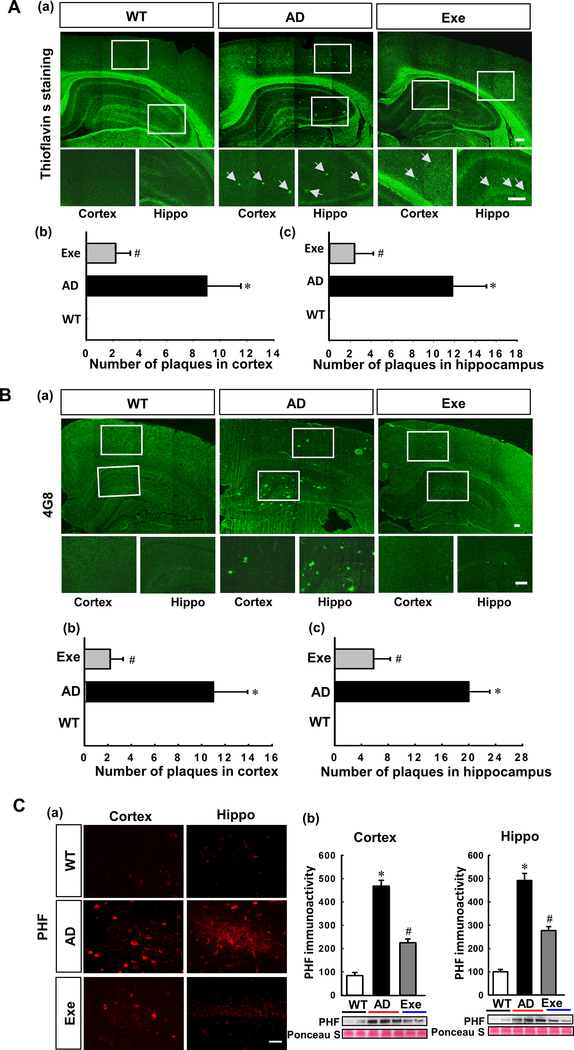
(A) Representative confocal microscopy images of ThioS staining (a) for WT, AD and AD+Exe groups in the cortex and hippocampus. Number of plaques in the cortex and hippocampus were counted and analyzed (b&c). Scale bar denotes 200 μm. (B) Sections from WT, AD and AD+Exe were subjected to immunofluorescent staining of Aβ (–24) (clone 4G8). Representative confocal microscopy images were shown in (a). Number of Aβ plaques in the cortex and hippocampus were counted and analyzed (b&c). Scale bar denotes 20 μm. (C) Phosphorylation of tau protein (PHF) was examined by immunofluorescent staining (a) Scale bar represents 20 μm. Results of Western blot analysis of PHF were shown in (b) to further confirm the results of immunofluorescent staining. Ponceau S staining was used as loading control for Western blots, as shown in (b). All values are expressed as mean ± SEM. *P < 0.05 vs WT group, #P < 0.05 vs AD group. Hippo, Hippocampus. Areas enclosed in white boxes were enlarged below their respective image.
Figure. 5.
Figure. 5.. Treadmill exercise reduces microgliosis and suppresses pro-inflammatory cytokine production in the cortex and hippocampus of TgF344-AD Rats
(A) Immunofluorescence staining and immunoactivity intensity analyses of IBA1 (a marker of microglia). Representative microscopy images of IBA1 in the cortex and hippocampal CA1 region (a). n=5–6 animals/group. Scale bar represents 30 μm. Western blotting and quantitative analyses of Iba-1 were performed using protein from the cortex and hippocampus (b, n=4). Ponceau S staining of the Western blots shown in (b) was used as loading control. (B) ELISA analyses of major pro-inflammatory transcription factor NF-κB (a), TNFα (b), and IL-1β (c) were performed to examine the effect of treadmill training on the release of inflammatory cytokines. (C) The levels of inflammatory cytokines in the tissue proteins (cortex and hippocampus) were measured using a Proteome Profiler Rat Cytokine Array Kit. All values are expressed as mean ± SEM. *P < 0.05 vs WT group, #P < 0.05 vs AD group.
Figure. 6.
Figure. 6.. Treadmill exercise training reduces oxidative stress, enhances total antioxidant capacity, and improves the levels of 5-HT and its receptor in TgF344-AD.
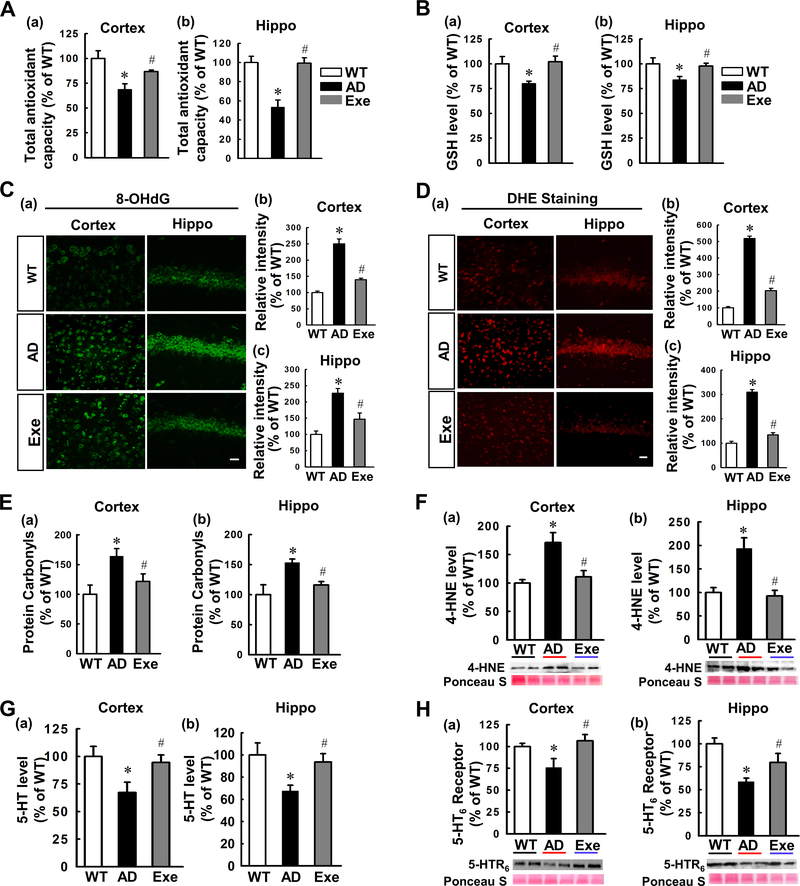
(A) Total antioxidant capacity and (B) GSH levels in the cortex and hippocampus and were presented as percentage changes versus respective control group (n=5–8). (C) Representative 8-OHdG staining (a DNA damage marker) for WT, AD and Exe in the cortex and hippocampal CA1 region (a). Fluorescence intensity associated with 8-OHdG in the cortex (b) and CA1 (c) was calculated with Image J analysis software and expressed as percentage changes versus WT groups (n=4–5). (D) Representative images of dihydroethidium (DHE) staining in the cortex and CA1 were presented in (a). Fluorescence intensity was quantified and expressed as percentage changes versus control group (n=4–5). (E) Protein carbonyls were detected in the cortex and hippocampus and presented as percentage changes versus respective control group (n=5–8). (F) The levels of 4-HNE (an oxidative damage marker for lipid peroxidation) in the cortex (a) and hippocampus (b) were explored using Western blotting and quantitative analysis (n=4). (G) The levels of 5-HT in the cortex (a) and hippocampus (b) were measured using 5-HT assay kit as detailed in the method (n=5–6). (H) Western blot analysis was performed to measure the level of 5-HT6 receptor. Representative Western blotting and quantification of 5-HT6 receptor in the cortex and hippocampus were shown in (a&b) (n=5). Scale bar represents 20 μm. All values are expressed as mean ± SEM. *P < 0.05 vs WT group, #P < 0.05 vs AD group. Ponceau S staining of the Western blots shown in F and H was used as loading control.

References

    1. Wu C, Yang L, Tucker D et al. Beneficial Effects of Exercise Pretreatment in a Sporadic Alzheimer’s Rat Model. Medicine and science in sports and exercise. 2018;50(5):945–56. - PMC - PubMed
    1. Tarawneh R, Holtzman DM. The clinical problem of symptomatic Alzheimer disease and mild cognitive impairment. Cold Spring Harbor perspectives in medicine. 2012;2(5):a006148. - PMC - PubMed
    1. Breitve MH, Hynninen MJ, Bronnick K et al. A longitudinal study of anxiety and cognitive decline in dementia with Lewy bodies and Alzheimer’s disease. Alzheimer’s research & therapy. 2016;8:3. - PMC - PubMed
    1. Gutzmann H, Qazi A. Depression associated with dementia. Zeitschrift fur Gerontologie und Geriatrie. 2015;48(4):305–11. - PubMed
    1. Bennett S, Thomas AJ. Depression and dementia: cause, consequence or coincidence? Maturitas. 2014;79(2):184–90. - PubMed

Publication types

MeSH terms