Review
. 2020 Feb 3;9(2):346.
doi: 10.3390/cells9020346.

Beyond Tumor Suppression: Senescence in Cancer Stemness and Tumor Dormancy

Affiliations
Review

Beyond Tumor Suppression: Senescence in Cancer Stemness and Tumor Dormancy

Francisco Triana-Martínez et al. Cells. .

Abstract

Here, we provide an overview of the importance of cellular fate in cancer as a group of diseases of abnormal cell growth. Tumor development and progression is a highly dynamic process, with several phases of evolution. The existing evidence about the origin and consequences of cancer cell fate specification (e.g., proliferation, senescence, stemness, dormancy, quiescence, and cell cycle re-entry) in the context of tumor formation and metastasis is discussed. The interplay between these dynamic tumor cell phenotypes, the microenvironment, and the immune system is also reviewed in relation to cancer. We focus on the role of senescence during cancer progression, with a special emphasis on its relationship with stemness and dormancy. Selective interventions on senescence and dormancy cell fates, including the specific targeting of cancer cell populations to prevent detrimental effects in aging and disease, are also reviewed. A new conceptual framework about the impact of synthetic lethal strategies by using senogenics and then senolytics is given, with the promise of future directions on innovative anticancer therapies.

Keywords: cellular senescence; dormancy; quiescence; senolytic; stemness.


Conflict of interest statement

All authors declare no competing interests.

Figures
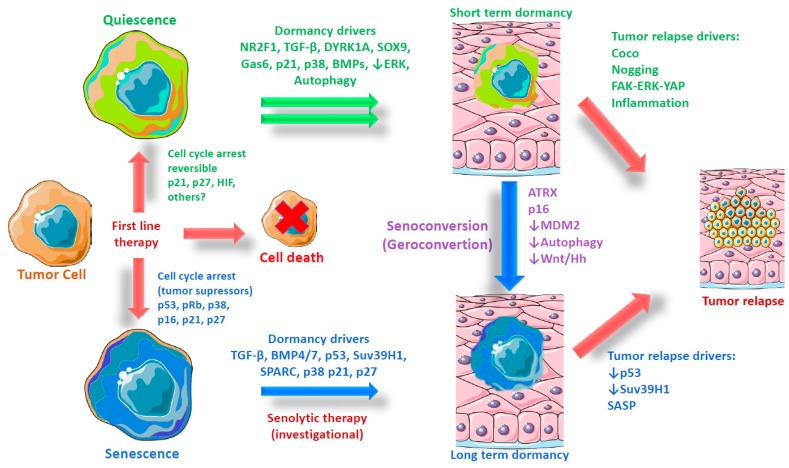
Figure 1
Figure 1
Origin and evolution of dormant tumor cells. Graphical representation of the evolution of tumor dormancy according to two models—quiescence and senescence—including possible triggers and driver genes. Quiescence is the most accepted model for tumor cell dormancy. This model is based on the observation of some molecular triggers in the microenvironment and final effectors that regulate cell cycling. Dormant cells have been observed to express markers such as a low ERK/ high p38 ratio during the activation of other genes like NR2F1 and DYRK1A. However, in some models of dormancy, senescence markers have been noted. This observation, plus the activation genes during senescence shared with quiescence (i.e., TGF-β, BMPs, p21, and p27), leads us to propose an alternative model of tumor dormancy in which senescence is a major phenotype acquired during long-term dormancy. If this assumption is true, it opens the possibility of the use of senolytics to avoid metastatic recurrence.

References

    1. Batlle E., Clevers H. Cancer stem cells revisited. Nat. Med. 2017;23:1124–1134. doi: 10.1038/nm.4409. - DOI - PubMed
    1. Serrano M., Lin A.W., McCurrach M.E., Beach D., Lowe S.W. Oncogenic ras provokes premature cell senescence associated with accumulation of p53 and p16INK4a. Cell. 1997;88:593–602. doi: 10.1016/S0092-8674(00)81902-9. - DOI - PubMed
    1. Krizhanovsky V., Yon M., Dickins R.A., Hearn S., Simon J., Miething C., Yee H., Zender L., Lowe S.W. Senescence of Activated Stellate Cells Limits Liver Fibrosis. Cell. 2008;134:657–667. doi: 10.1016/j.cell.2008.06.049. - DOI - PMC - PubMed
    1. Da Silva-Álvarez S., Picallos-Rabina P., Antelo-Iglesias L., Triana-Martínez F., Barreiro-Iglesias A., Sánchez L., Collado M. The development of cell senescence. Exp. Gerontol. 2019;128:110742. doi: 10.1016/j.exger.2019.110742. - DOI - PubMed
    1. McHugh D., Gil J. Senescence and aging: Causes, consequences, and therapeutic avenues. J. Cell Biol. 2018;217:65–77. doi: 10.1083/jcb.201708092. - DOI - PMC - PubMed

Publication types
