


Morbidity and Mortality Due to Schistosoma mansoni Related Periportal Fibrosis: Could Early Diagnosis of Varices Improve the Outcome Following Available Treatment Modalities in Sub Saharan Africa? A Scoping Review
- PMID: 32028581
- PMCID: PMC7157192
- DOI: 10.3390/tropicalmed5010020
Morbidity and Mortality Due to Schistosoma mansoni Related Periportal Fibrosis: Could Early Diagnosis of Varices Improve the Outcome Following Available Treatment Modalities in Sub Saharan Africa? A Scoping Review
Abstract
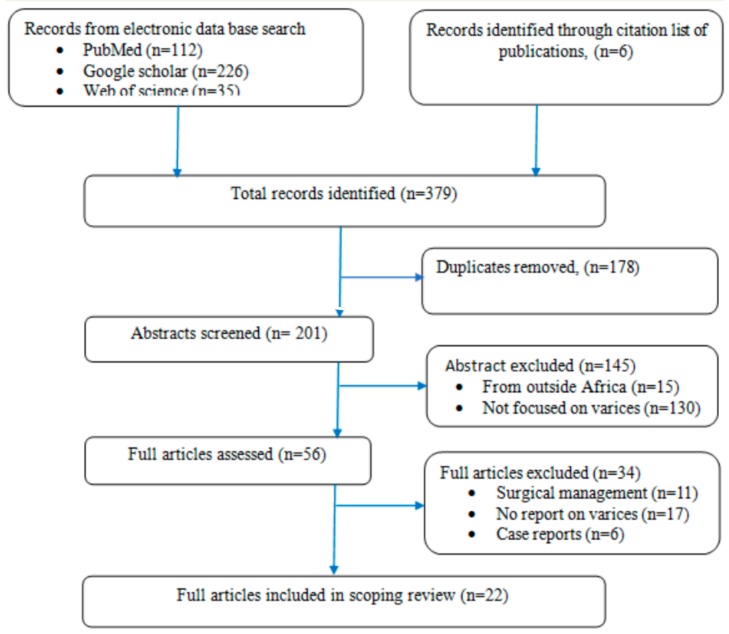
Schistosomiasis affects about 240 million people worldwide and Schistosoma mansoni alone affects over 54 million people leaving 400 million at-risk especially in Sub Saharan Africa (SSA). About 20 million people are currently suffering from complications of chronic S. mansoni infection and up to 42% of those infected have been found with periportal fibrosis (PPF). About 0.2 million deaths are attributed to chronic S. mansoni every year, which is mainly due to varices. Death occurs in up to 29% of those who present late with bleeding varices even with the best available in-hospital care. The diagnosis of varices before incident bleeding could potentially improve the outcome of this subgroup of patients is SSA. However, there is no prior review which has ever evaluated this issue detailing the magnitude and outcome of varices following available treatment modalities among patients with Schistosoma PPF in SSA. This review summarizes the available literature on this matter and exposes potential practical gaps that could be bridged to maximize the long-term outcome of patients with S. mansoni related PPF in SSA. A total of 22 studies were included in this review. The average prevalence of varices was 82.1% (SD: 29.6; range: 11.1%-100%) among patients with PPF. Late diagnosis of varices was frequent with average bleeding and mortality of 71.2% (SD: 36.5; range: 4.3%-100.0%) and 13.6% (SD: 9.9; range: 3.5%-29%), respectively. Predictors were reported in seven (31.8%) studies including platelet count to splenic diameter ratio (PSDR) for prediction large varices in one study. Active S. mansoni infection was very prevalent, (mean: 69.9%; SD: 24.4; range: 29.2-100.0%). Praziquantel could reverse PPF and use of non-selective B-blockers reduced both rebleeding and mortality. Use of sclerotherapy for secondary prevention of variceal bleeding was associated with high rebleeding and mortality rates. Conclusions: This review shows that varices due to schistosomal PPF are a big problem in SSA. However, patients are often diagnosed late with fatal bleeding varices. No study had reported a clinical tool that could be useful in early diagnosis of patients with varices and no study reported on primary and effective secondary prevention of bleeding and its outcome. Regular screening for S. mansoni and the provision of Praziquantel (PZQ) is suggested in this review. More studies are required to bridge these practical gaps in Sub Saharan Africa.
Keywords: Schistosoma related liver fibrosis; Sub Saharan Africa; endoscopic sclerotherapy; endoscopic variceal ligation; esophageal varices; esophagogastric varices; non-invasive predictors; non-selective B-blockers; periportal fibrosis; primary prevention; secondary prevention.
Conflict of interest statement
The authors declare to have no competing interest to declare
Figures
References
-
- WHO . Schistosomiasis: Progress Report 2001–2011 and Strategic Plan 2012–2020. World Health Organization; Geneva, Switzerland: 2013. p. 74.
-
- Fenwick A., Webster J.P., Bosque-Oliva E., Blair L., Fleming F.M., Zhang Y., Garba A., Stothard J.R., Gabrielli A.F., Clements A.C., et al. The Schistosomiasis Control Initiative (SCI): Rationale, development, and implementation from 2002–2008. Parasitology. 2009;136:1719–1730. doi: 10.1017/S0031182009990400. - DOI - PubMed
-
- Woldegerima E., Bayih A.G., Tegegne Y., Aemero M., Zeleke A.J. Prevalence and Reinfection Rates of Schistosoma mansoni and Praziquantel Efficacy against the Parasite among Primary School Children in Sanja Town, Northwest Ethiopia. J. Parasitol. Res. 2019;2019:1–8. doi: 10.1155/2019/3697216. - DOI - PMC - PubMed
Publication types
LinkOut - more resources
Full Text Sources
Research Materials
