


Short cold exposures during incubation and postnatal cold temperature affect performance, breast meat quality, and welfare parameters in broiler chickens
- PMID: 32029166
- PMCID: PMC7587810
- DOI: 10.1016/j.psj.2019.10.024
Short cold exposures during incubation and postnatal cold temperature affect performance, breast meat quality, and welfare parameters in broiler chickens
Abstract
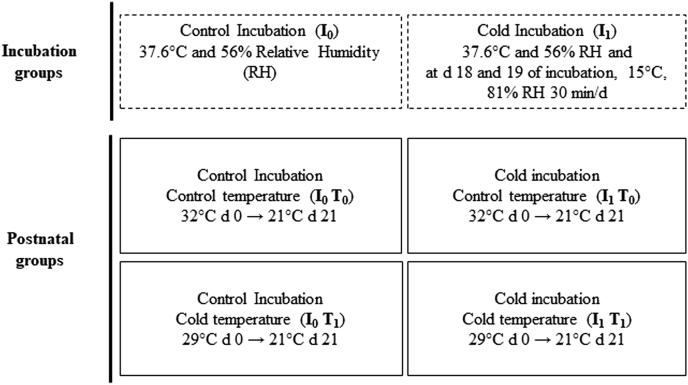
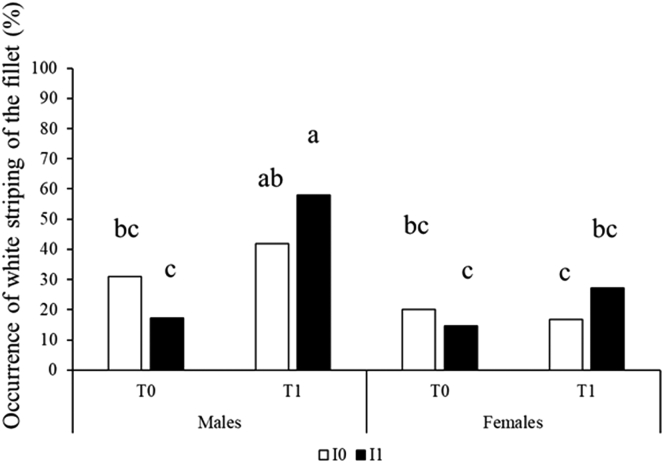
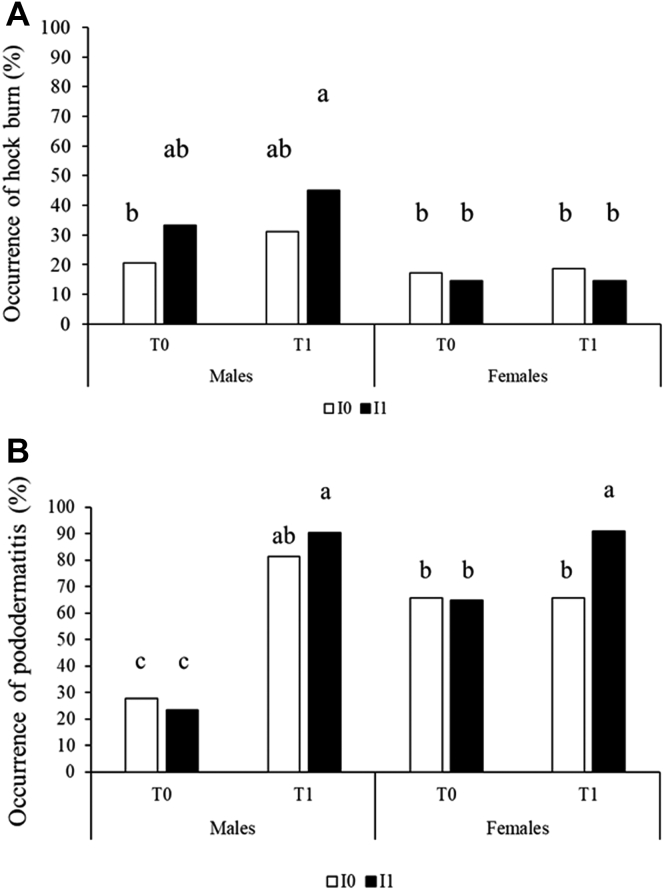
Cold stimulations during egg incubation were reported to limit the occurrence of ascites in broilers subjected to cold temperature after 14 d of age. However, data are lacking on the impacts of such strategy in case of cold temperature conditions at start. This study aimed to evaluate the effects of incubation and posthatch cold challenge on performance, breast muscle integrity, and meat processing quality in broiler chickens. Ross 308 eggs were incubated under control temperature (I0, 37.6°C) or subjected to 15°C during 30 min on day 18 and 19 of incubation (I1). Chicks from each group were reared in floor pens either at standard rearing temperature (T0), from 32°C at 0 d to 21°C at 21 d of age, or exposed to colder rearing temperature (T1), from 29°C at 0 to 21°C at 21 d of age. All birds were then kept at 21°C until slaughter (day 40), when body weights (BW), feed conversion ratio (FCR), breast muscle yield, meat processing quality, and the occurrences of meat defects, hock burns, and pododermatitis were recorded. No significant impact of incubation conditions on hatchability was observed. At day 40, BW was more under T1 than under T0 conditions, with T0 females (but not males) presenting more BW after I1 than after I0 conditions. In the whole period, T1 chickens presented lower FCR than T0 chickens and higher breast meat yields at day 40. The occurrence of white striping was more in I1T1 males than in all other groups, except for the I0T1 males. Hock burns were more frequent in I1T1 males than in all females and I0T0 males, whereas the occurrence of pododermatitis was lower in T0 males than in other groups. Despite some positive effects of I1 incubation on growth after starting under low ambient temperature, this study reveals the limits of such strategy concerning chicken health and welfare, demonstrating that early thermal environment is a major component of the quality and sustainability of chicken meat production.
Keywords: broiler; incubation; meat quality; welfare; white striping.
Copyright © 2019. Published by Elsevier Inc.
Figures
References
-
- Akşit M., Yalçin S., Siegel P.B., Yenisey Ç, Özdemir D., Özkan S. Broilers respond to cooler ambient temperatures after temperature acclimation during incubation and early postnatal age. J. Appl. Poult. Res. 2013;22:298–307.
-
- Alexandratos N., Bruinsma J. World agriculture towards 2030/2050. Land Use Policy. 2012;20:375.
-
- Al-Musawi S.L., Stickland N.C., Bayol S.A.M. In ovo temperature manipulation differentially influences limb musculoskeletal development in two lines of chick embryos selected for divergent growth rates. J. Exp. Biol. 2012;215:1594–1604. - PubMed
-
- Alnahhas N., Berri C., Boulay M., Baéza E., Jego Y., Baumard Y., Chabault M., Le Bihan-Duval E. Selecting broiler chickens for ultimate pH of breast muscle: analysis of divergent selection experiment and phenotypic consequences on meat quality, growth and body composition traits. J. Anim. Sci. 2014;92:3816–3824. - PubMed
-
- Alnahhas N., Le Bihan-Duval E., Baéza E., Chabault M., Chartrin P., Bordeau T., Cailleau-Audouin E., Meteau K., Berri C. Impact of divergent selection for ultimate pH of pectoralis major muscle on biochemical, histological, and sensorial attributes of broiler meat. J. Anim. Sci. 2015;93:4524–4531. - PubMed
MeSH terms
LinkOut - more resources
Full Text Sources
