


Helminth Vaccines in Ruminants: From Development to Application
- PMID: 32029181
- PMCID: PMC7125739
- DOI: 10.1016/j.cvfa.2019.10.001
Helminth Vaccines in Ruminants: From Development to Application
Abstract
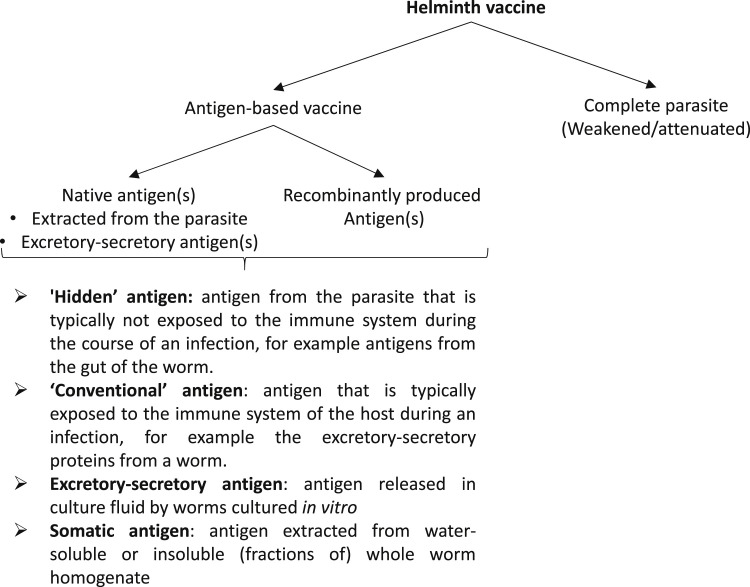
This article summarizes the state of the art in vaccine research against parasitic helminths in sheep and cattle. Optimization of antigen production (eg, recombinant expression) and antigen delivery, followed by extensive field testing, is still required for further development of vaccines. Helminth vaccines should sufficiently reduce parasite transmission to protect vaccinated animals against parasite-induced disorders and production loss. Vaccine efficacy requirements depend on the parasite's epidemiology and farm management, both of which vary in different geographic regions and are influenced by climate. Vaccination is likely to be part of integrated worm control, together with other worm control measures.
Keywords: Gastrointestinal nematodes; Liver fluke; Lungworm; Vaccines.
Copyright © 2019 Elsevier Inc. All rights reserved.
Conflict of interest statement
Disclosure The research on vaccine development against O ostertagi and C oncophora described in this article is financially supported by Zoetis.
Figures
References
-
- Vercruysse J., Charlier J., van Dijk J. Control of helminth ruminant infections by 2030. Parasitology. 2018;45(13):1655–1664. - PubMed
-
- Matthews J.B., Geldhof P., Tzelos T. Progress in the development of subunit vaccines for gastrointestinal nematodes of ruminants. Parasite Immunol. 2016;38:744–753. - PubMed
-
- Geldhof P., De Maere V., Vercruysse J. Recombinant expression systems: the obstacle to helminth vaccines? Trends Parasitol. 2007;23:527–532. - PubMed
-
- Benitez-Usher C., Armour J., Urquhart G.M. Studies on immunisation of suckling calves with dictol. Vet Parasitol. 1976;2:209–222.
Publication types
MeSH terms
Substances
LinkOut - more resources
Full Text Sources
Medical
