Preoperative hypoxemia in patients with type A acute aortic dissection: a retrospective study on incidence, related factors and clinical significance
- PMID: 32030257
- PMCID: PMC6988070
- DOI: 10.21037/jtd.2019.11.68
Preoperative hypoxemia in patients with type A acute aortic dissection: a retrospective study on incidence, related factors and clinical significance
Abstract
Background: Pre-operative hypoxemia (HO) is a serious complication occurring in acute type A aortic dissection (AAD) patients.
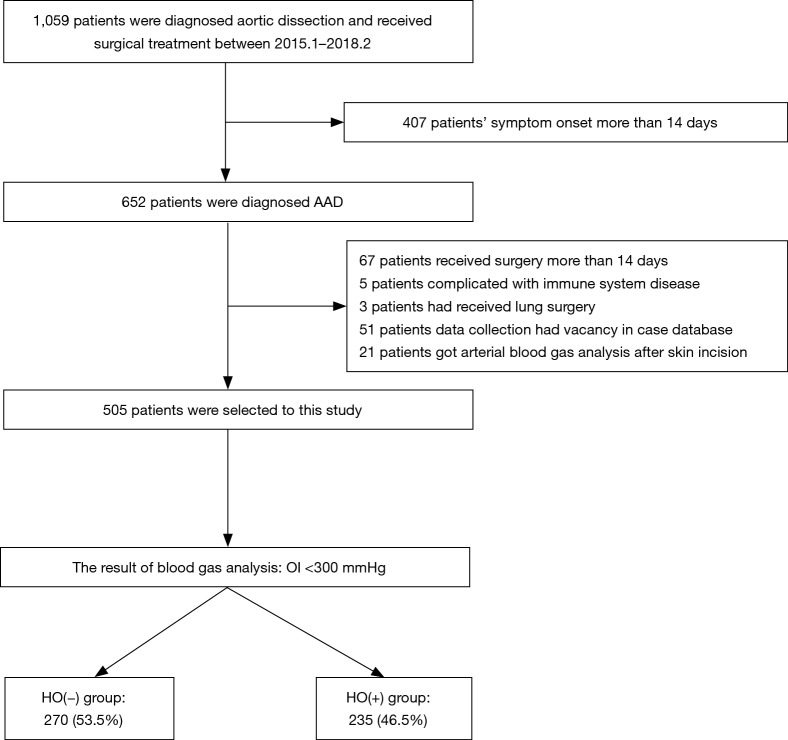
Methods: This was a retrospective study of 505 patients who underwent Stanford type A acute aortic dissection surgery in Anzhen hospital, Beijing, China, between January 2015 to February 2018. Patients were divided into a HO(+) group (PaO2/FiO2 ≤300) and a HO(-) group (PaO2/FiO2 >300) according to preoperative arterial blood gas (ABG) analysis. The incidence of preoperative hypoxemia in patients undergoing surgery for AAD was calculated as the main outcome. Multivariable binary logistic regression analysis was used to identify independent prognostic factors of HO.
Results: Preoperative HO occurred in 46.5% (235/505) of patients. Mean patient age was 47.8±9.6 years, and 189 (80.4%) were male. Multivariable logistic regression analysis showed a correlation between preoperative serum level of fibrinogen [95% confidence interval (CI), 0.95-0.99], white blood cell count (WBC) (95% CI, 1.07-1.18), systolic blood pressure (95% CI, 0.98-1.00), history of smoking (95% CI, 1.05-2.11) and pleural effusion (95% CI, 1.14-2.71) with preoperative HO. The HO(+) group had a significantly higher mortality than the HO(-) group (8.1% vs. 5.9%, P=0.38). The median of intubation time (P<0.01), the length of stay in the intensive care unit (P<0.01) and the length of hospital stay (P<0.01) were significantly longer in patients with HO. The activity of daily living scale score was significantly lower in the HO(+) group (P<0.01).
Conclusions: AAD patients were easy to have pre-operative HO, which had a higher morbidity than those without HO. Altered fibrinogen, WBC, systolic blood pressure levels, positive smoking history, and pleural effusion were associated with the presence of HO. More monitoring and treatment should be given to these patients.
Keywords: Acute type A aortic dissection (acute AAD); hypoxemia; related factors.
2019 Journal of Thoracic Disease. All rights reserved.
Conflict of interest statement
Conflicts of Interest: The authors have no conflicts of interest to declare.
Figures
References
LinkOut - more resources
Full Text Sources
Medical