Review
. 2020 Feb 6;22(2):19.
doi: 10.1007/s11912-020-0877-0.

Targeting and Therapeutic Monitoring of H3K27M-Mutant Glioma

Affiliations
Review

Targeting and Therapeutic Monitoring of H3K27M-Mutant Glioma

Kyle Wierzbicki et al. Curr Oncol Rep. .

Erratum in

Abstract

Purpose of review: H3K27M is a frequent histone mutation within diffuse midline gliomas and is associated with a dismal prognosis, so much so that the 2016 CNS WHO classification system created a specific category of "Diffuse Midline Glioma, H3K27M-mutant". Here we outline the latest pre-clinical data and ongoing current clinical trials that target H3K27M, as well as explore diagnosis and treatment monitoring by serial liquid biopsy.

Recent findings: Multiple epigenetic compounds have demonstrated efficacy and on-target effects in pre-clinical models. The imipridone ONC201 and the IDO1 inhibitor indoximod have demonstrated early clinical activity against H3K27M-mutant gliomas. Liquid biopsy of cerebrospinal fluid has shown promise for clinical use in H3K27M-mutant tumors for diagnosis and monitoring treatment response. While H3K27M has elicited a widespread platform of pre-clinical therapies with promise, much progress still needs to be made to improve outcomes for diffuse midline glioma patients. We present current treatment and monitoring techniques as well as novel approaches in identifying and targeting H3K27M-mutant gliomas.

Keywords: Circulating tumor DNA; Diffuse midline glioma; H3K27M; Liquid biopsy; ONC201; Panobinostat.


Figures
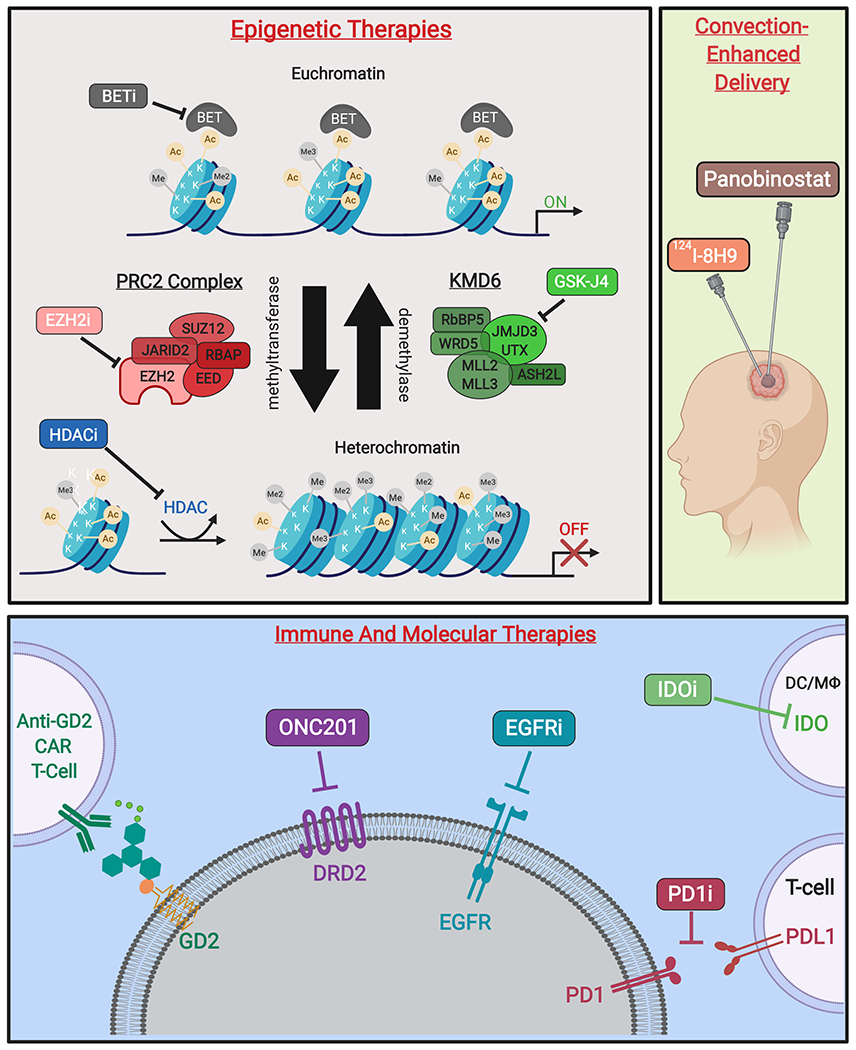
Fig 1.
Fig 1.
Novel therapies targeting H3K27M-mutant gliomas. (A)* Epigenetic therapies modify transcriptional activity at the level of chromatin. Competitive inhibition of BET family proteins reduce recognition of acetylated histones and subsequent transcription initiation. Additionally, inhibitors of EZH2 activity prevent formation of heterochromatin by inactivating the catalytic subunit of the PRC2 methyltransferase complex. Moreover, non-specific HDAC inhibitors reduce heterochromatin formation. Finally, prodrug GSK-J4/J1 increases H3K27 methylation by inhibition of K27-demethylases JMJD3 and UTX. (B) Therapeutic agents delivered by CED include omburtamab, a radioactive iodine isotope conjugated to the anti-glioma monoclonal antibody 8H9 (124I-8H9), which has undergone phase I evaluation [58]. Additionally, delivery of panobinostat nanoparticle formulation MTX110 via CED is ongoing (Phase I/II, PNOC015). (C) Emerging immune therapies include CAR T-cells against GD2, a disialoganglioside highly expressed in H3K27M gliomas. PD1/PDL1 immune checkpoint inhibitors prevent T-cell suppression, while IDO inhibitors increase T-cell activation at the site of tumors cells. Molecular therapies include small-molecule DRD2-antagonist ONC201, as well as inhibitors of EGFR to reduce tumor growth and proliferation [59]. Figure created with BioRender.com. *Figure 1A adapted from Hashizume (2017) [25].

References

    1. Louis DN, Perry A, Reifenberger G, von Deimling A, Figarella-Branger D, Cavenee WK, et al. The 2016 World Health Organization classfication of tumors of the central nervous system: a summary. Acta Neuropathol. 2016;131(6):803–820. doi: 10.1007/s00401-016-1545-1. - DOI - PubMed
    1. Karremann M, Gielen GH, Hoffmann M, Wiese M, Colditz N, Warmuth-Metz M, et al. Diffuse high-grade gliomas with H3 K27M mutations carry a dismal prognosis independent of tumor location. Neuro Oncol. 2018;20(1):123–31. doi: 10.1093/neuonc/nox149. - DOI - PMC - PubMed
    1. Sturm D, Witt H, Hovestadt V, Khuong-Quang DA, Jones DT, Konermann C, et al. Hotspot mutations in H3F3A and IDH1 define distinct epigenetic and biological subgroups of glioblastoma. Cancer Cell. 2012;22(4):425–37. doi: 10.1016/j.ccr.2012.08.024. - DOI - PubMed
    1. Hoffman LM, Veldhuijzen van Zanten SEM, Colditz N, Baugh J, Chaney B, Hoffmann M, et al. Clinical, radiologic, pathologic, and molecular characteristics of long-term survivors of diffuse intrinsic pontine glioma (DIPG): a collaborative report from the international and european society for pediatric oncology DIPG registries. J Clin Oncol. 2018;36(19):1963–72. - PMC - PubMed
    1. Cohen KJ, Jabado N, Grill J. Diffuse intrinsic pontine gliomas-current management and new biologic insights. Is there a glimmer of hope? Neuro Oncol. 2017;19(8):1025–34. doi: 10.1093/neuonc/nox021. - DOI - PMC - PubMed

MeSH terms

Substances
