Randomized Controlled Trial
. 2020 Jul;22(7):1207-1214.
doi: 10.1111/dom.13991. Epub 2020 Mar 28.

Association between uric acid levels and cardio-renal outcomes and death in patients with type 2 diabetes: A subanalysis of EMPA-REG OUTCOME

Affiliations
Randomized Controlled Trial

Association between uric acid levels and cardio-renal outcomes and death in patients with type 2 diabetes: A subanalysis of EMPA-REG OUTCOME

Subodh Verma et al. Diabetes Obes Metab. 2020 Jul.

Abstract

In the EMPA-REG OUTCOME trial, we explored the association between pre-randomization uric acid level tertile (<309.30 μmol/L; 309.30 to <387.21 μmol/L; ≥387.21 μmol/L) and cardiovascular (CV) death, hospitalization for heart failure (HHF), HHF or CV death, all-cause mortality, three-point major adverse CV events (MACE), and incident or worsening nephropathy. Patients with type 2 diabetes and CV disease received empagliflozin or placebo. The median baseline plasma uric acid level was 344.98 μmol/L, and patients' baseline characteristics were mainly balanced across tertiles. Baseline uric acid levels were associated with cardio-renal outcomes: in the placebo group, for the highest versus lowest tertile, the multivariable hazard ratios for three-point MACE, HHF or CV death, and incident or worsening nephropathy were 1.22 (95% confidence interval [CI] 0.89-1.67; P = 0.2088), 1.51 (95% CI 1.02-2.23; P = 0.0396) and 1.77 (95% CI 1.33-2.34; P < 0.0001), respectively. When tested as a continuous variable, baseline uric acid was associated with all outcomes in the placebo group. Empagliflozin improved all cardio-renal outcomes across tertiles, with all interaction P values >0.05. Further investigation of these relationships is required.

Keywords: SGLT2 inhibitor; cardiovascular disease; clinical trial; empagliflozin; type 2 diabetes.


Conflict of interest statement

S.V. is President of the Canadian Medical and Surgical Knowledge Translation Research Group, a federally incorporated not‐for‐profit physician organization, holds a Tier 1 Canada Research Chair in Cardiovascular Surgery, and has received research grants and/or speaking honoraria from Boehringer Ingelheim/Eli Lilly and Company, AstraZeneca, Janssen, Merck, Novartis, Novo Nordisk, Amgen, Sanofi, Servier, Valeant, Bayer and Pfizer. Q.J. has received travel support as an advisory board member from Merck & Co., Inc for the STRATEGY study, and has attended advisory boards and been a speaker for Eli Lilly, Novo Nordisk, Merck Sharp & Dohme China, Sanofi Aventis, Huadong Pharmaceuticals Company and Medtronic, and received research grants from Novo Nordisk, Merck Sharp & Dohme China and AstraZeneca. D.L.B. discloses the following relationships: Advisory Board: Cardax, Cereno Scientific, Elsevier Practice Update Cardiology, Medscape Cardiology, PhaseBio, PLx Pharma, Regado Biosciences; Board of Directors: Boston VA Research Institute, Society of Cardiovascular Patient Care, TobeSoft; Chair: American Heart Association Quality Oversight Committee; Data Monitoring Committees: Baim Institute for Clinical Research (formerly Harvard Clinical Research Institute, for the PORTICO trial, funded by St. Jude Medical, now Abbott), Cleveland Clinic (including for the ExCEED trial, funded by Edwards), Duke Clinical Research Institute, Mayo Clinic, Mount Sinai School of Medicine (for the ENVISAGE trial, funded by Daiichi Sankyo), Population Health Research Institute; Honoraria: American College of Cardiology (Senior Associate Editor, Clinical Trials and News, ACC.org; Vice‐Chair, ACC Accreditation Committee), Baim Institute for Clinical Research (formerly Harvard Clinical Research Institute; RE‐DUAL PCI clinical trial steering committee funded by Boehringer Ingelheim; AEGIS‐II executive committee funded by CSL Behring), Belvoir Publications (Editor in Chief, Harvard Heart Letter), Duke Clinical Research Institute (clinical trial steering committees, including for the PRONOUNCE trial, funded by Ferring Pharmaceuticals), HMP Global (Editor in Chief, Journal of Invasive Cardiology), Journal of the American College of Cardiology (Guest Editor; Associate Editor), Medtelligence/ReachMD (CME steering committees), Population Health Research Institute (for the COMPASS operations committee, publications committee, steering committee, and USA national co‐leader, funded by Bayer), Slack Publications (Chief Medical Editor, Cardiology Today's Intervention), Society of Cardiovascular Patient Care (Secretary/Treasurer), WebMD (CME steering committees); Other: Clinical Cardiology (Deputy Editor), NCDR‐ACTION Registry Steering Committee (Chair), VA CART Research and Publications Committee (Chair); Research Funding: Abbott, Afimmune, Amarin, Amgen, AstraZeneca, Bayer, Boehringer Ingelheim, Bristol‐Myers Squibb, Cardax, Chiesi, CSL Behring, Eisai, Ethicon, Ferring Pharmaceuticals, Forest Laboratories, Fractyl, Idorsia, Ironwood, Ischemix, Lexicon, Lilly, Medtronic, Pfizer, PhaseBio, PLx Pharma, Regeneron, Roche, Sanofi Aventis, Synaptic, The Medicines Company; Royalties: Elsevier (Editor, Cardiovascular Intervention: A Companion to Braunwald's Heart Disease); Site Co‐Investigator: Biotronik, Boston Scientific, CSI, St. Jude Medical (now Abbott), Svelte; Trustee: American College of Cardiology; Unfunded Research: FlowCo, Merck, Novo Nordisk, Takeda. C.D.M. has received consulting fees from Amgen, Boehringer Ingelheim, and Octapharma. M.A. has no conflicts of interest to declare. S.E.I. has received honoraria for lectures, advisory work and/or clinical trial leadership from AstraZeneca, Boehringer Ingelheim, Eisai (TIMI), Novo Nordisk, Sanofi/Lexicon, VTV Therapeutics and Zafgen, Merck, and Abbott/Alere. C.W. reports honoraria from AstraZeneca, Boehringer Ingelheim, Eli Lilly and Company, MSD and Sanofi. B.Z. has received research grants awarded to his institution from Boehringer Ingelheim, AstraZeneca and Novo Nordisk, and honoraria from Janssen, Sanofi, Eli Lilly and Company, Boehringer Ingelheim, Novo Nordisk and Merck. A.P.O., I.Z. and J.T.G are employees of Boehringer Ingelheim. D.F. has received honoraria from Sanofi, Merck & Co., Amgen, AstraZeneca, Eli Lilly and Company, and Boehringer Ingelheim, and has served on the data and safety monitoring board for Novo Nordisk.

Figures

Figure 1
Figure 1
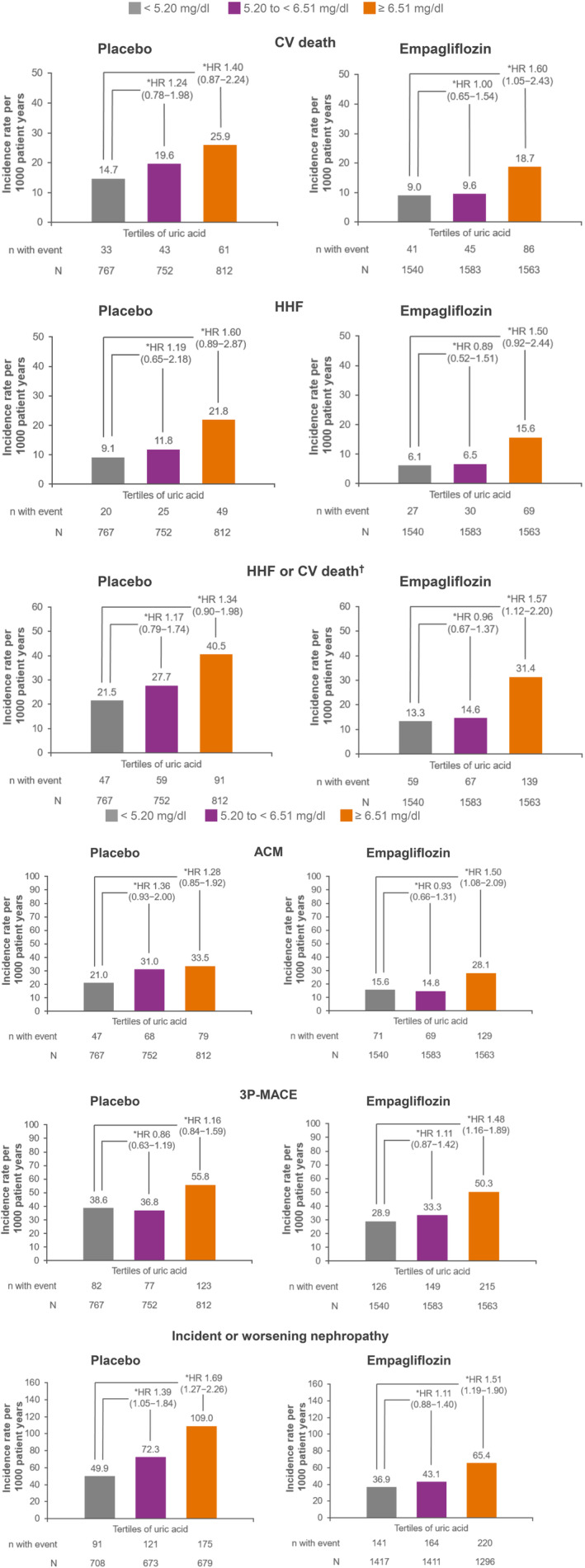
Multivariable Cox regression between tertiles of uric acid at baseline (<309.30 μmol/L, 309.30 to <387.21 μmol/L, and ≥387.21 μmol/L) for cardiovascular (CV) and kidney outcomes in the placebo and empagliflozin treatment groups. *Cox regression analysis was used to derive the hazard ratio (HR) and 95% confidence interval (CI). Cox regression model included age, sex, baseline body mass index (BMI; categorical), baseline glycated haemoglobin (HbA1c; categorical), baseline estimated glomerular filtration rate (eGFR; categorical), region, baseline use of diuretics, baseline anti‐gout medication, baseline heart failure (HF), and tertiles of baseline uric acid. Excludes fatal stroke. 3P‐MACE, three‐point major adverse CV events; ACM, all‐cause mortality; HHF, hospitalization for heart failure
Figure 2
Figure 2
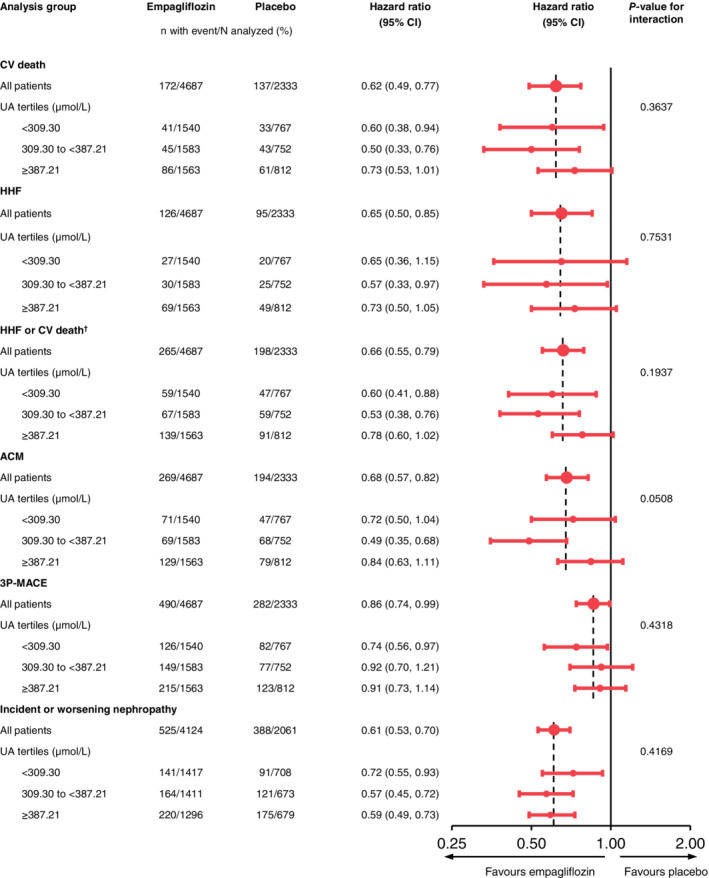
Effect of empagliflozin versus placebo on major outcomes by tertile of baseline uric acid. Cox regression analysis for time to first event in patients treated with ≥1 dose of study drug. Cox regression model included age, sex, baseline body mass index (BMI; categorical), baseline glycated haemoglobin (HbA1c; categorical), baseline estimated glomerular filtration rate (eGFR; categorical), region, treatment, tertile of baseline uric acid (UA) and interaction of treatment*tertile of baseline uric acid. P values for trend for tertiles of uric acid, for both placebo and empagliflozin, are shown in Table S2. Excludes fatal stroke. 3P‐MACE, three‐point major adverse CV events; ACM, all‐cause mortality; CI, confidence interval; CV, cardiovascular; HHF, hospitalization for heart failure

References

    1. Ames BN, Cathcart R, Schwiers E, Hochstein P. Uric acid provides an antioxidant defense in humans against oxidant‐ and radical‐caused aging and cancer: a hypothesis. Proc Natl Acad Sci U S A. 1981;78:6858‐6862. - PMC - PubMed
    1. Ndrepepa G. Uric acid and cardiovascular disease. Clin Chim Acta. 2018;484:150‐163. - PubMed
    1. Johnson RJ, Bakris GL, Borghi C, et al. Hyperuricemia, Acute and Chronic Kidney Disease, Hypertension, and Cardiovascular Disease: Report of a Scientific Workshop Organized by the National Kidney Foundation. Am J Kidney Dis. 2018;71:851‐865. - PMC - PubMed
    1. Bailey CJ. Uric acid and the cardio‐renal effects of SGLT2 inhibitors. Diabetes Obes Metab. 2019;21:1291‐1298. - PubMed
    1. Zinman B, Wanner C, Lachin JM, et al. Empagliflozin, Cardiovascular Outcomes, and Mortality in Type 2 Diabetes. N Engl J Med. 2015;373:2117‐2128. - PubMed

Publication types

MeSH terms