


Acute Caffeine Intake Enhances Mean Power Output and Bar Velocity during the Bench Press Throw in Athletes Habituated to Caffeine
- PMID: 32033103
- PMCID: PMC7071256
- DOI: 10.3390/nu12020406
Acute Caffeine Intake Enhances Mean Power Output and Bar Velocity during the Bench Press Throw in Athletes Habituated to Caffeine
Abstract
Background: The main objective of the current investigation was to evaluate the effects of caffeine on power output and bar velocity during an explosive bench press throw in athletes habituated to caffeine.
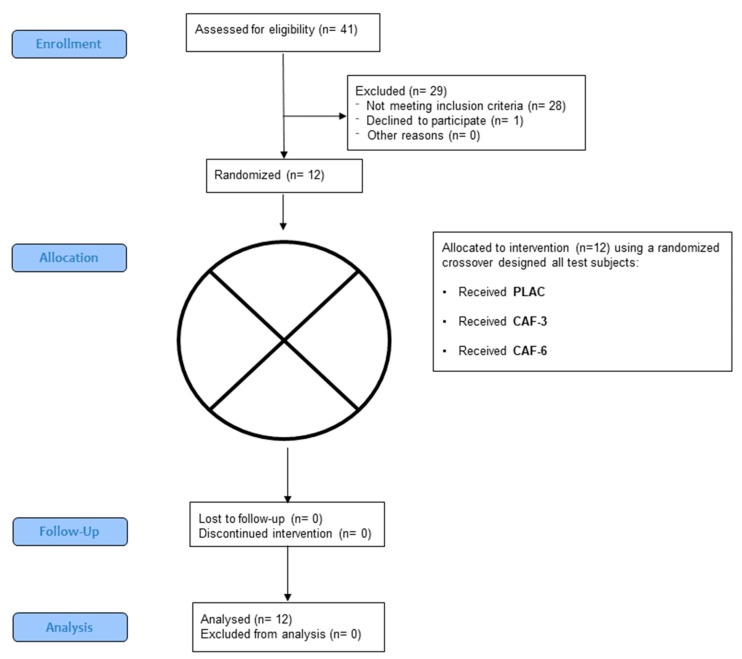
Methods: Twelve resistance trained individuals habituated to caffeine ingestion participated in a randomized double-blind experimental design. Each participant performed three identical experimental sessions 60 min after the intake of a placebo, 3, and 6 mg/kg/b.m. of caffeine. In each experimental session, the participants performed 5 sets of 2 repetitions of the bench press throw (with a load equivalent to 30% repetition maximum (RM), measured in a familiarization trial) on a Smith machine, while bar velocity and power output were registered with a rotatory encoder.
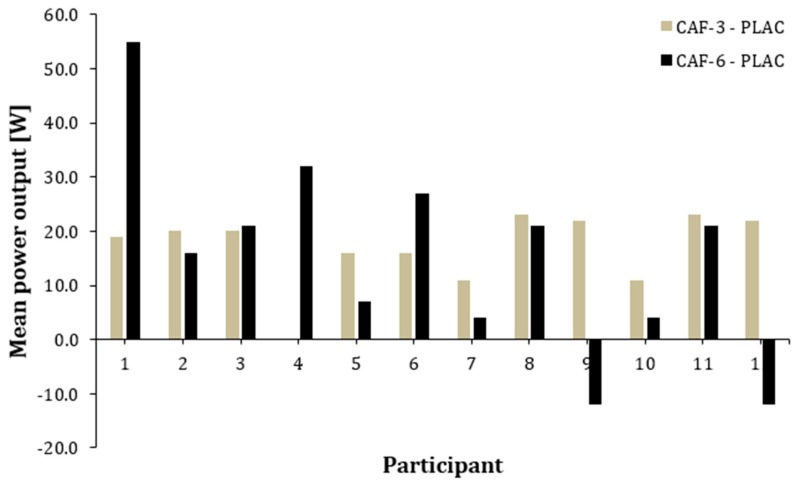
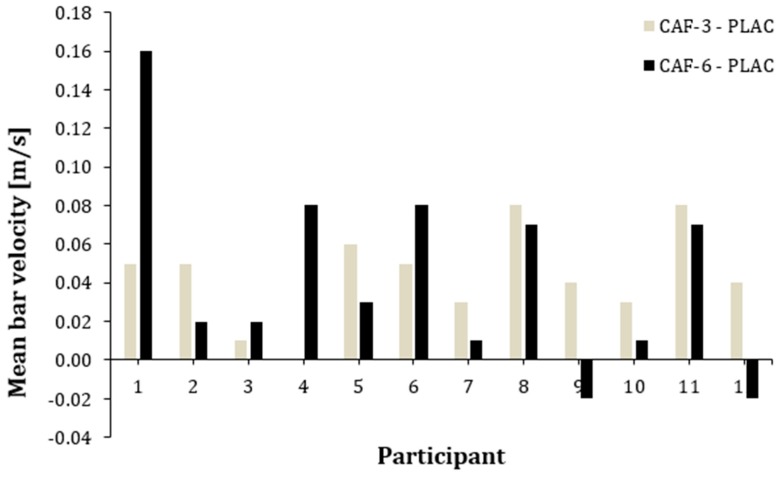
Results: In comparison to the placebo, the intake of caffeine increased mean bar velocity during 5 sets of the bench press throw (1.37 ± 0.05 vs. 1.41 ± 0.05 and 1.41 ± 0.06 m/s for placebo, 3, and 6 mg/kg/b.m., respectively; p < 0.01), as well as mean power output (545 ± 117 vs. 562 ± 118 and 560 ± 107 W; p < 0.01). However, caffeine was not effective at increasing peak velocity (p = 0.09) nor peak power output (p = 0.07) during the explosive exercise.
Conclusion: The acute doses of caffeine before resistance exercise may increase mean power output and mean bar velocity during the bench press throw training session in a group of habitual caffeine users. Thus, caffeine prior to ballistic exercises enhances performance during a power-specific resistance training session.
Keywords: ballistic exercise; ergogenic substances; resistance exercise; sport performance; upper limbs.
Conflict of interest statement
The authors declare that they have no conflicts of interest.
Figures
References
-
- Maughan R.J., Burke L.M., Dvorak J., Larson-Meyer D.E., Peeling P., Phillips S.M., Rawson E.S., Walsh N.P., Garthe I., Geyer H., et al. IOC Consensus Statement: Dietary Supplements and the High-Performance Athlete. Int. J. Sport Nutr. Exerc. Metab. 2018;28:104–125. doi: 10.1123/ijsnem.2018-0020. - DOI - PubMed
-
- Shushakov V., Stubbe C., Peuckert A., Endeward V., Maassen N. The relationships between plasma potassium, muscle excitability and fatigue during voluntary exercise in humans: Plasma potassium, muscle excitability and fatigue in humans. Exp. Physiol. 2007;92:705–715. doi: 10.1113/expphysiol.2006.036384. - DOI - PubMed
-
- Bowtell J.L., Mohr M., Fulford J., Jackman S.R., Ermidis G., Krustrup P., Mileva K.N. Improved Exercise Tolerance with Caffeine Is Associated with Modulation of both Peripheral and Central Neural Processes in Human Participants. Front. Nutr. 2018;5:6. doi: 10.3389/fnut.2018.00006. - DOI - PMC - PubMed
Publication types
MeSH terms
Substances
LinkOut - more resources
Full Text Sources
Medical
