Review
. 2020 Feb 5;12(2):181.
doi: 10.3390/v12020181.

DEAD-Box Helicases: Sensors, Regulators, and Effectors for Antiviral Defense

Affiliations
Review

DEAD-Box Helicases: Sensors, Regulators, and Effectors for Antiviral Defense

Frances Taschuk et al. Viruses. .

Abstract

DEAD-box helicases are a large family of conserved RNA-binding proteins that belong to the broader group of cellular DExD/H helicases. Members of the DEAD-box helicase family have roles throughout cellular RNA metabolism from biogenesis to decay. Moreover, there is emerging evidence that cellular RNA helicases, including DEAD-box helicases, play roles in the recognition of foreign nucleic acids and the modulation of viral infection. As intracellular parasites, viruses must evade detection by innate immune sensing mechanisms and degradation by cellular machinery while also manipulating host cell processes to facilitate replication. The ability of DEAD-box helicases to recognize RNA in a sequence-independent manner, as well as the breadth of cellular functions carried out by members of this family, lead them to influence innate recognition and viral infections in multiple ways. Indeed, DEAD-box helicases have been shown to contribute to intracellular immune sensing, act as antiviral effectors, and even to be coopted by viruses to promote their replication. However, our understanding of the mechanisms underlying these interactions, as well as the cellular roles of DEAD-box helicases themselves, is limited in many cases. We will discuss the diverse roles that members of the DEAD-box helicase family play during viral infections.

Keywords: RNA-protein interactions, intrinsic immunity, antiviral, virus-host interactions, RNA helicase, DEAD-box helicase, viral replication, ribonucleoprotein complexes.


Conflict of interest statement

The authors declare no conflict of interest.

Figures
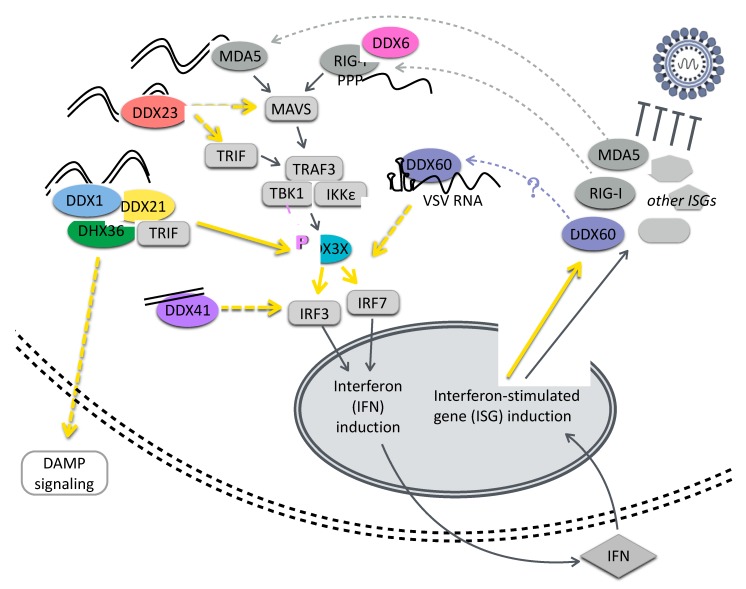
Figure 1
Figure 1
DEAD-box helicases contribute to innate immune signaling. DEAD-box helicases have been demonstrated to serve as sensors for nucleic acids, including dsRNA, cytoplasmic DNA, and viral RNAs, leading to the induction of interferon and interferon-stimulated genes. DEAD-box helicases also contribute to innate immune signaling downstream of nucleic acid sensing by mediating protein–protein interactions and promoting DAMP signaling. Moreover, some DEAD-box helicases are ISGs, suggesting positive feedback on their innate immune roles. RIG-I and MDA-5, while considered members of the RIG-I-like receptors (RLR) family, contain related DExD/H-box RNA binding domains. DEAD-box helicases are shown in color and other cellular components are shown in gray. Dotted yellow lines are used where there may be intermediate steps in the indicated relationship. (DAMP, damage-associated molecular pattern; IFN, interferon; ISG, interferon-stimulated gene; TLR, toll-like receptor; VSV, vesicular stomatitis virus).
Figure 2
Figure 2
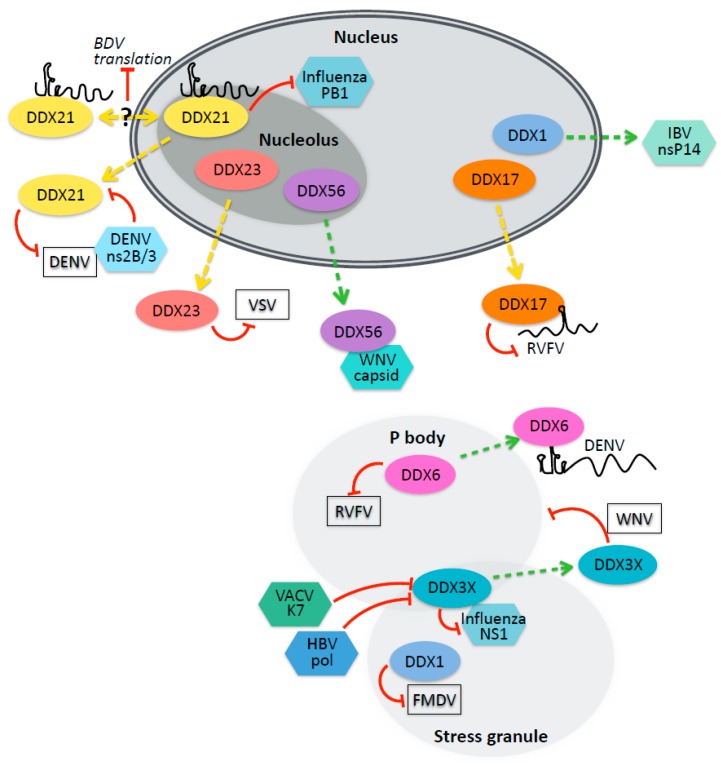
DEAD-box helicases with diverse cellular roles and localization interact with viral components and influence infection. DEAD-box helicases residing in nuclear, p-body, and stress granule compartments, have been implicated in viral infection. Interactions involve viral proteins, viral RNAs, or remain undefined. DEAD-box helicases can have positive or negative effects on infection. In some cases, viruses have been shown to counteract antiviral helicases, to alter the localization of helicases, or to disrupt RNA-protein (RNP) complexes. The red lines indicate negative interactions; the green arrows indicate positive interactions; and the dotted lines indicate protein relocalization. (VSV, vesicular stomatitis virus; DENV, dengue virus; RVFV, Rift Valley fever virus; WNV, West Nile virus; BDV, Borna disease virus; IBV, infections bronchitis virus, FMDV, foot and mouth disease virus; HBV, hepatitis B virus; VACV, vaccinia virus).

References

    1. Linder P., Lasko P.F., Ashburner M., Leroy P., Nielsen P.J., Nishi K., Schnier J., Slonimski P.P. Birth of the d-e-a-d box. Nature. 1989;337:121–122. doi: 10.1038/337121a0. - DOI - PubMed
    1. Tanner N.K., Linder P. DExD/H box RNA helicases. Mol. Cell. 2001;8:251–262. doi: 10.1016/S1097-2765(01)00329-X. - DOI - PubMed
    1. Tanner N.K., Cordin O., Banroques J., Doère M., Linder P. The Q motif: A newly identified motif in DEAD box helicases may regulate ATP binding and hydrolysis. Mol. Cell. 2003;11:127–138. doi: 10.1016/S1097-2765(03)00006-6. - DOI - PubMed
    1. Cordin O., Banroques J., Tanner N.K., Linder P. The dead-box protein family of rna helicases. Gene. 2006;367:17–37. doi: 10.1016/j.gene.2005.10.019. - DOI - PubMed
    1. Sengoku T., Nureki O., Nakamura A., Kobayashi S., Yokoyama S. Structural basis for rna unwinding by the dead-box protein drosophila vasa. Cell. 2006;125:287–300. doi: 10.1016/j.cell.2006.01.054. - DOI - PubMed

Publication types