


Predictive Ability of Waist Circumference and Waist-to-Height Ratio for Cardiometabolic Risk Screening among Spanish Children
- PMID: 32033484
- PMCID: PMC7071136
- DOI: 10.3390/nu12020415
Predictive Ability of Waist Circumference and Waist-to-Height Ratio for Cardiometabolic Risk Screening among Spanish Children
Abstract
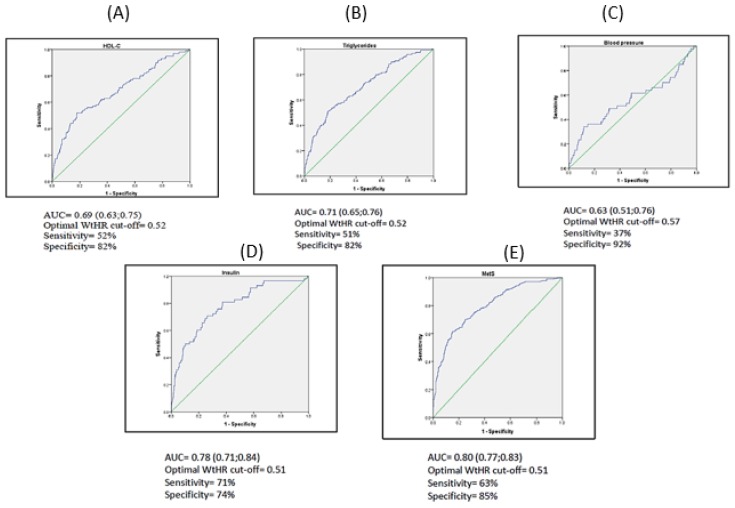
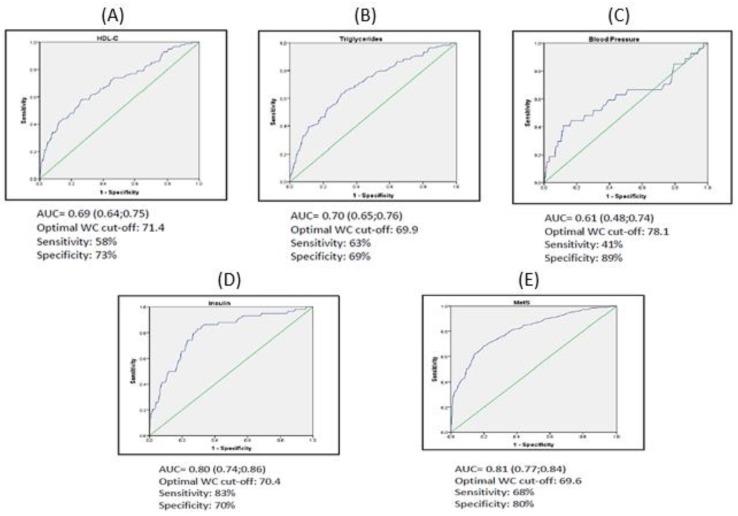
An excess of fat mass has been associated with adverse cardiometabolic risk factors. Different anthropometric measures have been proposed as alternative non-invasive measures for obesity-related cardiometabolic risk. To evaluate the magnitude of association between waist circumference (WC) and waist-to-height ratio (WtHR) with cardiometabolic risk factors and metabolic syndrome and to determine the WtHR cutoff associated with a more favorable cardiometabolic risk profile in Spanish children, data were taken from a cross-sectional survey conducted in 2010 among 848 schoolchildren aged 8-11 years from 20 public schools in the province of Cuenca (Spain). Anthropometric variables, glucose, insulin, triglycerides (TG), high-density lipoprotein cholesterol (HDL-C), systolic (SBP) and diastolic blood pressure (DBP) and metabolic syndrome (MetS) were also analyzed. WtHR and WC had a good accuracy for TG, insulin, and MetS. The diagnostic odds ratio ranged from 2.95 to 9.07 for WtHR and from 5.30 to 27.40 for WC. The main result of the present study suggests that both WtHR and WC could be used as a screening tool to identify children with cardiometabolic abnormalities.
Keywords: anthropometric indicators; metabolic risk factors; obesity.
Conflict of interest statement
The authors declare that they have no conflict of interest.
Figures
References
Publication types
MeSH terms
Grants and funding
LinkOut - more resources
Full Text Sources
Medical
Miscellaneous
