


Why Physicians Prescribe Prophylactic Seizure Medications after Intracerebral Hemorrhage: An Adaptive Conjoint Analysis
- PMID: 32033905
- PMCID: PMC7099929
- DOI: 10.1016/j.jstrokecerebrovasdis.2019.104628
Why Physicians Prescribe Prophylactic Seizure Medications after Intracerebral Hemorrhage: An Adaptive Conjoint Analysis
Abstract
Background: Seizures are a morbid complication of intracerebral hemorrhage (ICH) and increase the risk for herniation, status epilepticus, and worse patient outcomes. Prophylactic levetiracetam is administered to approximately 40% of patients with ICH. It is unclear which patients are consciously selected for treatment by physicians. We sought to determine how patients are selected for treatment with prophylactic levetiracetam after ICH.
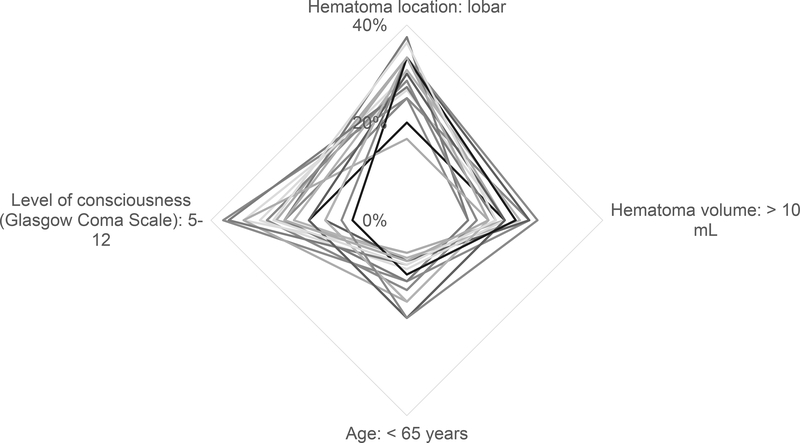
Methods: We administered an adaptive conjoint analysis using decision making software to an NIH Stroke Trials Network Working Group. The adaptive conjoint analysis determines the most influential attributes for making a decision in an iterative, algorithm-driven process. We asked respondents which would most influence a decision to administer prophylactic levetiracetam. The attributes and their levels were taken from published phenotypes associated with prophylactic seizure medications and the likelihood of seizures after ICH: hematoma location (lobar or basal ganglia), hematoma volume (<=10 mL or >10 mL), level of consciousness (Glasgow Coma Scale 5-12 or Glasgow Coma Scale 13-15), age (<65 or ≥65 years), and race (White or Caucasian or Black/African American). The algorithm terminated when the attributes were ranked from most to least influential.
Results: The study sample included 27 respondents who completed the adaptive conjoint analysis out of 42 who responded to the survey with a mean age of 43.4 ± 9.4 years. The attribute with the greatest weight was hematoma location (30%), followed by reduced level of consciousness (24%), hematoma volume (19%), race (14%), and age (13%). Ranks of attributes were different (P < .001).
Conclusions: The decision to administer prophylactic levetiracetam to patients with ICH is driven by lobar hematoma location and depressed level of consciousness. Future research on prophylactic seizure medication could focus on patients most likely to receive it.
Keywords: Seizure medications; adaptive conjoint analysis; decision making; intracerebral hemorrhage; levetiracetam.
Copyright © 2019 Elsevier Inc. All rights reserved.
Conflict of interest statement
Conflict of Interest Disclosure
The authors are unaware of any conflict of interest.
Figures
References
-
- Vespa PM, O’Phelan K, Shah M, et al. Acute seizures after intracerebral hemorrhage: a factor in progressive midline shift and outcome. Neurology 2003;60:1441–6. - PubMed
-
- Broderick J, Connolly S, Feldmann E, et al. Guidelines for the management of spontaneous intracerebral hemorrhage in adults. 2007 Update. Stroke 2007;38:2001–23. - PubMed
-
- Naidech AM, Garg RK, Liebling S, et al. Anticonvulsant Use and Outcomes After Intracerebral Hemorrhage. Stroke 2009;40:3810–5. - PubMed
-
- Messe SR, Sansing LH, Cucchiara BL, Herman ST, Lyden PD, Kasner SE. Prophylactic antiepileptic drug use is associated with poor outcome following ICH. Neurocrit Care 2009;11:38–44. - PubMed
MeSH terms
Substances
Grants and funding
LinkOut - more resources
Full Text Sources
Medical
