. 2020 Feb 7;10(1):2133.
doi: 10.1038/s41598-020-59016-0.

Patterns of Oral Microbiota Diversity in Adults and Children: A Crowdsourced Population Study

Collaborators, Affiliations

Patterns of Oral Microbiota Diversity in Adults and Children: A Crowdsourced Population Study

Zachary M Burcham et al. Sci Rep. .

Abstract

Oral microbiome dysbiosis has been associated with various local and systemic human diseases such as dental caries, periodontal disease, obesity, and cardiovascular disease. Bacterial composition may be affected by age, oral health, diet, and geography, although information about the natural variation found in the general public is still lacking. In this study, citizen-scientists used a crowdsourcing model to obtain oral bacterial composition data from guests at the Denver Museum of Nature & Science to determine if previously suspected oral microbiome associations with an individual's demographics, lifestyle, and/or genetics are robust and generalizable enough to be detected within a general population. Consistent with past research, we found bacterial composition to be more diverse in youth microbiomes when compared to adults. Adult oral microbiomes were predominantly impacted by oral health habits, while youth microbiomes were impacted by biological sex and weight status. The oral pathogen Treponema was detected more commonly in adults without recent dentist visits and in obese youth. Additionally, oral microbiomes from participants of the same family were more similar to each other than to oral microbiomes from non-related individuals. These results suggest that previously reported oral microbiome associations are observable in a human population containing the natural variation commonly found in the general public. Furthermore, these results support the use of crowdsourced data as a valid methodology to obtain community-based microbiome data.


Conflict of interest statement

The authors declare no competing interests.

Figures
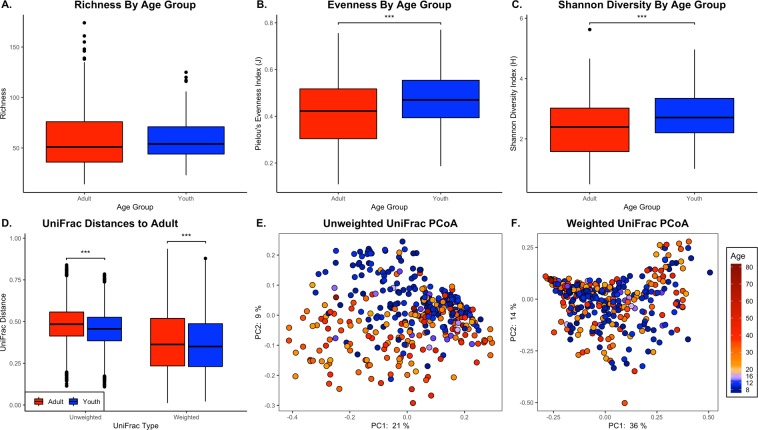
Figure 1
Figure 1
Adult and Youth Diversity Comparisons. Diversity comparisons between age groups using Kruskal-Wallis tests on (A). Richness, (B). Evenness, and (C). Shannon’s index. PERMANOVA tests were used to compare (D). UniFrac distances, which were visualized as (E). unweighted and (F). weighted UniFrac PCoA plots. UniFrac distance comparisons were as adults to adults and adults to youth. Significance determined by q < 0.05 (*), ≤0.01 (**), ≤0.001 (***).
Figure 2
Figure 2
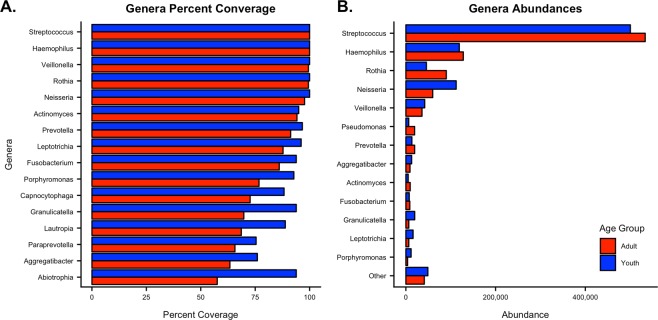
Adult and Youth Genera Compositions. (A) Genera percent coverage and (B) abundances are shown in descending order by adult samples. Genera percent coverage is represented as the percent of samples in which a genus was detected and was only calculated if a genus was present in at least 75% of samples in either age group. Genera abundances were calculated for each age group based on read counts.
Figure 3
Figure 3
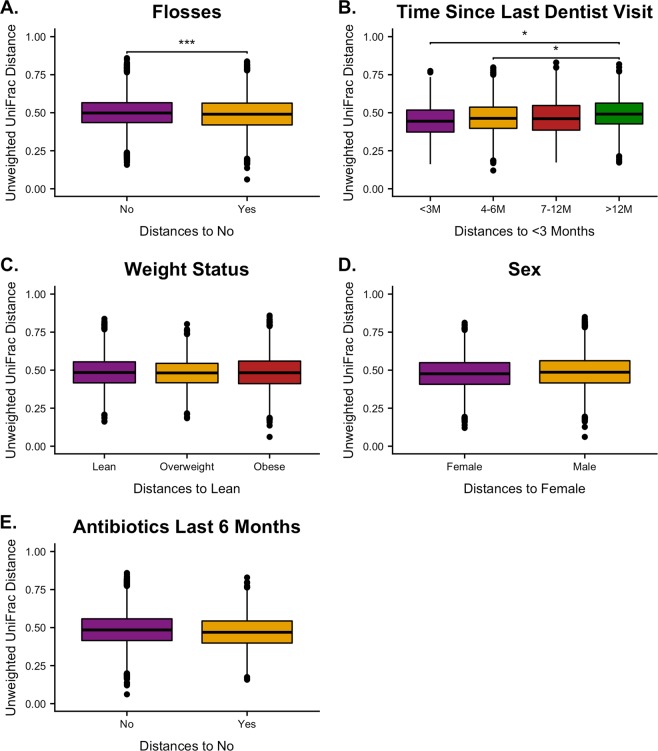
Beta Diversity Comparisons in Adults. Unweighted UniFrac adult distance comparisons on (A). flosses, (B). time since last dentist visit, (C). Weight status, (D). Sex, and (E). Antibiotic use last 6 months using PERMANOVA. Significance determined by q < 0.05 (*), ≤0.01 (**), ≤0.001 (***).
Figure 4
Figure 4
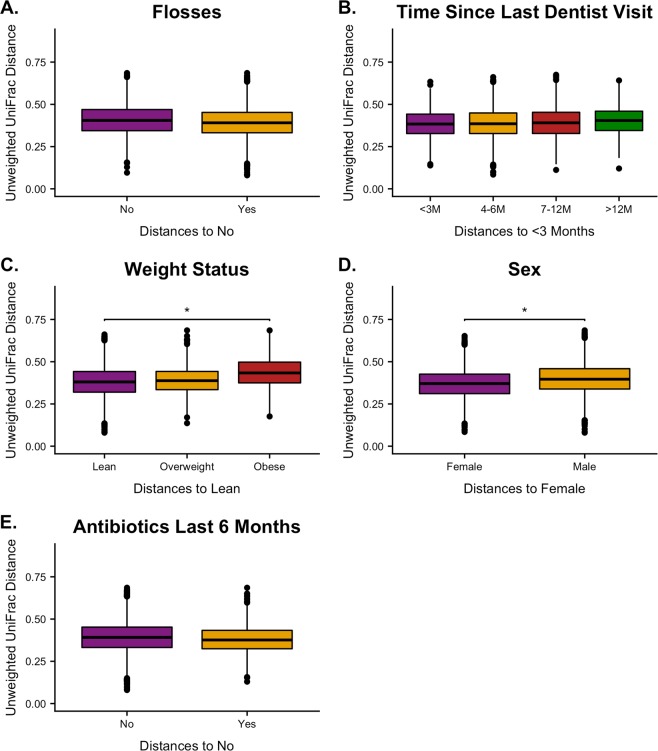
Beta Diversity Comparisons in Youth. Unweighted UniFrac youth distance comparisons on (A). flosses, (B). Time since last dentist visit, (C). Weight status, (D). Sex, and (E). antibiotic use last 6 months using PERMANOVA. Significance determined by q < 0.05 (*), ≤0.01 (**), ≤0.001 (***).
Figure 5
Figure 5
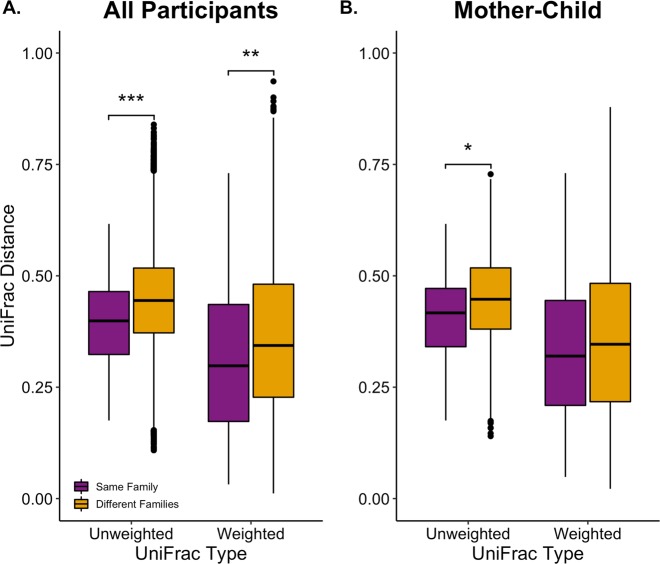
Familial Beta Diversity Comparisons. Wilcoxon rank-sum test comparing unweighted and weighted UniFrac distances of (A). All participants within the same family against all participants of different families and (B). Same family mother-child distances against different family mother-child distances. Significance determined by q < 0.05 (*), ≤0.01 (**), ≤0.001 (***).
Figure 6
Figure 6
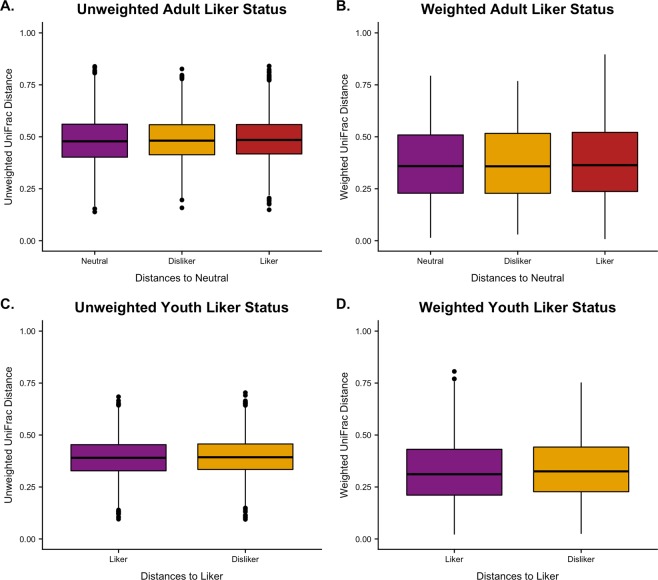
Beta Diversity Comparison on Sweet-Liking Phenotype. UniFrac distance comparisons on (A). adult unweighted distances, (B). Adult weighted distances, (C). Youth unweighted distances, and (D). Youth weighted distances against sweet-liking phenotype using PERMANOVA. Significance determined by q < 0.05 (*), ≤0.01 (**), ≤0.001 (***).

References

    1. Beck JD, Offenbacher S. Systemic effects of periodontitis: epidemiology of periodontal disease and cardiovascular disease. J. Periodontol. 2005;76:2089–2100. doi: 10.1902/jop.2005.76.11-S.2089. - DOI - PubMed
    1. Seymour GJ, Ford PJ, Cullinan MP, Leishman S, Yamazaki K. Relationship between periodontal infections and systemic disease. Clin. Microbiol. Infect. 2007;13(Suppl 4):3–10. doi: 10.1111/j.1469-0691.2007.01798.x. - DOI - PubMed
    1. Goodson JM, Groppo D, Halem S, Carpino E. Is obesity an oral bacterial disease? J. Dent. Res. 2009;88:519–523. doi: 10.1177/0022034509338353. - DOI - PMC - PubMed
    1. Wade WG. The oral microbiome in health and disease. Pharmacol. Res. 2013;69:137–143. doi: 10.1016/j.phrs.2012.11.006. - DOI - PubMed
    1. Chen H, Jiang W. Application of high-throughput sequencing in understanding human oral microbiome related with health and disease. Front. Microbiol. 2014;5:508. - PMC - PubMed

Publication types

MeSH terms