Review
. 2020 Apr;17(4):251-266.
doi: 10.1038/s41571-019-0308-z. Epub 2020 Feb 7.

Improving cancer immunotherapy using nanomedicines: progress, opportunities and challenges

Affiliations
Review

Improving cancer immunotherapy using nanomedicines: progress, opportunities and challenges

John D Martin et al. Nat Rev Clin Oncol. 2020 Apr.

Abstract

Multiple nanotherapeutics have been approved for patients with cancer, but their effects on survival have been modest and, in some examples, less than those of other approved therapies. At the same time, the clinical successes achieved with immunotherapy have revolutionized the treatment of multiple advanced-stage malignancies. However, the majority of patients do not benefit from the currently available immunotherapies and many develop immune-related adverse events. By contrast, nanomedicines can reduce - but do not eliminate - the risk of certain life-threatening toxicities. Thus, the combination of these therapeutic classes is of intense research interest. The tumour microenvironment (TME) is a major cause of the failure of both nanomedicines and immunotherapies that not only limits delivery, but also can compromise efficacy, even when agents accumulate in the TME. Coincidentally, the same TME features that impair nanomedicine delivery can also cause immunosuppression. In this Perspective, we describe TME normalization strategies that have the potential to simultaneously promote the delivery of nanomedicines and reduce immunosuppression in the TME. Then, we discuss the potential of a combined nanomedicine-based TME normalization and immunotherapeutic strategy designed to overcome each step of the cancer-immunity cycle and propose a broadly applicable 'minimal combination' of therapies designed to increase the number of patients with cancer who are able to benefit from immunotherapy.


Conflict of interest statement

Competing interests

J.D.M. became a full-time employee of NanoCarrier during the preparation of this manuscript. R.K.J. has received honoraria from Amgen, has acted as a consultant for Chugai, Merck, Ophthotech, Pfizer, SPARC, SynDevRx and XTuit, owns equity in Enlight, Ophthotech and SynDevRx and serves on the Boards of Trustees of Tekla Healthcare Investors, Tekla Life Sciences Investors, Tekla Healthcare Opportunities Fund and Tekla World Healthcare Fund. H.C. and T.S. declare no competing interests.

Figures
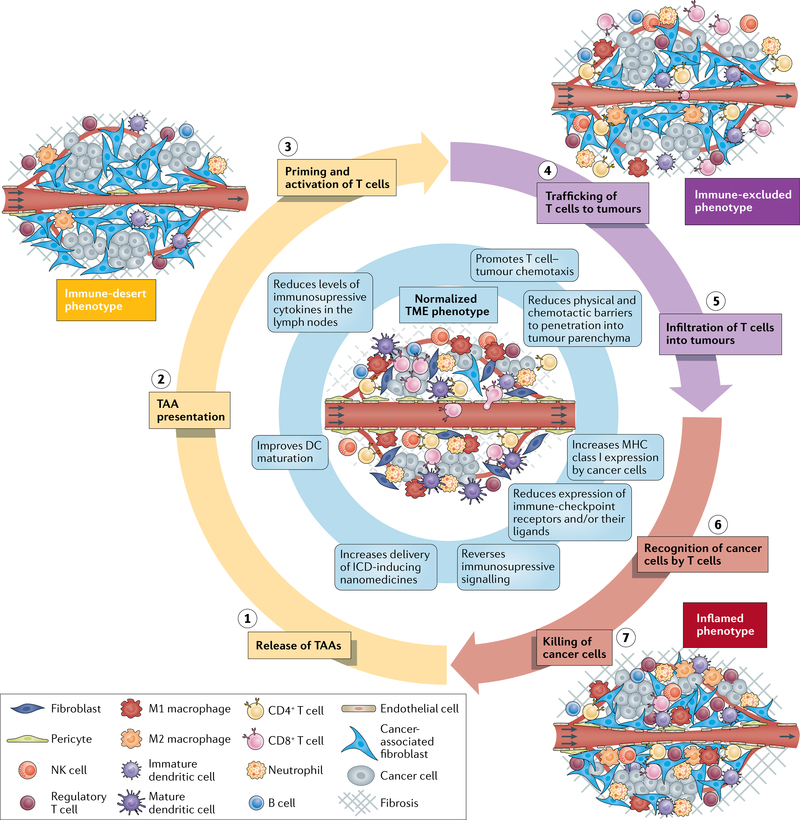
Fig. 1 |
Fig. 1 |. Cancer-immunity TME phenotypes affecting responsiveness to immunotherapy.
Three distinct cancer-immunity phenotypes exist and can affect responsiveness to immunotherapies in different ways. These phenotypes reflect tumours at different phases of the seven-step cancer-immunity cycle that must be completed repeatedly for immunotherapies to be effective. Tumour microenvironment (TME) normalization (centre, blue shading) promotes perpetuation of the cycle. In tumours of the immune-desert phenotype (yellow shading), the TME and the often limited number of immune cells within the tumour are immunosuppressed. The host immune system permits cancer cell growth owing to a lack of antigen recognition, immune tolerance and/or a failure to prime cytotoxic T cells. Some of these processes are affected by hypoxia. In tumours of the immune-excluded phenotype (purple shading), immune cell infiltration is restricted to the periphery and/or the stroma. The stromal factors that promote this phenotype similarly inhibit the delivery of nanomedicines and/or oxygen. In tumours of the inflamed phenotype (red shading), immune cells are stimulated by pro-inflammatory cytokines and are able to move throughout the tumour parenchyma. However, various inhibitory factors, which are often induced by hypoxia, lead to a reduction in antitumour immunity. Normalization of the vasculature by targeting angiogenic factors (such as VEGF and/or angiopoietin-2) and/or immune checkpoints and normalization of the tumour extravascular compartment by reprogramming cancer-associated fibroblasts (CAFs) to produce a less dense extracellular matrix (ECM) are two strategies that can be applied alone or in combination to normalize the entire TME and improve perfusion, oxygen delivery and drug distribution. Improper use of these strategies, however, can lead to excessive vessel pruning or CAF and/or ECM depletion, which might accelerate tumour progression and metastasis. Anti-programmed cell death 1 (PD-1) or programmed cell death 1 ligand 1 (PD-L1) antibodies can also normalize blood vessels in some tumour types and could promote the growth of mature blood vessels that are protected from pruning by antiangiogenic agents, which primarily target immature vessels. Signalling pathways such as those activated by VEGF, angiopoietin-2, CXCL12/CXCR4 and transforming growth factor-β, which can all be targeted to normalize the TME, are themselves immunosuppressive. As a result of these effects, the combination of therapies targeting these pathways with immunotherapies is a promising approach. Thus, specific TME normalization strategies based on the TME immune phenotype of the target tumour could increase both the response rates and the magnitude of responses to immunotherapies. DC, dendritic cell; ICD, immunogenic cell death; NK, natural killer; TAA, tumour-associated antigen.
Fig. 2 |
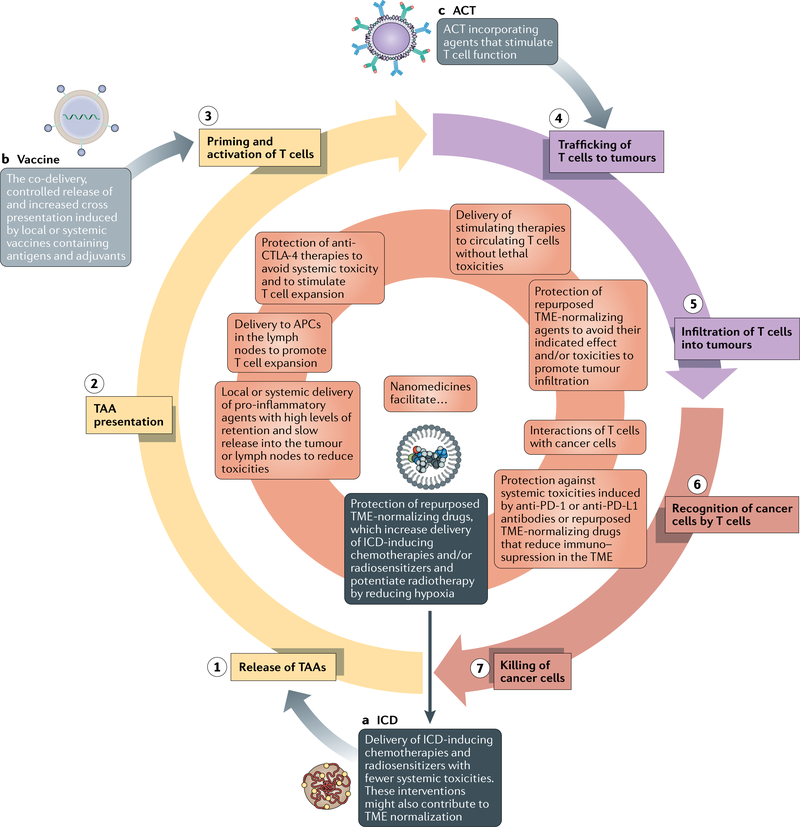
Fig. 2 |. How nanomedicines can be used to perpetuate the cancer-immunity cycle.
The goal of nanomedicine-based immunotherapy is to ensure that the cancer-immunity cycle (the seven numbered steps) perpetuates. Initially, in order to ensure that T cells are capable of attacking cancer cells, we highlight three nanomedicine-based starting points: (a) immunogenic cell death (ICD)-inducing therapy, (b) vaccines and (c) nanoparticle-loaded T cells. Therapies specifically relevant to each of these starting points are in dark grey, light grey and grey boxes, respectively. After one of these initiations, various types of nanomedicines described in this Perspective can turn the cycle forward (the inner orange circle). ACT, adoptive cellular therapy; APC, antigen-presenting cell; CTL A-4, cytotoxic T lymphocyte-associated protein 4; DC, dendritic cell; PD-1, programmed cell death 1; PD-L1, programmed cell death 1 ligand 1; TAA, tumour-associated antigen; TME, tumour microenvironment.
Fig. 3 |
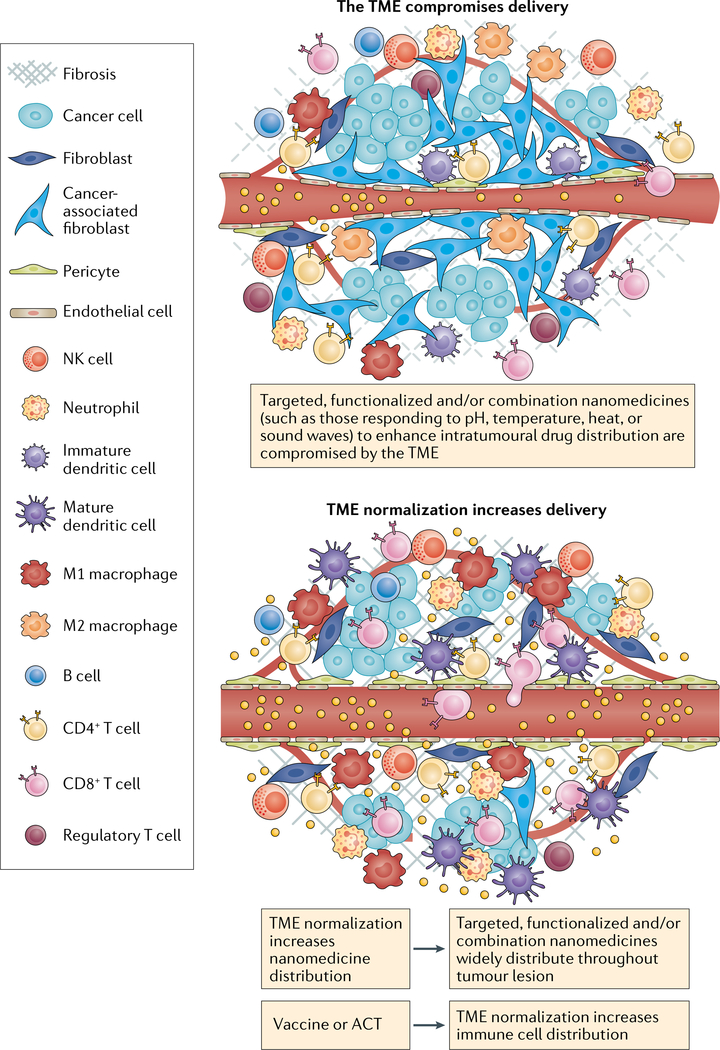
Fig. 3 |. Normalizing the TME to increase the penetration of combination therapies.
Targeted or stimuli-responsive nanomedicines often have a limited level of distribution within tumours because the tumour microenvironment (TME) limits blood flow and therefore the extent of tumour penetration. With insufficient penetration and a limited density of antitumour immune cells, the advantage of these nanomedicines compared with passively accumulating and releasing nanomedicines is reduced. TME-normalizing therapies increase and homogenize the intratumour distribution of immune cells and nanomedicines. Nanomedicine-based vaccines and autologous transferred T cells carrying nanomedicines increase the number of antitumour T cells in the host. If followed by TME normalization, a larger percentage of these T cells can migrate to the tumour parenchyma. Similarly, functionalized nanomedicines following TME normalization can penetrate the tumour parenchyma in higher fractions thereby reaching their target and/or stimuli and demonstrating a larger improvement over passive nanomedicine. Thus, normalizing the TME could increase the effectiveness of targeted nanomedicines that combine cytotoxic agents and immunotherapies. ACT, adoptive cellular therapy; NK, natural killer.

References

    1. Jain RK & Stylianopoulos T Delivering nanomedicine to solid tumors. Nat. Rev. Clin. Oncol. 7, 653–664 (2010). - PMC - PubMed
    1. Haslam A & Prasad V Estimation of the percentage of US patients with cancer who are eligible for and respond to checkpoint inhibitor immunotherapy drugs. JAMA Netw. Open. 2, e192535–e192535 (2019). - PMC - PubMed
    1. Postow MA, Sidlow R & Hellmann MD Immune-related adverse events associated with immune checkpoint blockade. N. Engl. J. Med. 378, 158–168 (2018). - PubMed
    1. Riley RS, June CH, Langer R & Mitchell MJ Delivery technologies for cancer immunotherapy. Nat. Rev. Drug. Discovery 18, 175–196 (2019). - PMC - PubMed
    1. Goldberg MS et al. Improving cancer immunotherapy through nanotechnology. Nat. Rev. Cancer 19, 587–602 (2019). - PubMed

Publication types

MeSH terms