


An Updated Systematic Review and Meta-regression Analysis: Mental Disorders Among Adolescents in Juvenile Detention and Correctional Facilities
- PMID: 32035113
- PMCID: PMC8222965
- DOI: 10.1016/j.jaac.2020.01.015
An Updated Systematic Review and Meta-regression Analysis: Mental Disorders Among Adolescents in Juvenile Detention and Correctional Facilities
Abstract
Objective: To synthesize evidence on the prevalence of mental disorders in adolescents in juvenile detention and correctional facilities and examine sources of heterogeneity between studies.
Method: Electronic databases and relevant reference lists were searched to identify surveys published from January 1966 to October 2019 that reported on the prevalence of mental disorders in unselected populations of detained adolescents. Data on the prevalence of a range of mental disorders (psychotic illnesses, major depression, attention-deficit/hyperactivity disorder [ADHD], conduct disorder, and posttraumatic stress disorder [PTSD]) along with predetermined study characteristics were extracted from the eligible studies. Analyses were reported separately for male and female adolescents, and findings were synthesized using random-effects models. Potential sources of heterogeneity were examined by meta-regression and subgroup analyses.
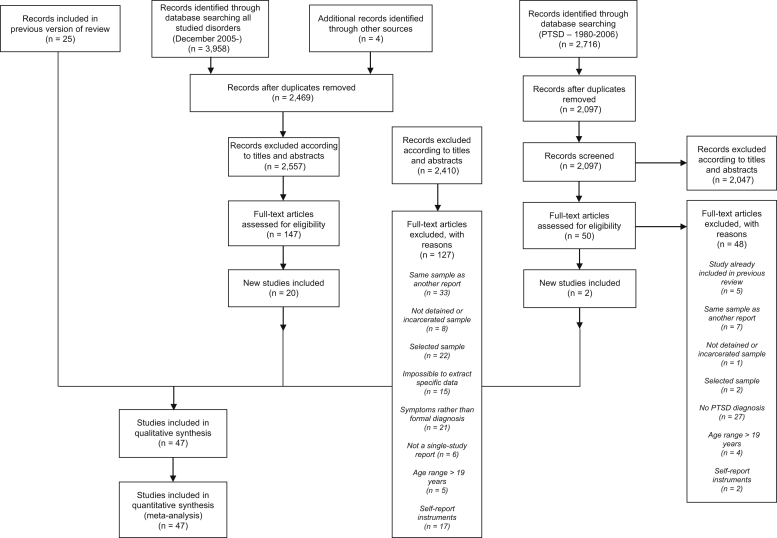
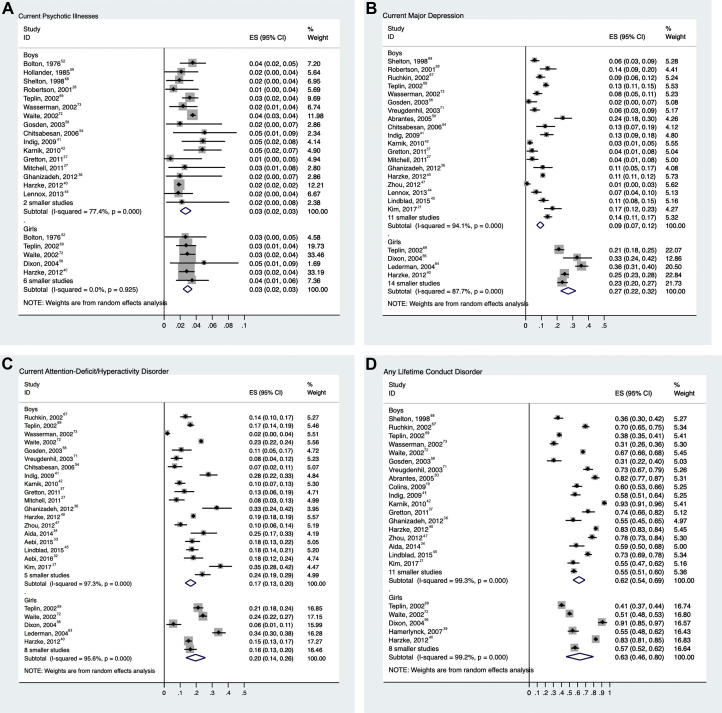
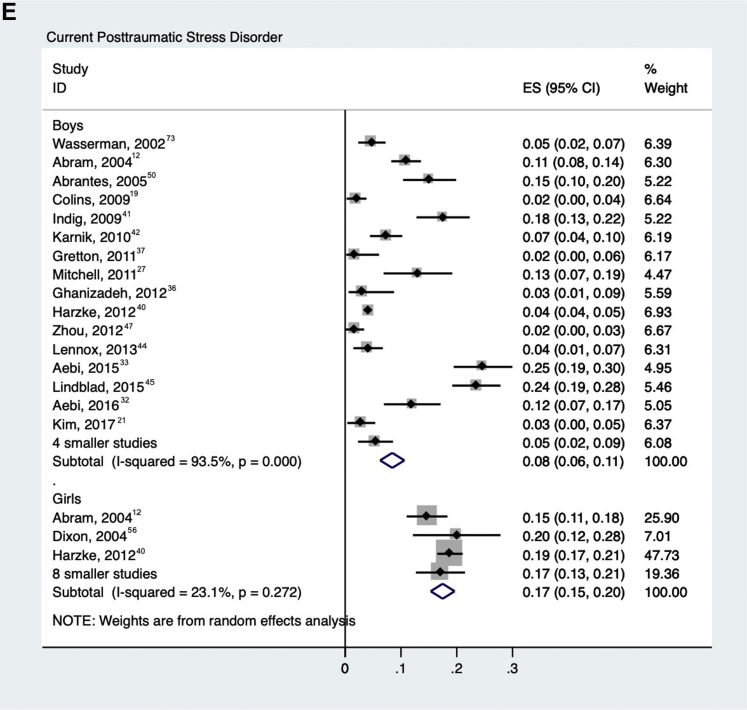
Results: Forty-seven studies from 19 countries comprising 28,033 male and 4,754 female adolescents were identified. The mean age of adolescents assessed was 16 years (range, 10-19 years). In male adolescents, 2.7% (95% CI 2.0%-3.4%) had a diagnosis of psychotic illness; 10.1% (95% CI 8.1%-12.2%) major depression; 17.3% (95% CI 13.9%-20.7%) ADHD; 61.7% (95% CI 55.4%-67.9%) conduct disorder; and 8.6% (95% CI 6.4%-10.7%) PTSD. In female adolescents, 2.9% (95% CI 2.4%-3.5%) had a psychotic illness; 25.8% (95% CI 20.3%-31.3%) major depression; 17.5% (95% CI 12.1%-22.9%) ADHD; 59.0% (95% CI 44.9%-73.1%) conduct disorder; and 18.2% (95% CI 13.1%-23.2%) PTSD. Meta-regression found higher prevalences of ADHD and conduct disorder in investigations published after 2006. Female adolescents had higher prevalences of major depression and PTSD than male adolescents.
Conclusion: Consideration should be given to reviewing whether health care services in juvenile detention can address these levels of psychiatric morbidity.
Keywords: PTSD; criminal justice; detention; mental disorders; systematic review.
Copyright © 2020 The Authors. Published by Elsevier Inc. All rights reserved.
Figures
Comment in
-
Mental Disorders Among Detained Youth: The Hidden Nature and Peculiarities of African Literature.J Am Acad Child Adolesc Psychiatry. 2021 Feb;60(2):202-203. doi: 10.1016/j.jaac.2020.06.012. J Am Acad Child Adolesc Psychiatry. 2021. PMID: 33509405
-
Ms. Beaudry et al. Reply.J Am Acad Child Adolesc Psychiatry. 2021 Feb;60(2):203-204. doi: 10.1016/j.jaac.2020.08.001. J Am Acad Child Adolesc Psychiatry. 2021. PMID: 33509406
References
-
- Sawyer W. Youth confinement: The whole pie. Prison Policy Initiative Web site. Published 2018. Available at: https://www.prisonpolicy.org/reports/youth2019.html. Accessed May 17, 2019.
-
- Schubert C.A., Mulvey E.P., Glasheen C. Influence of mental health and substance use problems and criminogenic risk on outcomes in serious juvenile offenders. J Am Acad Child Adolesc Psychiatry. 2011;50:925–937. - PubMed
-
- McReynolds L.S., Schwalbe C.S., Wasserman G.A. The contribution of psychiatric disorder to juvenile recidivism. Crim Justice Behav. 2010;37:204–216.
-
- Plattner B., Steiner H., The S.S. Sex-specific predictors of criminal recidivism in a representative sample of incarcerated youth. Compr Psychiatry. 2009;50:400–407. - PubMed
-
- Penn J.V., Esposito C.L., Schaeffer L.E., Fritz G.K., Spirito A. Suicide attempts and self-mutilative behavior in a juvenile correctional facility. J Am Acad Child Adolesc Psychiatry. 2003;42:762–769. - PubMed
Publication types
MeSH terms
Grants and funding
LinkOut - more resources
Full Text Sources
Other Literature Sources
Medical
