. 2020 May;45(6):1034-1041.
doi: 10.1038/s41386-020-0632-0. Epub 2020 Feb 8.

Ventromedial prefrontal value signals and functional connectivity during decision-making in suicidal behavior and impulsivity

Affiliations

Ventromedial prefrontal value signals and functional connectivity during decision-making in suicidal behavior and impulsivity

Vanessa M Brown et al. Neuropsychopharmacology. 2020 May.

Abstract

Suicide is linked to impaired value-based decision-making and impulsivity, but whether these risk factors share neural underpinnings is unclear. Disrupted ventromedial prefrontal cortex (vmPFC) value signals may underlie this behavioral phenotype. We investigated vmPFC value signals, vmPFC-frontoparietal connectivity, and the impact of impulsivity during decision-making in depressed individuals with and without suicidal behavior. Middle-aged and older adults (n = 116; 35 with a history of suicide attempts, 25 with ideation only, 25 depressed controls with no ideation, and 31 nonpsychiatric controls) completed a decision-making task with drifting reward probabilities during fMRI. Values of choices, estimated by a reinforcement learning model, were regressed against BOLD signal. VmPFC value activation was compared between groups. Moderating effects of impulsivity on vmPFC-frontoparietal connectivity were assessed in nonpsychiatric controls and compared among patient groups. VmPFC value responses in participants with a history of suicide attempts were reduced relative to nonpsychiatric controls (p < 0.05). In nonpsychiatric controls, vmPFC-frontoparietal connectivity was negatively moderated by impulsivity (pFWE corrected < 0.05). This effect was preserved in comparison patient groups but abolished in suicide attempters (p < 0.001). This change in neural connectivity patterns also affected behavior: people with a history of suicide attempts showed a disrupted effect of vmPFC-frontoparietal connectivity, impulsivity, and reinforcement on choice quality (p < 0.001). These effects were specific to vmPFC and not to striatum. In summary, findings from this study largely support disrupted vmPFC value signals in suicidal behavior. In addition, it uncovers an altered pattern of vmPFC-frontoparietal connectivity in impulsive people with suicidal behavior, which may underlie disrupted choice processes in a suicidal crisis.


Figures
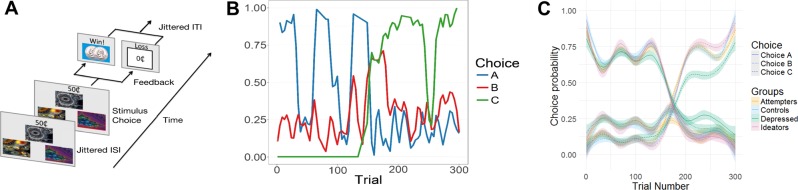
Fig. 1
Fig. 1. Volatile reinforcement learning task and participants’ performance.
a Task schematic. On each trial in the task, participants were presented with three stimuli and the possible winnings (10, 25, or 50¢) if the chosen stimulus was rewarded. Reward magnitude was manipulated independently of the chosen stimulus and shown at trial onset. Stimuli and possible winnings were presented until participants made a response using MRI-compatible response gloves. After an option was selected, it was highlighted and the presence or absence of a reward was displayed after a jittered ISI (sampled from an exponential distribution with mean = 4000 ms); reward feedback was displayed for 750 ms. The intertrial interval was sampled from an exponential distribution with a mean of 2920 ms. b Reward probabilities by trial and stimulus. The probability of reward after choosing each stimulus varied dynamically over time, requiring participants to continually update the expected values. Colored lines indicate the probability of reward (y axis; 0–1) for each stimulus at each trial (x axis; 1–300). c Task performance by groups. All participants were able to track the changing probabilities and choose stimuli that reflected updated reward probabilities. Line types represent choices (A–C, corresponding to lines in b) and line colors represent participant groups.
Fig. 2
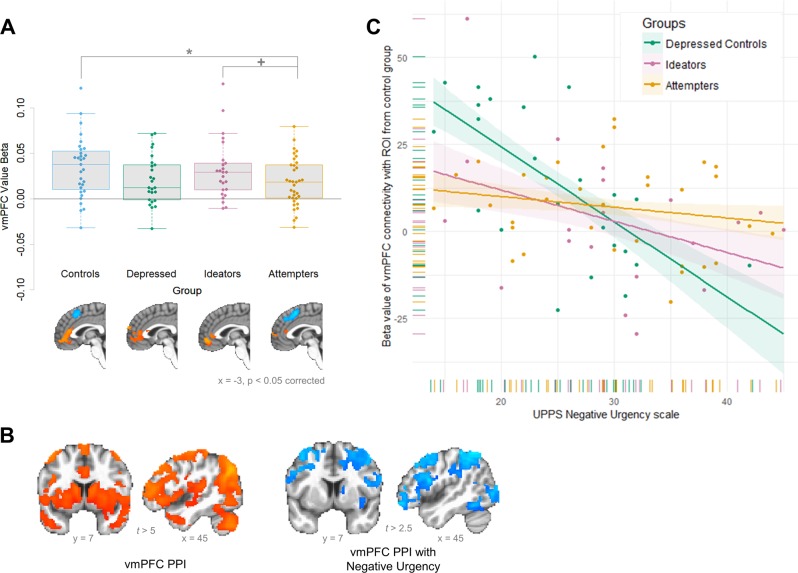
Fig. 2. Neural processing of value in vmPFC by group and moderation of connectivity by impulsivity.
a Ventromedial PFC value signals by group. Box plots are grouped by patient group and individual dots represent each participant in the group. Values shown are the average beta value for expected value in a meta-analytically defined vmPFC region of interest. Participants with a history of suicide attempts showed reduced vmPFC activation to value relative to nonpsychiatric controls and moderately reduced relative to participants with suicidal ideation but no history of attempts. b Ventromedial PFC connectivity with value and moderated by impulsivity in nonpsychiatric controls. In controls, vmPFC signal at the time of feedback was significantly correlated with activity in cortical and subcortical brain areas (left); frontoparietal regions were significantly negatively correlated with greater negative urgency scores in this group (right). c Moderation of relationship between vmPFC–frontoparietal connectivity with impulsivity by group. X axis represents impulsivity scores (UPPS negative urgency) and Y axis represents connectivity between vmPFC and region of interest showing altered connectivity with impulsivity in nonpsychiatric controls (mask derived from regions shown in b, left). Dots indicate individual participants and lines indicate overall relationship per group; colors indicate patient groups. Connectivity in participants with a history of suicide attempts (yellow) is not affected by impulsivity, in contrast to other patient groups.
Fig. 3
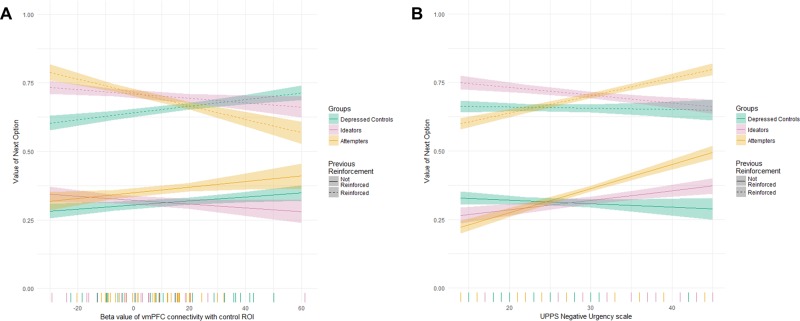
Fig. 3. Effect of altered vmPFC–frontoparietal activity on behavioral performance.
X axis is vmPFC–frontoparietal connectivity, Y axis is the value of the next choice (as calculated by the computational model), and line types indicate the presence of reinforcement on the current trial. In non-suicidal depressed participants, higher vmPFC–frontoparietal connectivity is associated with choosing better (higher valued) choices after both reinforced and non-reinforced trials, while participants with a history of suicide attempts show a breakdown in performance with high connectivity after reinforced trials.

References

    1. Dombrovski AY, Hallquist MN. The decision neuroscience perspective on suicidal behavior: evidence and hypotheses. Curr Opin Psychiatry. 2017;30:7–14. doi: 10.1097/YCO.0000000000000297. - DOI - PMC - PubMed
    1. Richard-Devantoy S, Berlim MT, Jollant F. A meta-analysis of neuropsychological markers of vulnerability to suicidal behavior in mood disorders. Psychol Med. 2014;44:1663–73. doi: 10.1017/S0033291713002304. - DOI - PubMed
    1. Mann JJ, Waternaux C, Haas GL, Malone KM. Toward a clinical model of suicidal behavior in psychiatric patients. Am J Psychiatry. 1999;156:181–9. - PubMed
    1. Dombrovski AY, Szanto K, Clark L, Reynolds CF, Siegle GJ. Reward signals, attempted suicide, and impulsivity in late-life depression. JAMA Psychiatry. 2013;70:1. - PMC - PubMed
    1. Montague PR, Dolan RJ, Friston KJ, Dayan P. Computational psychiatry. Trends Cogn Sci. 2012;16:72–80. doi: 10.1016/j.tics.2011.11.018. - DOI - PMC - PubMed

Publication types