


Rising prevalence of multiple sclerosis in Saudi Arabia, a descriptive study
- PMID: 32035478
- PMCID: PMC7007659
- DOI: 10.1186/s12883-020-1629-3
Rising prevalence of multiple sclerosis in Saudi Arabia, a descriptive study
Abstract
Background: In 2015, the first nationwide, multicenter Multiple Sclerosis (MS) registry was initiated in the Kingdom of Saudi Arabia (KSA) mainly with an objective to describe current epidemiology, disease patterns, and clinical characteristics of MS in Saudi Arabia. This article aimed to report initial findings of the registry and regional prevalence of MS.
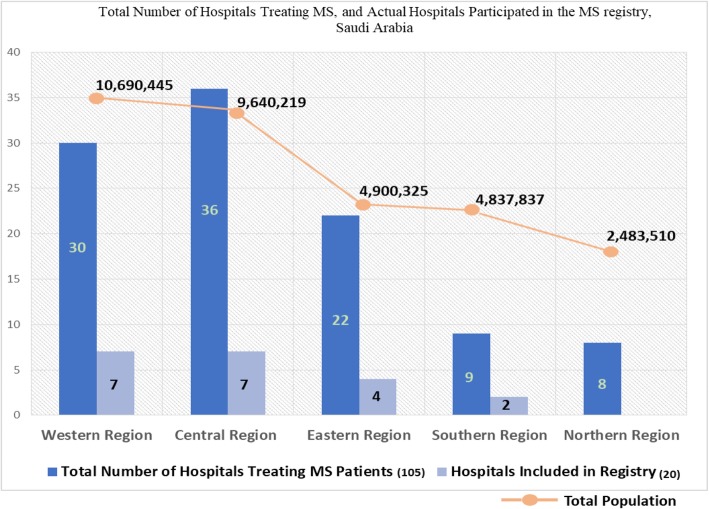
Method: In 2015, a national MS registry was launched in KSA to register all MS patient with confirmed diagnosis according to the 2010 McDonald Criteria. The registry aimed to identify and recruit all healthcare facilities treating MS patients in the Kingdom, and collect data such as demographics, clinical characteristics (disease onset, diagnosis, presentation of symptoms at onset, disease course, relapse rate, and disability measures), family history, and treatments. All the included sites have obtained IRB/EC approvals for participating in the registry. Currently, the registry includes 20 hospitals from different regions across the Kingdom. The Projected prevalence was calculated based on the assumption that the number of diagnosed MS cases in participating hospitals (in each region) is similar to the number of cases in remaining nonparticipant hospitals in the same region.
Results: As of September 2018, the registry has included 20 hospitals from the different regions across the Kingdom and has collected comprehensive data on 2516 patients from those hospitals, with median age 32 (Range: 11-63) and 66.5% being females. The reported prevalence of MS for those hospitals was estimated to be 7.70/100,000 population and 11.80/100,000 Saudi nationals. Based on the assumption made earlier, we projected the prevalence for each region and for the country as a whole. The overall prevalence of MS at the country level was reported to be 40.40/100,000 total population and 61.95/100,000 Saudi nationals. Around 3 out of every 4 patients (77.5%) were 40 years of age or younger. Female to male ratio was 2:1. The prevalence was higher among females, young and educated individuals across all five regions of Saudi Arabia.
Conclusion: The prevalence of MS has significantly increased in Saudi Arabia but is still much lower than that in the western and other neighboring countries like Kuwait, Qatar, and the UAE. However, compared to the past rates, Saudi Arabia's projected prevalence of MS through this national study is 40.40/100,000 population, putting the Kingdom above the low risk zone as per Kurtzke classification. The projected prevalence was estimated to be much higher among Saudi nationals (61.95/100,000 Saudi-nationals). The prevalence was higher among female, younger and educated individuals. Further studies are needed to assess the risk factors associated with increased prevalence in Saudi Arabia.
Keywords: Multiple sclerosis; Prevalence; Registry; Saudi Arabia.
Conflict of interest statement
The authors declare that they have no competing interests.
Figures
References
-
- Karikari TK, Charway-Felli A, Höglund K, Blennow K, Zetterberg H. Commentary: global, regional, and national burden of neurological disorders during 1990–2015: a systematic analysis for the global burden of disease study 2015. Front Neurol. 2018;9:201. doi: 10.3389/fneur.2018.00201. - DOI - PMC - PubMed
-
- Mulitple Sclerosis International Federation. What is MS? Available at: https://www.msif.org/about-ms/what-is-ms/. Accessed: 20 June 2019.
Publication types
MeSH terms
Grants and funding
LinkOut - more resources
Full Text Sources
Medical
Research Materials
Miscellaneous
