


Pacing in vasovagal syncope: Physiology, pacemaker sensors, and recent clinical trials-Precise patient selection and measurable benefit
- PMID: 32036025
- PMCID: PMC7196018
- DOI: 10.1016/j.hrthm.2020.01.029
Pacing in vasovagal syncope: Physiology, pacemaker sensors, and recent clinical trials-Precise patient selection and measurable benefit
Abstract
The role of pacing in vasovagal syncope (VVS) is considered from a physiological basis. Most VVS patients lose consciousness due to hypotension before severe bradycardia/asystole occurs. Patients who benefit from dual-chamber pacing typically are older with highly symptomatic, late-onset, frequent and severe syncope with short/no prodrome and documented severe cardioinhibition. Tilt testing is of value in patients with recurrent unexplained syncope to identify important hypotensive susceptibility stemming from reduced venous return and stroke volume (SV). A negative tilt test in vasovagal patients with spontaneous asystole documented by an implantable/insertable loop recorder is associated with lower syncope recurrence rates after pacemaker implantation. Pacing may be more effective if triggered by sensor detection of a parameter changing earlier in the reflex than bradycardia when SV may still be relatively preserved. In this regard, detection of right ventricular impedance offers promise. Conservatism is recommended, limiting pacing in VVS to a small subset of symptomatic older patients with clearly documented cardioinhibition and paying particular attention to the timing of loss of consciousness in relation to asystole/bradycardia. Understanding VVS physiology permits application of well-timed, appropriate pacing that yields benefit for highly symptomatic patients.
Keywords: Asystole; Cardioinhibition; Pacemaker; Vasodepression; Vasovagal syncope.
Copyright © 2020 Heart Rhythm Society. All rights reserved.
Conflict of interest statement
Conflicts of interest
AF consultant to Medtronic Inc; patent royalties from ThermoFisher Scientific (biomarkers in syncope), RS consultant to Medtronic Inc., member of Speakers' Bureau of Abbott Laboratories and shareholder in Boston Scientific Inc., Edwards Lifesciences Corp, and holds RDR patent in name only.
Figures
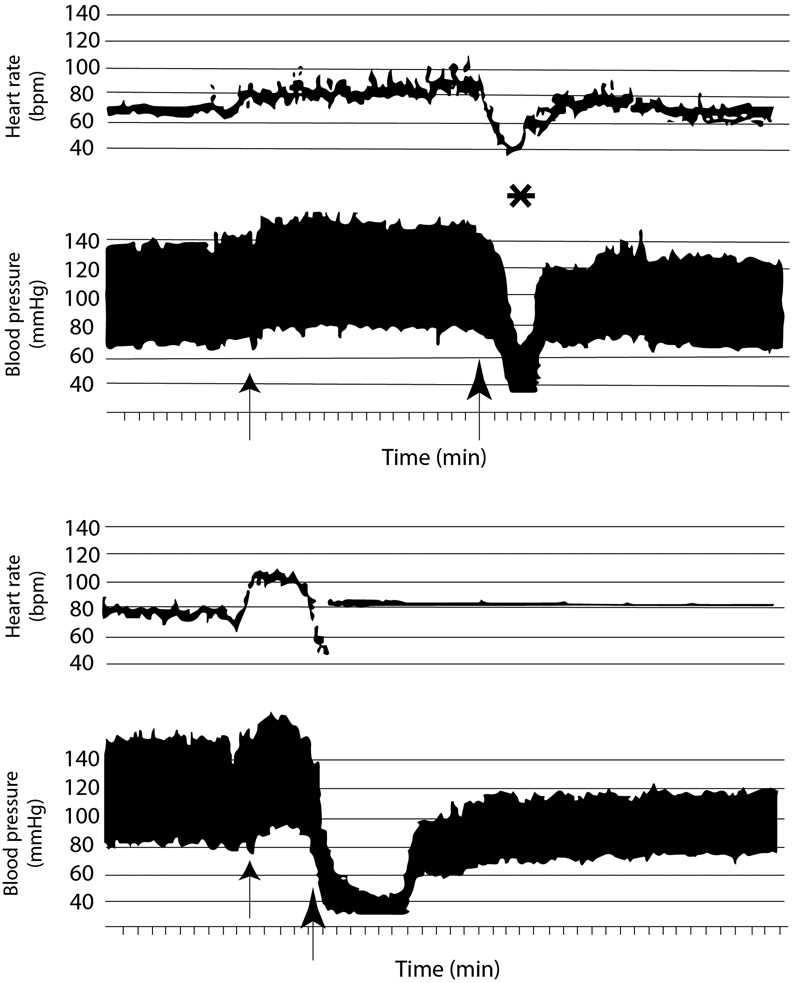
Comment in
-
Neurocardiogenic syncope: Pacemaker or cardioneuroablation?Heart Rhythm. 2020 May;17(5 Pt A):829-830. doi: 10.1016/j.hrthm.2020.02.026. Epub 2020 Feb 27. Heart Rhythm. 2020. PMID: 32113895 No abstract available.
References
-
- Brignole M, Moya A, Lange D et al. 2018 ESC Guidelines for the diagnosis and management of syncope. Eur Heart J. 2018. June 1;39(21): 1883–1948. - PubMed
-
- Saal DP, Thijs RD, van Zwet EW, Bootsma M, Brignole M, Benditt DG, van Dijk JG. Temporal relationship of asystole to onset of transient loss of consciousness in tilt-induced reflex syncope. JACC: Clin Electrophysiol 2017;3:1592–1598. - PubMed
-
- Benditt DG, Sutton R, Gammage MD, Markowitz T, Gorski J, Nygaard GA, Fetter J. Clinical experience with Thera DR rate-drop response pacing algorithm in carotid sinus syndrome and vasovagal syncope. The International Rate-Drop Investigators Group. Pacing Clin Electrophysiol 1997; 20: 832–839. - PubMed
-
- Kurbaan AS, Franzen AC, Stack Z, Heaven D, Mathur G, Sutton R. Determining the optimal pacing intervention rate for vasovagal syncope. J Interv Card Electrophysiol 2000;4:585–589. - PubMed
Publication types
MeSH terms
Grants and funding
LinkOut - more resources
Full Text Sources
