Review
. 2020 Apr:63:102-113.
doi: 10.1016/j.ceb.2020.01.001. Epub 2020 Feb 7.

Advances in elucidating the function of leucine-rich repeat protein kinase-2 in normal cells and Parkinson's disease

Affiliations
Review

Advances in elucidating the function of leucine-rich repeat protein kinase-2 in normal cells and Parkinson's disease

Matthew Taylor et al. Curr Opin Cell Biol. 2020 Apr.

Abstract

Autosomal dominant missense mutations that hyperactivate the leucine-rich repeat protein kinase-2 (LRRK2) are a common cause of inherited Parkinson's disease and therapeutic efficacy of LRRK2 inhibitors is being tested in clinical trials. In this review, we discuss the nuts and bolts of our current understanding of how the LRRK2 is misregulated by mutations and how pathway activity is affected by LRRK2 binding to membrane, microtubule filaments, and 14-3-3, as well as by upstream components such as Rab29 and VPS35. We discuss recent work that points toward a subset of Rab proteins comprising key physiological substrates that bind new sets of effectors, such as RILPL1/2, JIP3 and JIP4 after phosphorylation by LRRK2. We explore what is known about how LRRK2 regulates ciliogenesis, the endosomal-lysosomal system, immune responses and interplay with alpha-synuclein and tau and how this might be linked to Parkinson's' disease.

Keywords: Ciliogenesis; Lysosomal stress; Neuroinflammation; Protein kinase; RILPL1; Rab GTPase; Signal transduction.


Conflict of interest statement

Conflicts of interest statement Nothing declared.

Figures

Figure 1
Figure 1
LRRK2 structure, upstream regulation and pathogenic mutations. Schematic of LRRK2 domain structure. ARM, Armadillo; ANK, Ankyrin; LRR, Leucine-rich repeat; ROC, Ras of complex; COR, C-terminal of ROC; KIN, Kinase. Depicted are the clear-cut autophosphorylation site S1292 (Blue) and other phosphorylation sites S910, S935, S955, S973 (Purple) with S910/S935 mediating 14-3-3 binding. Familial Parkinson's disease pathogenic mutations (Red) indicated with the proposed pathological mechanism enhancing kinase activity. Upstream regulation of LRRK2 shown previously, including Rab29 recruitment to Golgi, possible LRRK2 recruitment by unknown Rabs (gray) to other organelle membranes or vesicles and the pathogenic VPS35[D620N] mutation. Dashed Lines indicate more-than-one step processes. LRRK2, leucine-rich repeat protein kinase-2.
Figure 2
Figure 2
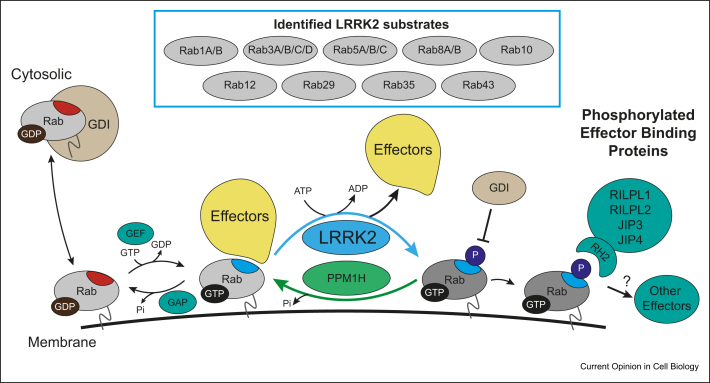
LRRK2-substrate Rab phosphorylation overview. Identified LRRK2-substrate Rabs (Rab1A/B, Rab3A/B/C/D, Rab5A/B/C, Rab8A/B, Rab10, Rab12, Rab29, Rab35, Rab43) are phosphorylated at a conserved serine/threonine residue within the Switch-II motif. Rab membrane association is via C-terminal prenylation. Guanine nucleotide exchange factor (GEF) mediated GDP–GTP exchange and activation leading to a conformational change in the Switch-II effector binding motif (red to blue) controls interaction with effectors. GTPase activating proteins (GAP) mediate Rab inactivation via GTP hydrolysis and subsequent recognition by guanine nucleotide dissociation inhibitor (GDI) triggers membrane dissociation to the cytosol. GTP-bearing Rabs interact with effector proteins to elicit downstream functions. LRRK2-mediated Rab phosphorylation leads to dissociation of most Switch-II binding effectors and promotes binding of a set of new phospho-dependent effectors through an RH2-domain [46]. PPM1H mediates selective, LRRK2-substrate Rab dephosphorylation (Rab3A/B/C/D, Rab8A/B, Rab10). RH2, RILP homology domain 2.
Figure 3
Figure 3
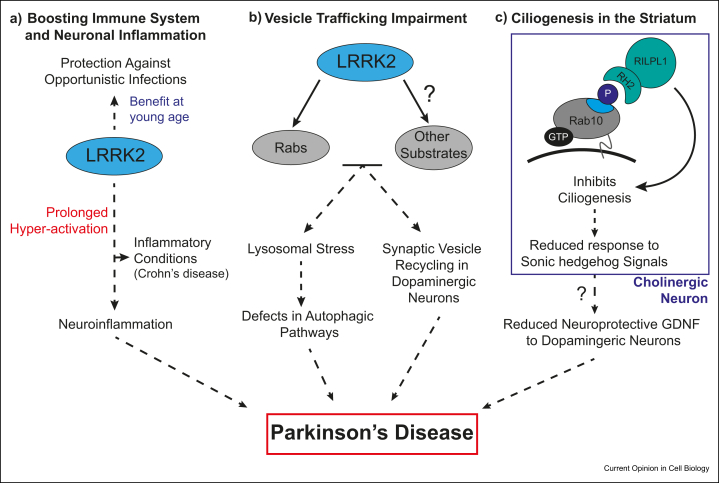
Proposed mechanisms linking LRRK2 with Parkinson's disease.(a). Pathogenic mutations enhancing LRRK2-mediated activity result in boosted immune responses to infectious pathogens. Prolonged hyperactivation may lead to neuroinflammation, increasing PD susceptibility and is linked to chronic inflammatory conditions, such as Crohn's disease. (b). LRRK2 is implicated in vesicular trafficking pathways by phosphorylation of Rabs and other key regulators in the endolysosome system. Dysregulation may lead to (1) lysosomal stress and subsequent defects in autophagic clearance pathways and (2) impaired synaptic vesicle recycling in dopaminergic neurons. (c) Elevated LRRK2-mediated activity increases phosphorylated Rab10 and in turn binding of RILPL1 in cholinergic interneurons of the dorsal striatum. This leads to ciliogenesis defects and decreased response to Sonic hedgehog signals from dopaminergic neurons of the substantia nigra. This results in the transmission of less neuroprotective GDNF (glial cell–derived neurotrophic factor) signaling to dopaminergic circuits under stress conditions. Dashed lines indicate a more-than-one step process. RILPL1, Rab interacting lysosomal-like protein 1; LRRK2, leucine-rich repeat protein kinase-2.

References

    1. Nukada H., Kowa H., Saitoh T., Tazaki Y., Miura S. [A big family of paralysis agitans (author's transl)] Rinsho Shinkeigaku. 1978;18:627–634. - PubMed
    1. Funayama M., Hasegawa K., Kowa H., Saito M., Tsuji S., Obata F. A new locus for Parkinson's disease (PARK8) maps to chromosome 12p11.2-q13.1. Ann Neurol. 2002;51:296–301. - PubMed
    1. Zimprich A., Biskup S., Leitner P., Lichtner P., Farrer M., Lincoln S., Kachergus J., Hulihan M., Uitti R.J., Calne D.B. Mutations in LRRK2 cause autosomal-dominant parkinsonism with pleomorphic pathology. Neuron. 2004;44:601–607. - PubMed
    1. Paisan-Ruiz C., Jain S., Evans E.W., Gilks W.P., Simon J., van der Brug M., Lopez de Munain A., Aparicio S., Gil A.M., Khan N. Cloning of the gene containing mutations that cause PARK8-linked Parkinson's disease. Neuron. 2004;44:595–600. - PubMed
    1. Funayama M., Hasegawa K., Ohta E., Kawashima N., Komiyama M., Kowa H., Tsuji S., Obata F. An LRRK2 mutation as a cause for the parkinsonism in the original PARK8 family. Ann Neurol. 2005;57:918–921. - PubMed

Publication types

MeSH terms

Substances