. 2020 Feb;99(2):725-733.
doi: 10.1016/j.psj.2019.12.002. Epub 2019 Dec 31.

The effects of dietary Bacillus subtilis supplementation, as an alternative to antibiotics, on growth performance, intestinal immunity, and epithelial barrier integrity in broiler chickens infected with Eimeria maxima

Affiliations

The effects of dietary Bacillus subtilis supplementation, as an alternative to antibiotics, on growth performance, intestinal immunity, and epithelial barrier integrity in broiler chickens infected with Eimeria maxima

Inkyung Park et al. Poult Sci. 2020 Feb.

Abstract

The objective of this study was to investigate the effects of dietary Bacillus subtilis supplementation on growth performance, jejunal lesion scores, oocyst shedding, and cytokine and tight junction protein expression in broiler chickens infected with Eimeria maxima. A total of 196 male day-old Ross 708 broilers were given a nonexperimental diet until 14 D of age. Then, all chickens were randomly assigned to one of seven dietary treatments: 2 basal diets (CON and NC); CON + virginiamycin (AB1); CON + bacitracin methylene disalicylate (BMD; AB2); CON + B. subtilis 1781 (PB1); CON + B. subtilis 747 (PB2); or CON + B. subtilis 1781 + 747 (PB3). At day 21, all chickens except those in the CON group were orally inoculated with E. maxima oocysts. At 7 D after E. maxima infection, the body weight gains of chickens fed PB2 and PB3 increased (P = 0.032) as much as those in chickens fed AB2. The body weight gain and feed efficiency of chickens fed PB2 were significantly increased (P < 0.001), and PB2 chickens showed (P = 0.005) the lowest lesion scores after E. maxima infection. Chickens fed PB2 showed (P < 0.05) lower mRNA expression of IL-1β in infected chicken groups. Chickens in the AB1, AB2, PB1, PB2, and PB3 groups showed (P < 0.05) greater mRNA expression of junctional adhesion molecule 2 in jejunal tissue, whereas occludin expression increased (P < 0.05) in the jejunal tissue of chickens fed AB2 or PB2. Dietary B. subtilis supplementation significantly improved the growth performance of young chickens to a level comparable with that induced by virginiamycin or BMD without E. maxima infection. After infection with E. maxima, dietary virginiamycin and BMD significantly enhanced the epithelial barrier integrity, and the dietary B. subtilis 747 showed significantly enhanced growth performance, intestinal immunity, and epithelial barrier integrity. Together our results indicated that certain strains of B. subtilis provide beneficial effects on the growth of young broiler chickens and have the potential to replace antibiotic growth promoters.

Keywords: Bacillus subtilis; Eimeria maxima; chicken; gut health; intestinal immunity.


Figures

Figure 1
Figure 1
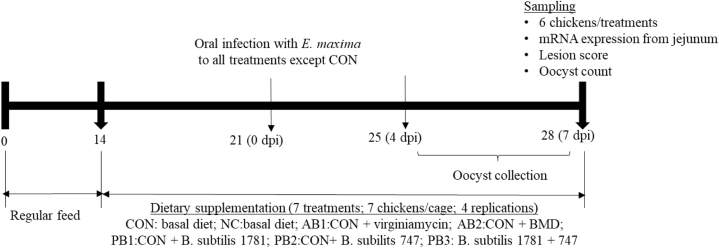
Schematic outline of the experimental design. Dpi: days postinfection. Abberviations: CON: basal diet; NC: basal diet; AB1; diet supplemented with virginiamycin at 20 g/ton (22 ppm); AB2: diet supplemented with BMD at 50 g/ton (55 ppm); PB1: diet supplemented with B. subtilis 1781; PB2: diet supplemented with B. subtilis 747; PB3: diet supplemented with B. subtilis 1781 + 747.
Figure 2
Figure 2
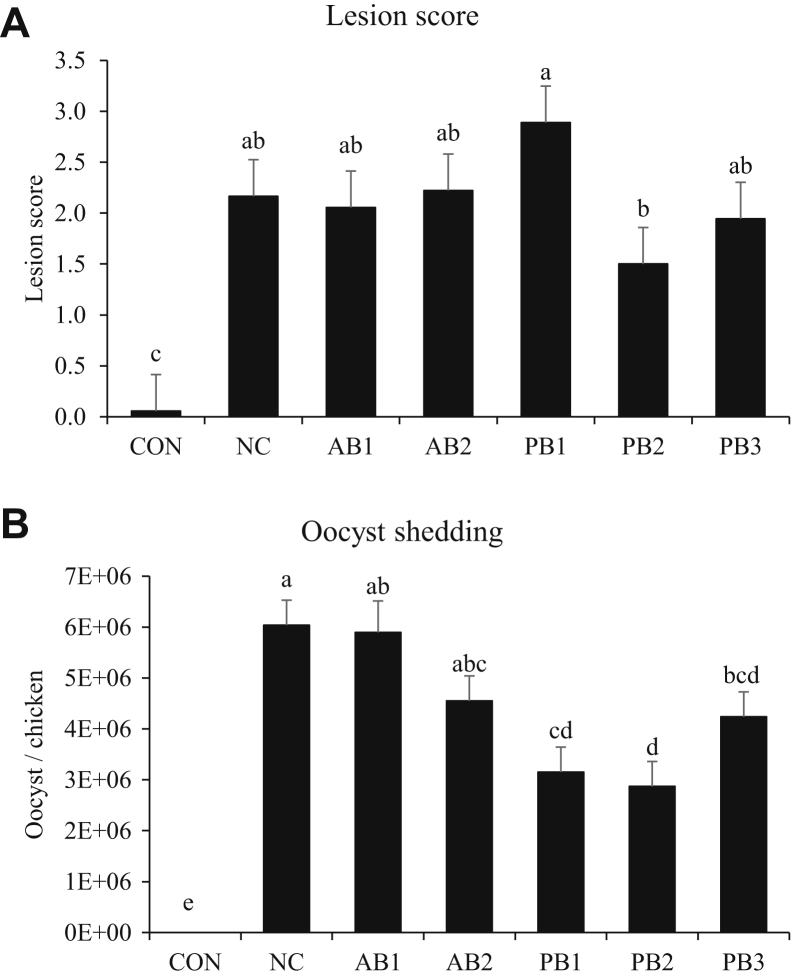
Lesion score and oocyst shedding of chickens fed diet supplemented with antibiotics or probiotics during infection with E. maxima. (A) Lesion score, (B) oocyst shedding. The dose of B. subtilis in treatment was 1.5 × 105 CFU/g feed. For PB3 (2-strain combination), each strain composed 50% of the total CFU count (each strain represents 7.5 × 104 CFU/g feed). All chickens except those fed CON were infected by oral gavage at day 21 with 1.0 × 104 oocysts/chicken of E. maxima. Bars with no common letter differ significantly (P < 0.05). The data were collected at day 28 (7 D postinfection) and were analyzed using Proc Mixed Procedure in SAS. Each bar represents the mean ± SEM (n = 6). Transcript levels of the cytokines were measured using quantitative RT-PCR and normalized to GAPDH transcript levels. Abberviations: CON: basal diet; NC: basal diet; AB1: diet supplemented with virginiamycin at 20 g/ton (22 ppm); AB2: diet supplemented with BMD at 50 g/ton (55 ppm); PB1: diet supplemented with B. subtilis 1781; PB2: diet supplemented with B. subtilis 747; PB3: diet supplemented with B. subtilis 1781 + 747; RT-PCR: real-time PCR.
Figure 3
Figure 3
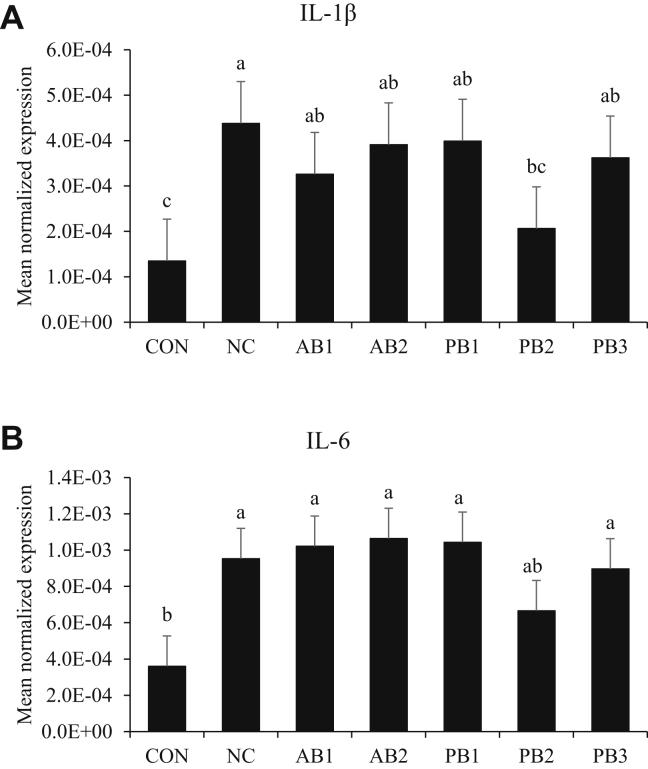
Transcripts of proinflammatory cytokines in the jejunum of chickens fed diet supplemented with antibiotics or probiotics during infection with E. maxima. (A) IL-1β, (B) IL-6. The dose of B. subtilis in treatment was 1.5 × 105 CFU/g feed. For PB3 (2-strain combination), each strain composed 50% of the total CFU count (each strain represents 7.5 × 104 CFU/g feed). All chickens except CON were infected by oral gavage at day 21 with 1.0 × 104 oocysts/bird of E. maxima. Bars with no common letter differ significantly (P < 0.05). Each bar represents the mean ± SEM (n = 6). The data were collected at day 28 (7 D postinfection) and were analyzed using Proc Mixed Procedure in SAS. Transcript levels of the cytokines were measured using quantitative RT-PCR and normalized to GAPDH transcript levels. Abberviations: CON: basal diet; NC: basal diet; AB1: diet supplemented with virginiamycin at 20 g/ton (22 ppm); AB2: diet supplemented with BMD at 50 g/ton (55 ppm); PB1: diet supplemented with B. subtilis 1781; PB2: diet supplemented with B. subtilis 747; PB3: diet supplemented with B. subtilis 0.1781 + 747.
Figure 4
Figure 4
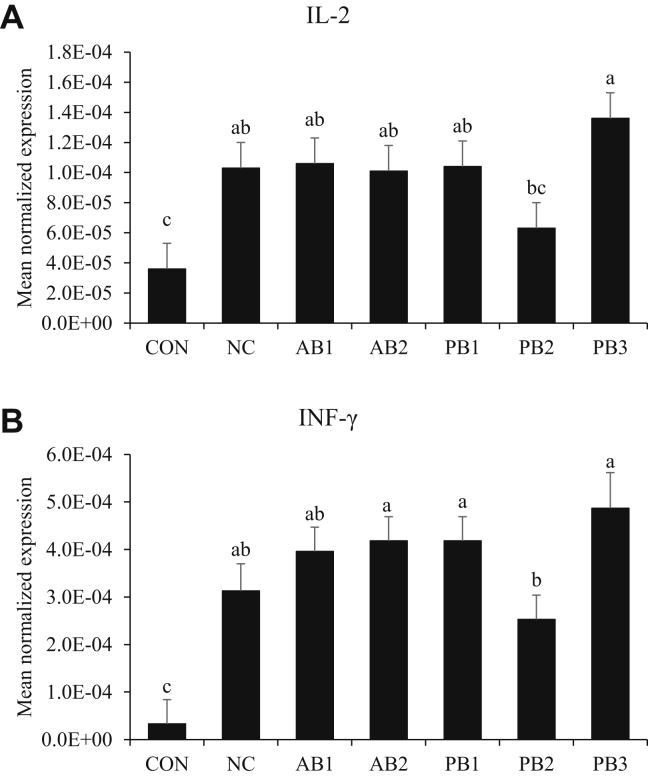
Transcripts of Th1 in the jejunum of chickens fed diet supplemented with antibiotics or probiotics during infection with E. maxima. (A) IL-2, (B) INF-γ. The dose of B. subtilis in treatment was 1.5 × 105 CFU/g feed. For PB3 (2-strain combination), each strain composed 50% of the total CFU count (each strain represents 7.5 × 104 CFU/g feed). All chickens except those fed CON were infected by oral gavage at day 21 with 1.0 × 104 oocysts/bird of E. maxima. Bars with no common letter differ significantly (P < 0.05). Each bar represents the mean ± SEM (n = 6). The data were collected at day 28 (7 D postinfection) and were analyzed using Proc Mixed Procedure in SAS. Transcript levels of the cytokines were measured using quantitative RT-PCR and normalized to GAPDH transcript levels. Abberviations: CON: basal diet; NC: basal diet; AB1: diet supplemented with virginiamycin at 20 g/ton (22 ppm); AB2: diet supplemented with BMD at 50 g/ton (55 ppm); PB1: diet supplemented with B. subtilis 1781; PB2: diet supplemented with B. subtilis 747; PB3: diet supplemented with B. subtilis 0.1781 + 747.
Figure 5
Figure 5
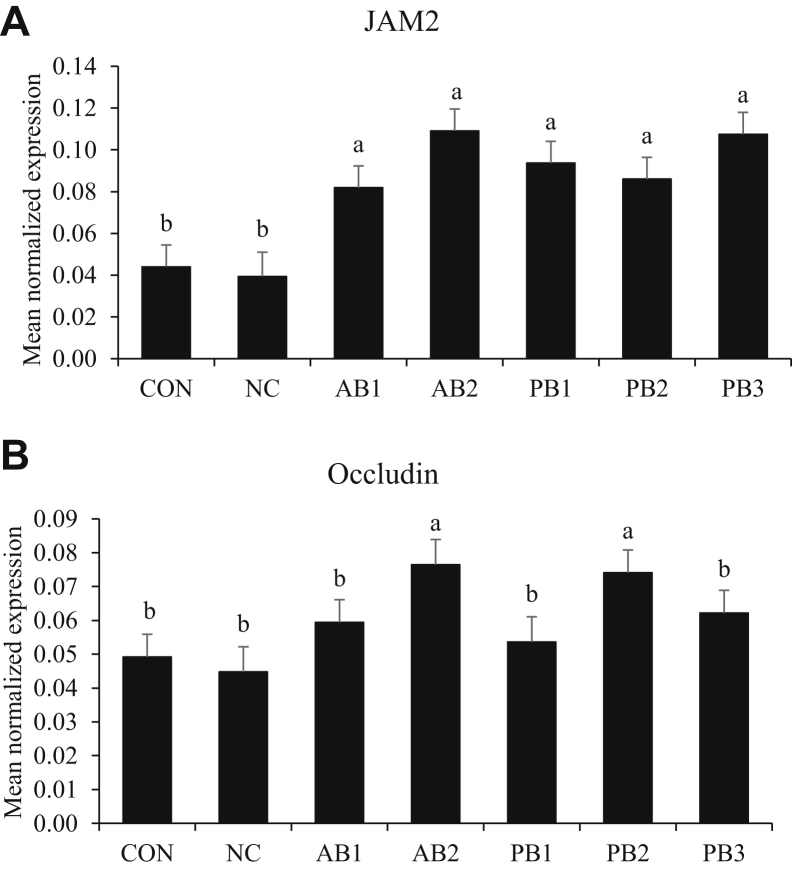
Transcripts of tight junction proteins in the jejunum of chickens fed diet supplemented with antibiotics or probiotics during infection with E. maxima. (A) JAM2, (B) occluding. The dose of B. subtilis in treatment was 1.5 × 105 CFU/g feed. For PB3 (2-strain combination), each strain composed 50% of the total CFU count (each strain represents 7.5 × 104 CFU/g feed). All chickens except those fed CON were infected by oral gavage at day 21 with 1.0 × 104 oocysts/bird of E. maxima. Bars with no common letter differ significantly (P < 0.05). Each bar represents the mean ± SEM (n = 6). The data were collected at day 28 (7 D postinfection) and were analyzed using Proc Mixed Procedure in SAS. Transcript levels of the tight junction proteins were measured using quantitative RT-PCR and normalized to GAPDH transcript levels. Abberviations: CON: basal diet; NC: basal diet; AB1: diet supplemented with virginiamycin at 20 g/ton (22 ppm); AB2: diet supplemented with BMD at 50 g/ton (55 ppm); PB1: diet supplemented with B. subtilis 1781; PB2: diet supplemented with B. subtilis 747; PB3: diet supplemented with B. subtilis 0.1781 + 747.

References

    1. Aliakbarpour H.R., Chamani M., Rahimi G., Sadeghi A.A., Qujeq D. The Bacillus subtilis and lactic acid bacteria probiotics influences intestinal mucin gene expression, histomorphology and growth performance in broilers. Asian Austral. J. Anim. 2012;25:1285–1293. - PMC - PubMed
    1. Al-Sadi R., Khatib K., Guo S., Ye D., Youssef M., Ma T. Occludin regulates macromolecule flux across the intestinal epithelial tight junction barrier. Am. J. Physiol. Gastrointest. Liver Physiol. 2011;300:G1054–G1064. - PMC - PubMed
    1. Broom L.J., Kogut M.H. Inflammation: friend or foe for animal production? Poult. Sci. 2018;97:510–514. - PubMed
    1. Chan G., Guthrie A., Sivaramalingam T., Wilson J., Vancraeynest D., Moody R., Clark S. A framework for assessing the efficacy of antimicrobials in the control of necrotic enteritis in broiler chickens. J. Appl. Poult. Res. 2015;24:246–256.
    1. Combs G.F., Bossard E.H. Comparison of growth response of chicks to virginiamycin and other antibiotics. Poult. Sci. 1963;42:681–685.

Publication types