. 2020 Jul 29;29(12):1986-1995.
doi: 10.1093/hmg/ddaa021.

Identification and activity of the functional complex between hnRNPL and the pseudoexfoliation syndrome-associated lncRNA, LOXL1-AS1

Affiliations

Identification and activity of the functional complex between hnRNPL and the pseudoexfoliation syndrome-associated lncRNA, LOXL1-AS1

Heather M Schmitt et al. Hum Mol Genet. .

Abstract

Individuals with pseudoexfoliation (PEX) syndrome exhibit various connective tissue pathologies associated with dysregulated extracellular matrix homeostasis. PEX glaucoma is a common, aggressive form of open-angle glaucoma resulting from the deposition of fibrillary material in the conventional outflow pathway. However, the molecular mechanisms that drive pathogenesis and genetic risk remain poorly understood. PEX glaucoma-associated single-nucleotide polymorphisms are located in and affect activity of the promoter of LOXL1-AS1, a long non-coding RNA (lncRNA). Nuclear and non-nuclear lncRNAs regulate a host of biological processes, and when dysregulated, contribute to disease. Here we report that LOXL1-AS1 localizes to the nucleus where it selectively binds to the mRNA processing protein, heterogeneous nuclear ribonucleoprotein-L (hnRNPL). Both components of this complex are critical for the regulation of global gene expression in ocular cells, making LOXL1-AS1 a prime target for investigation in PEX syndrome and glaucoma.


Figures

Figure 1
Figure 1
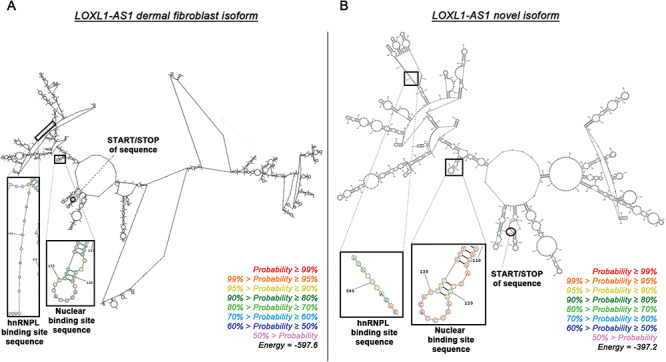
Predicted secondary structures of the LOXL1-AS1 isoforms. (A) The known isoform of LOXL1-AS1 (ENST00000566011) found in dermal fibroblast cells contains two more introns of sequence, and therefore has a vastly different predicted conformation from (B) the novel isoform of LOXL1-AS1 that is found in many major organ and ocular tissues. Individual nucleotides are colored based on the probability of forming the illustrated secondary structure. The overall illustrations are the predicted secondary structures based on the lowest free energy (Joules) required to create covalent bonds.
Figure 2
Figure 2
LOXL1-AS1 localizes to the nucleus in human embryonic kidney (HEK293) cells. (A) The nuclear localization motif and corresponding sequence in LOXL1-AS1 (red). (B–I) Immunofluorescence microscopy of HEK293 cells with fluorescence in situ hybridization (FISH) control and LOXL1-AS1-targeted FITC probes (green), DAPI nuclear labeling (blue) and GAPDH-TRITC cytoplasmic labeling (red). (J) Box and whisker plot showing fluorescence quantification of nuclear and cytoplasmic FITC fluorescence quantification indicates significantly higher nuclear localization of LOXL1-AS1 P = 0.0139. n = 4 biological replicates. Each data point is the average of cell compartment fluorescence measurements from 15 individual cells within one biological replicate. Student’s t-value (t) = 8.455. Degrees of freedom (df) = 73.54. Scale bar, 10 μm.
Figure 3
Figure 3
LOXL1-AS1 binds hnRNPL via the CANACA binding motif in immortalized human lens (HLE-B3) cells. (A) Western blot analysis showing hnRNPL protein specifically bound to LOXL1-AS1 and not control lncRNA after streptavidin immunoprecipitation. (B) Western blot analysis of non-specific binding of ERF3a to LOXL1-AS1 and control lncRNA. (C) Immunoprecipitation of endogenous hnRNPL from nuclear extract of HLE-B3 cells with (D) RT-qPCR quantitation of endogenous LOXL1-AS1 in complex. P = 0.0297. n = 4 biological replicate HLE-B3 cell samples. Each data point represents the mean of technical triplicate qPCR reactions. t = 2.05. df = 3.268 (E) Canonical hnRNPL binding motif and the overlapping repeat region within the LOXL1-AS1 sequence. Western blot analysis shows recombinant hnRNPL binding to WT, not Δ14-LOXL1-AS1, and quantitation of (F) WT and Δ14-LOXL1-AS1 bound to hnRNPL indicates significantly more WT LOXL1-AS1 bound to hnRNPL P = 0.0457. n = 3 biological replicate HLE-B3 cell samples. Each data point is the mean of technical triplicate qPCR reactions. t = 2.813. df = 2.102.
Figure 4
Figure 4
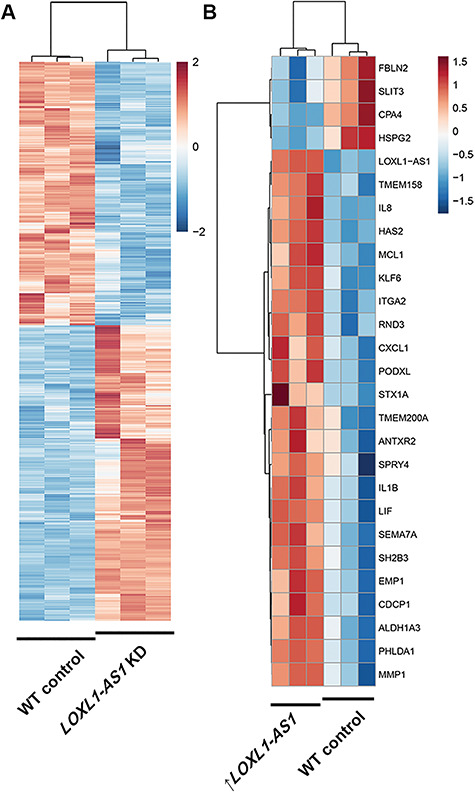
Alteration of LOXL1-AS1 lncRNA expression dysregulates downstream gene targets in immortalized HLE-B3 cells. RNAseq analysis heat maps with z-score thresholds set to +2 and − 2 for knockdown experiments and thresholds set to +1.5- and −1.5-fold change for overexpression experiments. (A) Knockdown of LOXL1-AS1 (log2FC = −2.45, P = 3.22 × 10−136) using a targeted siRNA leads to significant differential expression of over 450 gene targets in HLE-B3 cells. n = 3 biological replicate HLE-B3 samples per control or siRNA treatment. (B) Overexpression of LOXL1-AS1 also leads to significant changes in the expression of 27 genes. n = 3 biological replicate HLE-B3 samples per control or overexpression plasmid transfection treatment.
Figure 5
Figure 5
Illustration of LOXL1-AS1/hnRNPL complex gene regulation. Schematic of gene expression regulation by the LOXL1-AS1/hnRNPL complex. LOXL1-AS1 binds hnRNPL via the CANACA binding motif to regulate downstream gene expression.

References

    1. Aboobakar I.F., Johnson W.M., Stamer W.D., Hauser M.A. and Allingham R.R. (2017) Major review: exfoliation syndrome; advances in disease genetics, molecular biology, and epidemiology. Exp. Eye Res., 154, 88–103. - PubMed
    1. Schlötzer-Schrehardt U. (2009) Molecular pathology of pseudoexfoliation syndrome/glaucoma--new insights from LOXL1 gene associations. Exp. Eye Res., 88, 776–785. - PubMed
    1. Johnson W.M., Finnegan L.K., Hauser M.A. and Stamer W.D. (2018) lncRNAs, DNA methylation, and the pathobiology of exfoliation glaucoma. J. Glaucoma, 27, 202–209. - PubMed
    1. Quigley H.A. (1996) Number of people with glaucoma worldwide. Br. J. Ophthalmol., 80, 389–393. - PMC - PubMed
    1. Ritch R. and Schlotzer-Schrehardt U. (2001) Exfoliation syndrome. Surv. Ophthalmol., 45, 265–315. - PubMed

Publication types

MeSH terms