. 2020 Sep;62(6):768-782.
doi: 10.1002/dev.21950. Epub 2020 Feb 9.

Hair cortisol in pregnancy interacts with maternal depressive symptoms to predict maternal disrupted interaction with her infant at 4 months

Affiliations

Hair cortisol in pregnancy interacts with maternal depressive symptoms to predict maternal disrupted interaction with her infant at 4 months

Jennifer E Khoury et al. Dev Psychobiol. 2020 Sep.

Abstract

Disrupted maternal interaction in early infancy is associated with maladaptive child outcomes. Thus, identifying early risk factors for disrupted interaction is an important challenge. Research suggests that maternal depressive symptoms and maternal cortisol dysregulation are associated with disrupted maternal interaction, but both factors have rarely been considered together as independent or interactive predictors of disrupted interaction. In a sample of 51 women, hair cortisol concentrations (HCC) and depressive symptoms were assessed during pregnancy, and depressive symptoms were assessed again at 4-month postpartum. Maternal disrupted interaction was assessed during the Still-Face Paradigm at 4 months. Results indicated that HCC and depressive symptoms interacted to predict both maternal withdrawing and inappropriate/intrusive interaction. Withdrawing interaction was associated with high levels of HCC in pregnancy in the context of high depressive symptoms at 4 months; inappropriate/intrusive interaction was associated with high levels of HCC in the context of low depressive symptoms. Thus, high HCC potentiated both forms of disrupted interaction. Results raised questions about the meaning of very low reported depressive symptoms, and underscored the importance of chronic stress physiology and maternal depressed mood as risk factors for distinct forms of maternal disrupted interaction, both of which are deleterious for infant development.

Keywords: Still-Face Paradigm; disrupted maternal interaction; hair cortisol; maternal depressive symptoms; perinatal period.


Figures

FIGURE 1
FIGURE 1
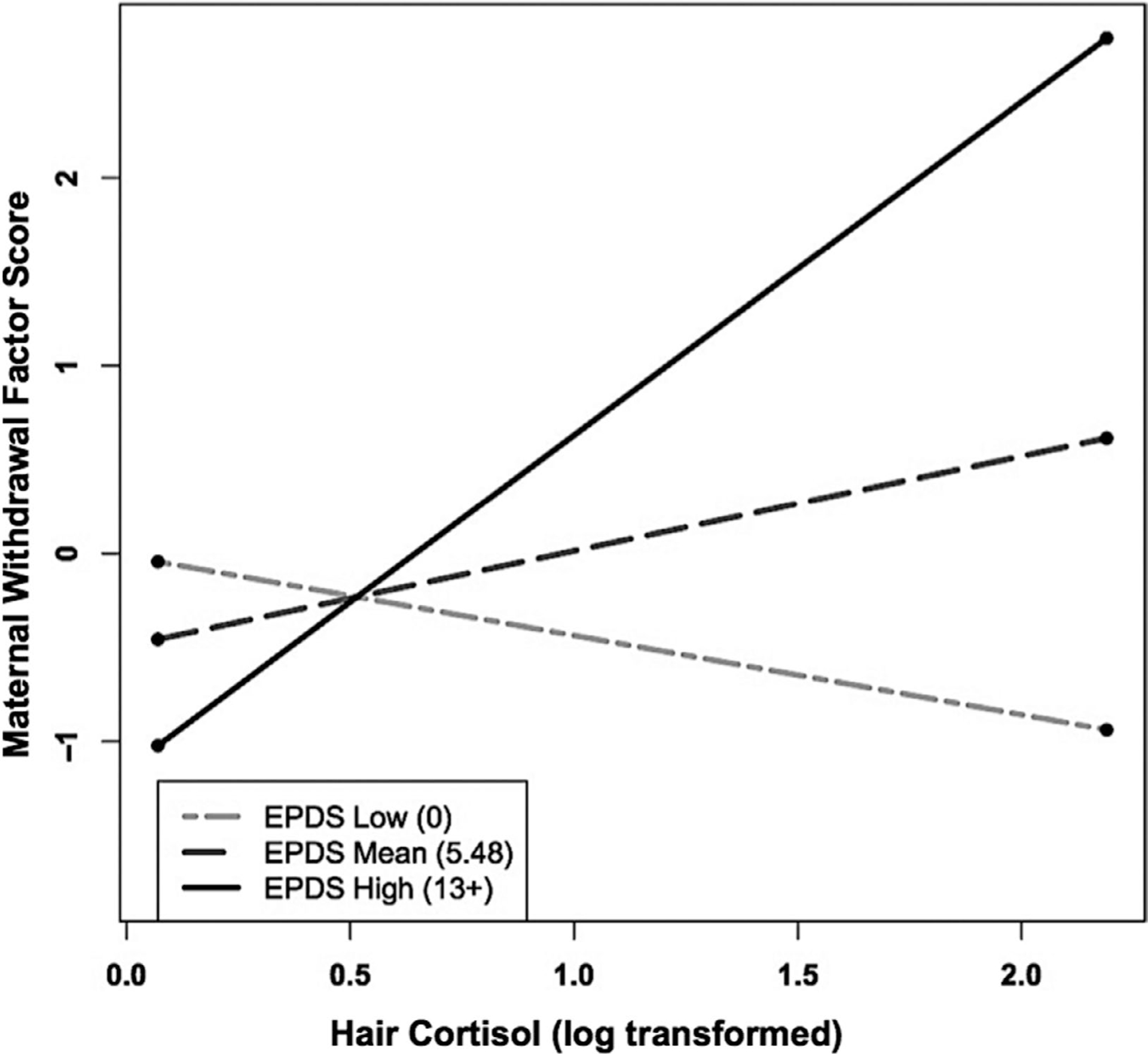
Maternal depressive symptoms at infant age 4 months moderates the relation between maternal hair cortisol concentration (HCC) in pregnancy and maternal withdrawing behavior during the Still-Face Paradigm at infant age 4 months. As shown, mothers who endorsed greater postpartum depressive symptoms (EPDS high) and had higher HCC displayed relatively greater Withdrawing interaction behaviors, whereas mothers who endorsed lower postpartum depressive symptoms (EPDS low) and had higher HCC displayed relatively low levels of Withdrawing interaction behaviors. Only the simple slope of the high depressive symptoms group was significantly different from zero. The slopes of the high depressive symptoms group and the low depressive symptoms group were significantly different from each other
FIGURE 2
FIGURE 2
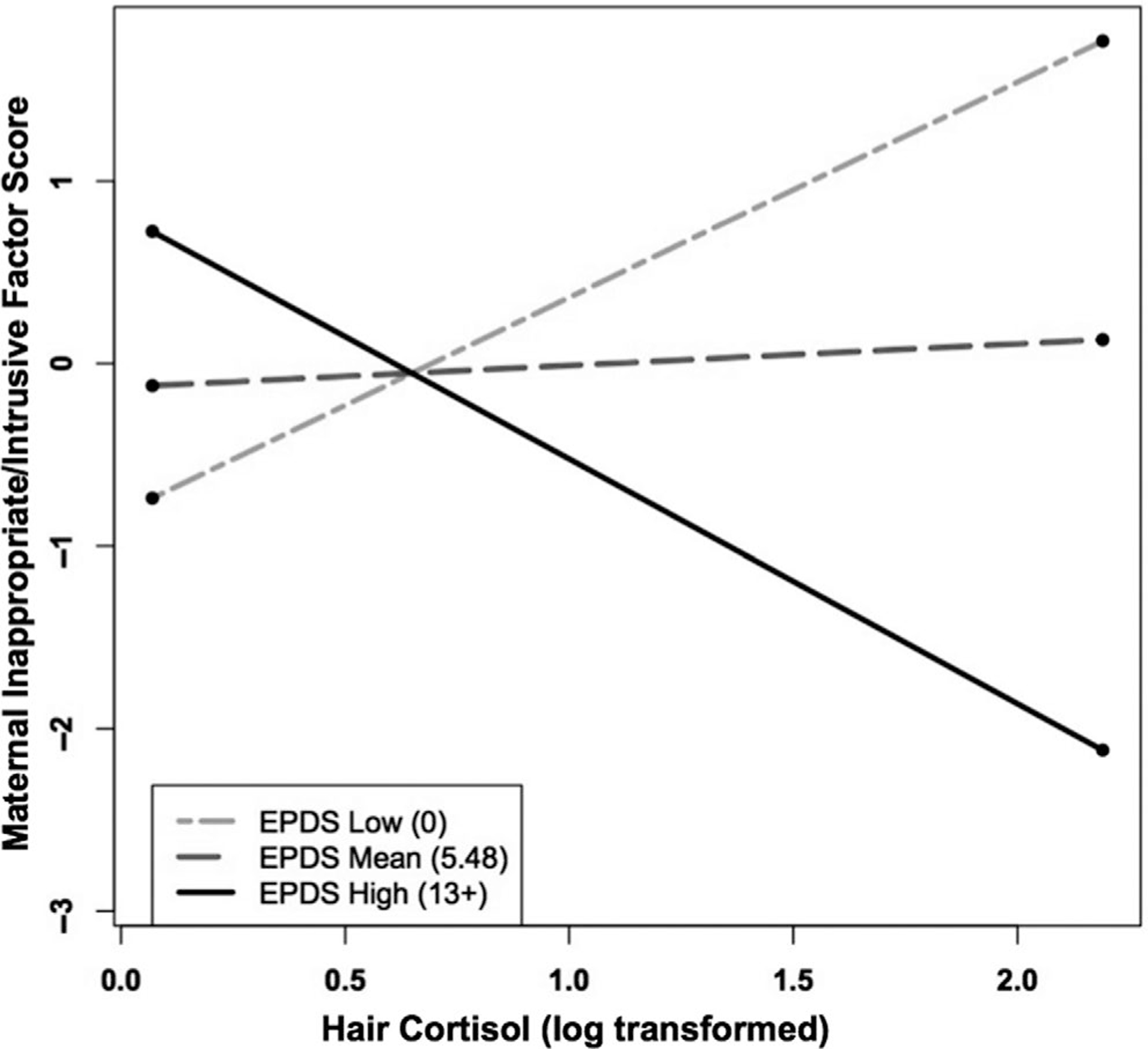
Maternal depressive symptoms at infant age 4 months moderates the relation between maternal hair cortisol concentration (HCC) in pregnancy and maternal inappropriate/intrusive interaction during the Still-Face Paradigm at infant age 4 months. As shown, mothers who endorsed greater postpartum depressive symptoms (EPDS high) and who had higher HCC displayed relatively low levels of Inappropriate/Intrusive interaction behaviors, whereas mothers who endorsed lower postpartum depressive symptoms (EPDS low) and had higher HCC displayed relatively high levels of Inappropriate/Intrusive interaction behaviors. Only the simple slope of the low depressive symptoms group was significantly different from zero. The slopes of the high depressive symptoms group and the low depressive symptoms

References

    1. Allen TA, Oshri A, Rogosch FA, Toth SL, & Cicchetti D (2019). Offspring personality mediates the association between maternal depression and childhood psychopathology. Journal of Abnormal Child Psychology, 47(2), 345–357. 10.1007/s10802-018-0453-3 - DOI - PMC - PubMed
    1. Alpern L, & Lyons-Ruth K (1993). Preschool children at social risk: Chronicity and timing of maternal depressive symptoms and child behavior problems at school and at home. Development and Psychopathology, 5, 369–385. 10.1017/S0954579400004478 - DOI
    1. Atkinson L, Paglia A, Coolbear J, Niccols A, Parker KC, & Guger S (2000). Attachment security: A meta-analysis of maternal mental health correlates. Clinical Psychology Review, 20(8), 1019–1040. 10.1016/S0272-7358(99)00023-9 - DOI - PubMed
    1. Barrett J, & Fleming AS (2010). Annual Research Review: All mothers are not created equal: Neural and psychobiological perspectives on mothering and the importance of individual differences. Journal of Child Psychology and Psychiatry, 52(4), 368–397. 10.1111/j.1469-7610.2010.02306.x - DOI - PubMed
    1. Bell AF, Carter CS, Davis JM, Golding J, Adejumo O, Pyra M, … Rubin LH (2016). Childbirth and symptoms of postpartum depression and anxiety: A prospective birth cohort study. Archives of Women’s Mental Health, 19(2), 219–227. 10.1007/s00737-015-0555-7 - DOI - PMC - PubMed

Publication types