. 2020 Jan 22:10:1410.
doi: 10.3389/fneur.2019.01410. eCollection 2019.

Epidemiology of Pediatric Traumatic Brain Injury and Hypothalamic-Pituitary Disorders in Arizona

Affiliations

Epidemiology of Pediatric Traumatic Brain Injury and Hypothalamic-Pituitary Disorders in Arizona

J Bryce Ortiz et al. Front Neurol. .

Abstract

Traumatic brain injury (TBI) in children can result in long-lasting social, cognitive, and neurological impairments. In adults, TBI can lead to endocrinopathies (endocrine system disorders), but this is infrequently reported in children. Untreated endocrinopathies can elevate risks of subsequent health issues, such that early detection in pediatric TBI survivors can initiate clinical interventions. To understand the risk of endocrinopathies following pediatric TBI, we identified patients who had experienced a TBI and subsequently developed a new-onset hypothalamic regulated endocrinopathy (n = 498). We hypothesized that pediatric patients who were diagnosed with a TBI were at higher risk of being diagnosed with a central endocrinopathy than those without a prior diagnosis of TBI. In our epidemiological assessment, we identified pediatric patients enrolled in the Arizona Health Care Cost Containment System (AHCCCS) from 2008 to 2014 who were diagnosed with one of 330 TBI International Classification of Diseases (ICD)-9 codes and subsequently diagnosed with one of 14 central endocrinopathy ICD-9 codes. Additionally, the ICD-9 code data from over 600,000 Arizona pediatric patients afforded an estimate of the incidence, prevalence, relative risk, odds ratio, and number needed to harm, regarding the development of a central endocrinopathy after sustaining a TBI in Arizona Medicaid pediatric patients. Children with a TBI diagnosis had 3.22 times the risk of a subsequent central endocrine diagnosis compared with the general population (±0.28). Pediatric AHCCCS patients with a central endocrine diagnosis had 3.2-fold higher odds of a history of a TBI diagnosis than those without an endocrine diagnosis (±0.29). Furthermore, the number of patients with a TBI diagnosis for one patient to receive a diagnosis of a central endocrine diagnosis was 151.2 (±6.12). Female subjects were more likely to present with a central endocrine diagnosis after a TBI diagnosis compared to male subjects (64.1 vs. 35.9%). These results are the first state-wide epidemiological study conducted to determine the risk of developing a hypothalamic-pituitary disorder after a TBI in the pediatric population. Our results contribute to a body of knowledge demonstrating a TBI etiology for idiopathic endocrine disorders, and thus advise physicians with regard to TBI follow-up care that includes preventive screening for endocrine disorders.

Keywords: adolescence; concussion; endocrine dysfunction; head injury; hypopituitarism; pediatrics; puberty; traumatic brain injury.


Figures

Figure 1
Figure 1
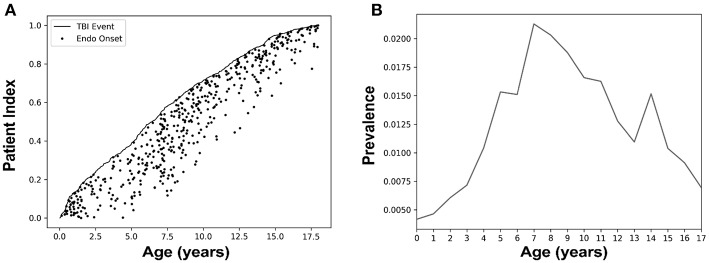
Pediatric patients with a traumatic brain injury (TBI) who were diagnosed with a hypothalamic-pituitary disorder showed the highest prevalence in ages 7–11. (A) Patients (n = 498) with a TBI and subsequent endocrine diagnosis were indexed by age. Here, we sorted all patients of our group of interest by age with patient index referring to the fraction of the total. The black line represents the age of each patient when they were diagnosed with a TBI, and the dot tracking along the x-axis from the line indicates the subsequent onset of their first endocrine diagnosis. (B) Prevalence of an endocrine diagnosis after a TBI stratified by age at the endocrine diagnosis. Here, prevalence was calculated as the number of TBI patients with an endocrine diagnosis divided by those TBI patients without an endocrine. Children aged 7–11 years had the highest prevalence of an endocrine disorder diagnosis after a TBI diagnosis compared to other age groups.
Figure 2
Figure 2
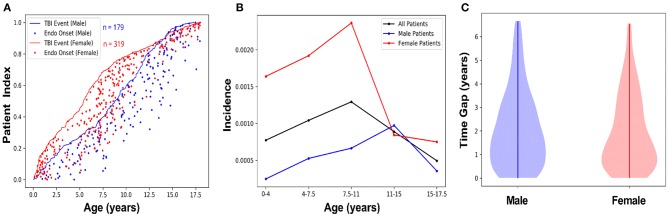
Female subjects show a higher incidence, and an early age of onset, of hypothalamic-pituitary disorder following TBI compared to male subjects. (A) Male and female patients with a TBI diagnosis and subsequent endocrine diagnosis were indexed by age, as a fraction of the total number of subjects in each group. The lines represent male (n = 179; blue) and female (n = 319; red) age of each patient when they were diagnosed with a TBI, and the dots tracking along the x-axis from the line indicate male (blue) and female (red) age at the time of their first endocrine diagnosis. (B) Endocrine diagnosis incidence rates after TBI were calculated for male/female patients in blocks of 4-year age groups, with children older than 0 and ≤ 4 years old in the first block, followed by children >4 years old and ≤ 7.5 years old in the second block, etc. Female subjects diagnosed with a TBI (red line) were more likely to have a central endocrine diagnosis at an earlier age compared with male subjects diagnosed with a TBI (blue line). The overall incidence of endocrine dysfunction peaked between ages 7 and 11. This is driven by the higher overall incidence of post-TBI endocrine diagnoses in female patients, compared to male patients, whose incidence peaks between ages 11 and 15. Incidence rate was calculated as the number of new cases per year of endocrine diagnoses in TBI patients divided by the cumulative population of TBI patients. (C) Data stratified by male/female indicated female patients showed a shorter time gap between diagnosis of TBI and subsequent endocrine diagnosis compared with male subjects, but not necessarily reflect the onset of undiagnosed symptoms.

References

    1. Faul M, Wald MM, Xu L, Coronado VG. Traumatic Brain Injury in the United States; Emergency Department Visits, Hospitalizations, and Deaths 2002–2006. Atlanta, GA: Centers for Disease Control and Prevention, National Center for Injury Prevention and Control; (2010).
    1. Babikian T, Merkley T, Savage RC, Giza CC, Levin H. Chronic aspects of pediatric traumatic brain injury: review of the literature. J Neurotrauma. (2015) 32:1849–60. 10.1089/neu.2015.3971 - DOI - PubMed
    1. Catroppa C, Anderson VA, Morse SA, Haritou F, Rosenfeld JV. Outcome and predictors of functional recovery 5 years following pediatric traumatic brain injury (TBI). J Pediatr Psychol. (2008) 33:707–18. 10.1093/jpepsy/jsn006 - DOI - PubMed
    1. Catroppa C, Godfrey C, Rosenfeld JV, Hearps SS, Anderson VA. Functional recovery ten years after pediatric traumatic brain injury: outcomes and predictors. J Neurotrauma. (2012) 29:2539–47. 10.1089/neu.2012.2403 - DOI - PubMed
    1. Currie J, Widom CS. Long-term consequences of child abuse and neglect on adult economic well-being. Child Maltreat. (2010) 15:111–20. 10.1177/1077559509355316 - DOI - PMC - PubMed

LinkOut - more resources