Review
. 2020 Jan 21:10:3137.
doi: 10.3389/fimmu.2019.03137. eCollection 2019.

Extracellular Vesicles in Glioblastoma Tumor Microenvironment

Affiliations
Review

Extracellular Vesicles in Glioblastoma Tumor Microenvironment

Anuroop Yekula et al. Front Immunol. .

Abstract

Glioblastomas (GBM) are highly aggressive primary brain tumors. Complex and dynamic tumor microenvironment (TME) plays a crucial role in the sustained growth, proliferation, and invasion of GBM. Several means of intercellular communication have been documented between glioma cells and the TME, including growth factors, cytokines, chemokines as well as extracellular vesicles (EVs). EVs carry functional genomic and proteomic cargo from their parental cells and deliver that information to surrounding and distant recipient cells to modulate their behavior. EVs are emerging as crucial mediators of establishment and maintenance of the tumor by modulating the TME into a tumor promoting system. Herein we review recent literature in the context of GBM TME and the means by which EVs modulate tumor proliferation, reprogram metabolic activity, induce angiogenesis, escape immune surveillance, acquire drug resistance and undergo invasion. Understanding the multifaceted roles of EVs in the niche of GBM TME will provide invaluable insights into understanding the biology of GBM and provide functional insights into the dynamic EV-mediated intercellular communication during gliomagenesis, creating new opportunities for GBM diagnostics and therapeutics.

Keywords: angiogenesis; extracellular vesicles; glioblastoma; immunomodulation; tumor microenvironment.


Figures

Figure 1
Figure 1
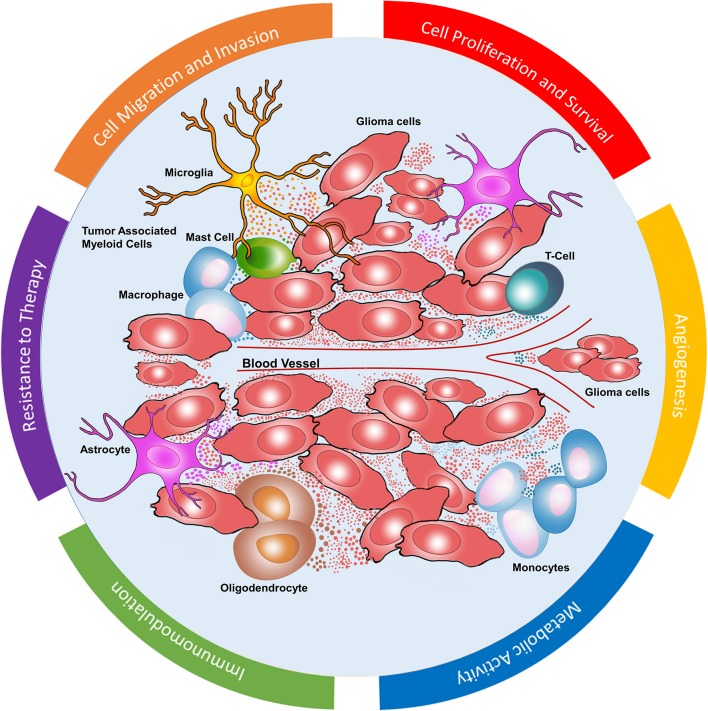
Glioblastoma microenvironment. Dynamic EV mediated communication between glioma cells and stromal cells including monocytes, macrophages, mast cells, microglia, T cells, astrocytes, and oligodendrocytes. EVs in GBM microenvironment mediate cell proliferation and survival, angiogenesis, metabolic activity, immunomodulation, resistance to chemoradiation as well as cell migration and invasion.
Figure 2
Figure 2
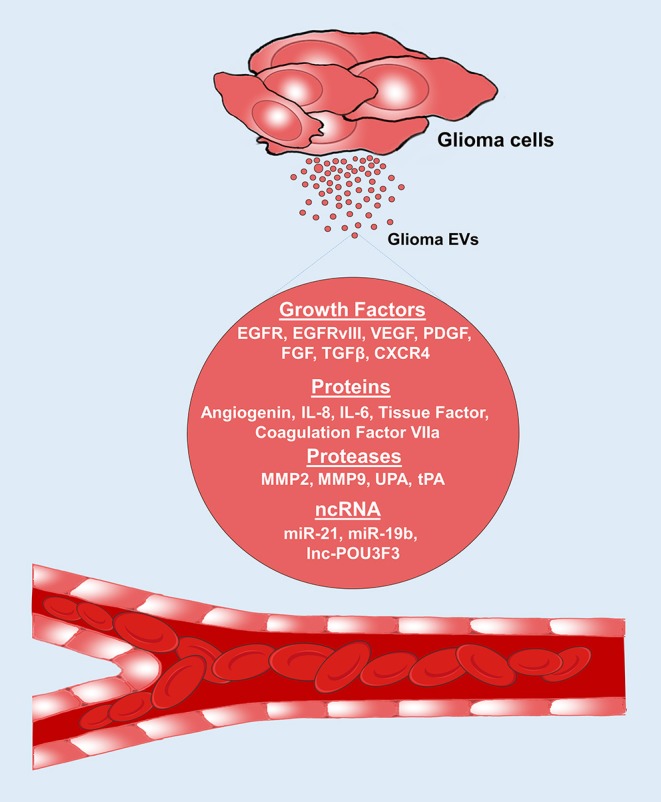
Glioma EVs promote angiogenesis. Glioma EVs contain several proangiogenic factors which induce angiogenesis. EGFR, epidermal growth factor receptor; VEGF, vascular endothelial growth factor; PDGF, platelet derived growth factor, FGF, fibroblast growth factor; TGF-β, Transforming growth factor-β; IL-8, interleukin-8; IL-6, interleukin-6; CXCR4, CXC chemokine receptor type 4; MMP2, matrix metalloproteinase 2; MMP9, matrix metalloproteinase 9; UPA, urokinase type-plasminogen activator; tPA, tissue type-plasminogen activator.
Figure 3
Figure 3
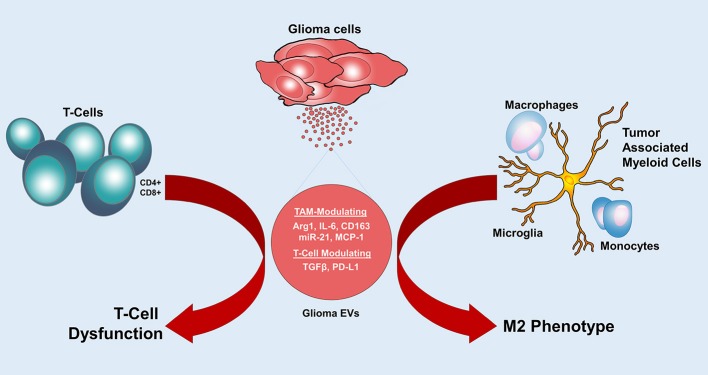
Glioma EVs mediate immunomodulation. Glioma EVs induce an M2 phenotype in tumor associated myeloid cells and cause T cell dysfunction. Arg1, arginase-1; IL-6, interleukin-6; MCP-1, monocyte chemoattractant protein 1; TGF-β, Transforming growth factor-β; PD-L1, programmed cell death 1 ligand.
Figure 4
Figure 4
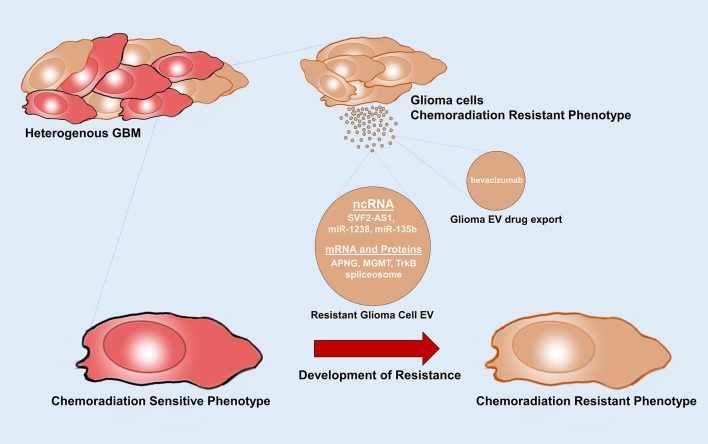
Glioma EVs mediate therapy resistance. Glioma EVs mediate the transfer of factors that induce a chemoradiation resistance phenotype in chemoradiation sensitive glioma cells. Glioma EVs also mediate drug export. APNG, alkyl purine-DNA-N-glycosylase; MGMT, O(6)-methylguanine DNA methyltransferase.

References

    1. Ostrom QT, Gittleman H, Xu J, Kromer C, Wolinsky Y, Kruchko C, et al. . CBTRUS statistical report: primary brain and other central nervous system tumors diagnosed in the United States in 2009–2013. Neuro-Oncol. (2016) 18:v1–75. 10.1093/neuonc/now207 - DOI - PMC - PubMed
    1. Abels ER, Broekman MLD, Breakefield XO, Maas SLN. Glioma EVs contribute to immune privilege in the brain. Trends Cancer Res. (2019) 5:393–6. 10.1016/j.trecan.2019.05.006 - DOI - PMC - PubMed
    1. Broekman ML, Maas SLN, Abels ER, Mempel TR, Krichevsky AM, Breakefield XO. Multidimensional communication in the microenvirons of glioblastoma. Nat Rev Neurol. (2018) 14:482–95. 10.1038/s41582-018-0025-8 - DOI - PMC - PubMed
    1. Han L, Lam EW, Sun Y. Extracellular vesicles in the tumor microenvironment: old stories, but new tales. Mol Cancer. (2019) 18:59. 10.1186/s12943-019-0980-8 - DOI - PMC - PubMed
    1. Skog J, Würdinger T, van Rijn S, Meijer DH, Gainche L, Sena-Esteves M, et al. . Glioblastoma microvesicles transport RNA and proteins that promote tumour growth and provide diagnostic biomarkers. Nat Cell Biol. (2008) 10:1470–6 10.1038/ncb1800 - DOI - PMC - PubMed

Publication types

MeSH terms

Substances