


Performance of the PRO-C3 collagen neo-epitope biomarker in non-alcoholic fatty liver disease
- PMID: 32039369
- PMCID: PMC7001575
- DOI: 10.1016/j.jhepr.2019.06.004
Performance of the PRO-C3 collagen neo-epitope biomarker in non-alcoholic fatty liver disease
Abstract
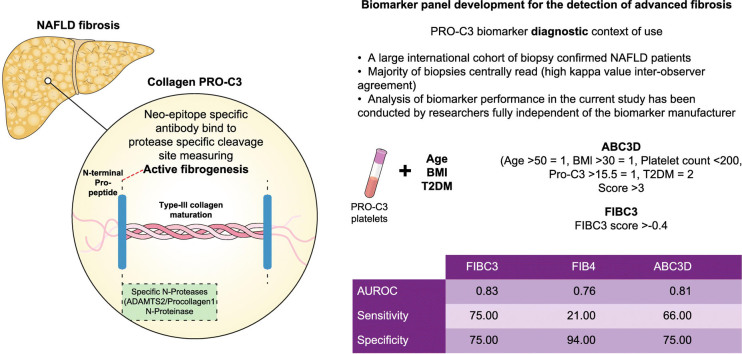
There is an unmet need for non-invasive biomarkers in non-alcoholic fatty liver disease (NAFLD) that can diagnose advanced disease and identify patients suitable for clinical trials. The PRO-C3 collagen neo-epitope is a putative direct marker of fibrogenesis. We assessed the performance of PRO-C3 in a large, well-characterised international NAFLD cohort and report the development and validation of 2 novel panels for the diagnosis of advanced fibrosis (F≥3) in NAFLD, including a simplified clinical score which eliminates the need for online calculators.
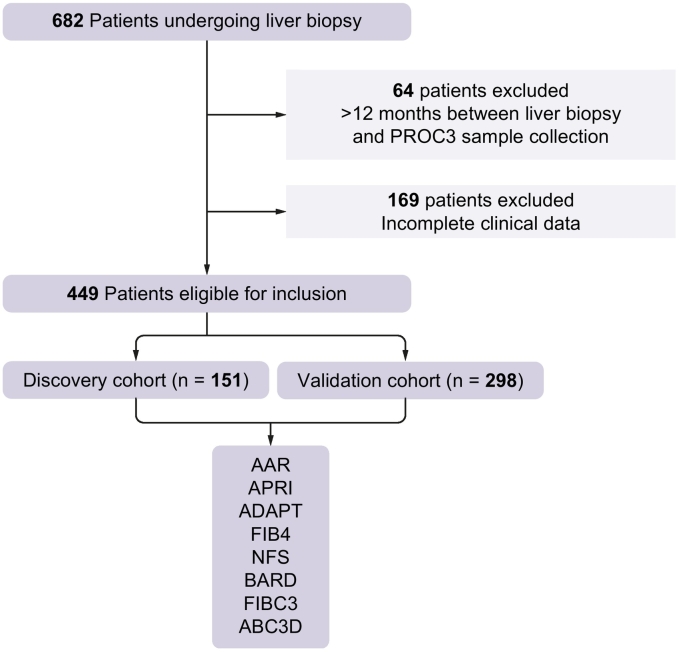
Methods: Plasma PRO-C3 levels were determined in a prospectively recruited international cohort of 449 patients with biopsy diagnosed NAFLD across the full disease spectrum (F0: n = 90; F1: 100; F2: 92; F3: 101; F4: 66). The cohort was divided into a discovery group (n = 151) and a validation group (n = 298). Logistic regression was performed to establish complex (FIBC3) and simplified (ABC3D) diagnostic scores that accurately identify advanced fibrosis. Performance for each was compared to established non-invasive fibrosis scoring systems.
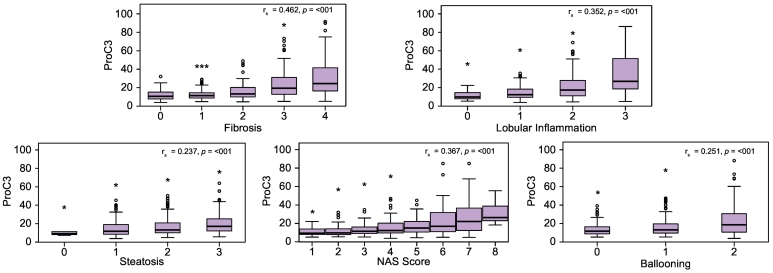
Results: Plasma PRO-C3 levels correlated with grade of histological steatohepatitis (rs = 0.367, p ≪0.0001) and stage of fibrosis (rs = 0.462, p ≪0.0001), exhibiting similar performance to current fibrosis scores such as FIB4 for the detection of F≥3 fibrosis. FIBC3 exhibited substantially improved accuracy (AUROC 0.89 and 0.83 in the discovery and validation sets, respectively) and outperformed FIB4 and other similar diagnostic panels. The simplified version, ABC3D, was concurrently developed and had comparable diagnostic accuracy (AUROC 0.88 and 0.81 in the discovery and validation sets, respectively).
Conclusion: Plasma PRO-C3 levels correlate with severity of steatohepatitis and fibrosis stage. The FIBC3 panel is an accurate tool with a single threshold value that maintains both sensitivity and specificity for the identification of F≥3 fibrosis in NAFLD, eliminating indeterminate results and outperforming commonly used non-invasive tools. A greatly simplified version (ABC3D) that is readily amenable to use in the clinic has been validated and shown to perform with similar accuracy, and may prove a useful tool in routine clinical practice.
Lay summary: We performed a comprehensive, independent evaluation of a collagen biomarker (PRO-C3) to detect and quantify liver fibrosis in patients with non-alcoholic fatty liver disease (NAFLD). We report the development of 2 diagnostic panels using PRO-C3 to identify patients with advanced fibrosis, one optimal but more complex to calculate (FIBC3), the other easier to use (ABC3D) whilst still performing well.
Keywords: Biomarker; NAFLD; NASH; PRO-C3; Steatohepatitis; fibrosis.
© 2019 The Authors.
Figures
References
-
- Anstee QM, Targher G, Day CP. Progression of NAFLD to diabetes mellitus, cardiovascular disease or cirrhosis. Nat Rev Gastroenterol Hepatol. 2013;10:330–344. - PubMed
-
- McPherson S, Hardy T, Henderson E, Burt AD, Day CP, Anstee QM. Evidence of NAFLD progression from steatosis to fibrosing-steatohepatitis using paired biopsies: Implications for prognosis and clinical management. J Hepatol. 2015;62:1148–1155. - PubMed
LinkOut - more resources
Full Text Sources
Other Literature Sources
Miscellaneous
