


Sleep Discrepancy in a Randomized Controlled Trial of Brief Behavioral Therapy for Chronic Insomnia in Older Adults
- PMID: 32039635
- PMCID: PMC7981845
- DOI: 10.1080/15402002.2020.1726750
Sleep Discrepancy in a Randomized Controlled Trial of Brief Behavioral Therapy for Chronic Insomnia in Older Adults
Abstract
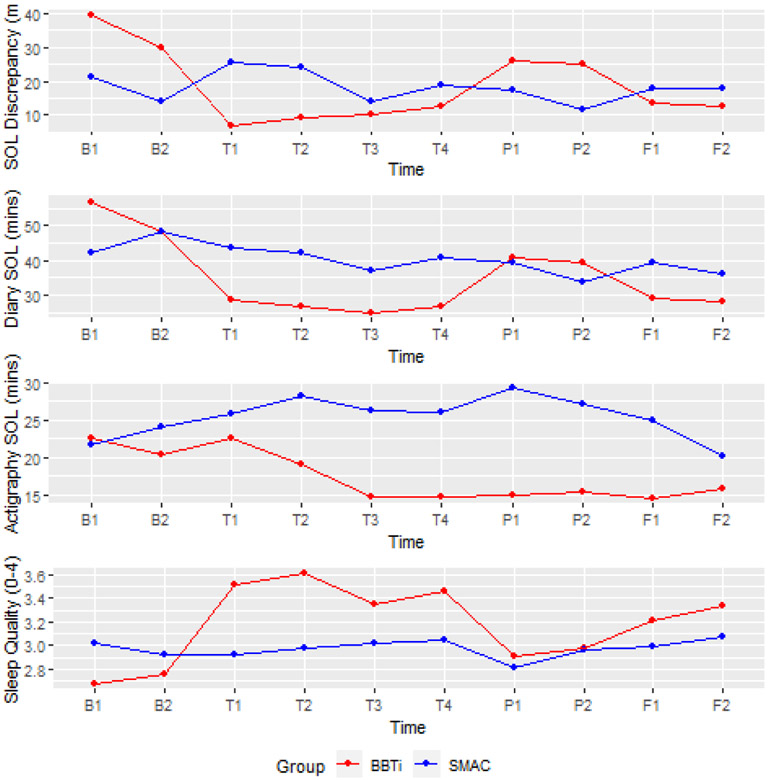
Background/Objective: Some older adults with insomnia experience sleep discrepancy, often characterized by greater subjective sleep difficulties and shorter subjective sleep duration than the estimates derived from objective measures. The present study examined whether a brief behavioral therapy for insomnia (BBTi) is efficacious for reducing sleep discrepancy in older adults. Methods: This study is a secondary analysis of a randomized controlled trial of BBTi for community dwelling older adults with chronic insomnia (N = 62). Thirty-two participants received BBTi, delivered in four individual face-to-face sessions. Thirty received the self-monitoring control (SMC). They all completed daily sleep diaries and wore an actigraph from baseline to posttreatment, and for 2 weeks at 3-month follow-up. Sleep discrepancy was calculated by subtracting diary from actigraphy estimates of sleep onset latency (SOL), wake after sleep onset (WASO), and total sleep time (TST). Mixed modeling was used to analyze data. SOL discrepancy decreased significantly in BBTi participants compared to SMC participants. The decreases in SOL discrepancy were explained by changes in diary-assessed SOL and subjective sleep quality but not changes in actigraphy-assessed SOL. Although WASO discrepancy and TST discrepancy decreased from baseline to posttreatment and follow-up, the Time by Group interaction effects were not significant indicating that BBTi participants did not experience greater reductions in WASO discrepancy and TST discrepancy than SMC participants. In conclusion, BBTi is efficacious for reducing SOL discrepancy in older adults with chronic insomnia.
Conflict of interest statement
All authors have approved the manuscript for submission and declare no conflict of interest.
Figures
References
-
- American Psychiatric Association. (2013). Diagnostic and Statistical Manual of Mental Disorders, 5th Edition (DSM-5). Diagnostic and Statistical Manual of Mental Disorders 4th Edition TR., 280. 10.1176/appi.books.9780890425596.744053 - DOI
Publication types
MeSH terms
Grants and funding
LinkOut - more resources
Full Text Sources
Medical
