


The EVITA framework for evidence-based mental health policy agenda setting in low- and middle-income countries
- PMID: 32040175
- PMCID: PMC7195852
- DOI: 10.1093/heapol/czz179
The EVITA framework for evidence-based mental health policy agenda setting in low- and middle-income countries
Abstract
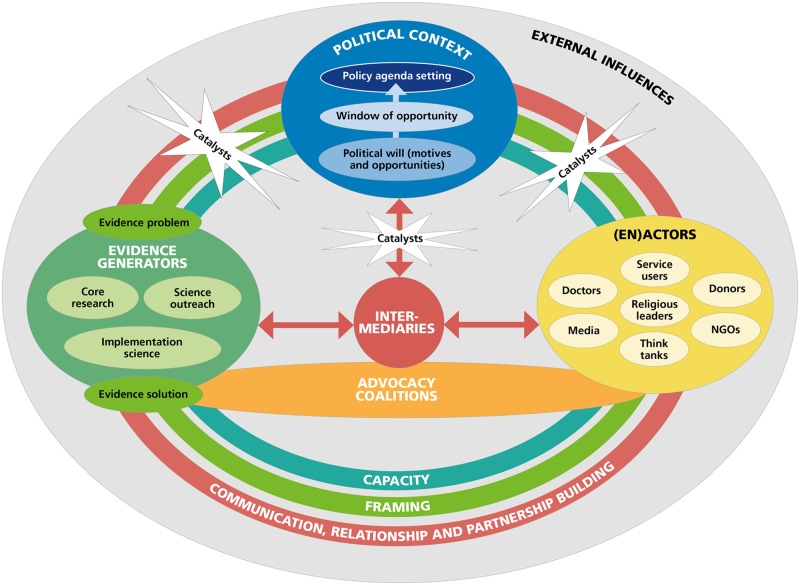
The burden of mental illness is excessive, but many countries lack evidence-based policies to improve practice. Mental health research evidence translation into policymaking is a 'wicked problem', often failing despite a robust evidence base. In a recent systematic review, we identified a gap in frameworks on agenda setting and actionability, and pragmatic, effective tools to guide action to link research and policy are needed. Responding to this gap, we developed the new EVITA 1.1 (EVIdence To Agenda setting) conceptual framework for mental health research-policy interrelationships in low- and middle-income countries (LMICs). We (1) drafted a provisional framework (EVITA 1.0); (2) validated it for specific applicability to mental health; (3) conducted expert in-depth interviews to (a) validate components and mechanisms and (b) assess intelligibility, functionality, relevance, applicability and effectiveness. To guide interview validation, we developed a simple evaluation framework. (4) Using deductive framework analysis, we coded and identified themes and finalized the framework (EVITA 1.1). Theoretical agenda-setting elements were added, as targeting the policy agenda-setting stage was found to lead to greater policy traction. The framework was validated through expert in-depth interviews (n = 13) and revised. EVITA 1.1 consists of six core components [advocacy coalitions, (en)actors, evidence generators, external influences, intermediaries and political context] and four mechanisms (capacity, catalysts, communication/relationship/partnership building and framing). EVITA 1.1 is novel and unique because it very specifically addresses the mental health research-policy process in LMICs and includes policy agenda setting as a novel, effective mechanism. Based on a thorough methodology, and through its specific design and mechanisms, EVITA has the potential to improve the challenging process of research evidence translation into policy and practice in LMICs and to increase the engagement and capacity of mental health researchers, policy agencies/planners, think tanks, NGOs and others within the mental health research-policy interface. Next, EVITA 1.1 will be empirically tested in a case study.
Keywords: Knowledge translation and exchange; agenda setting; evidence uptake; evidence-based policymaking; evidence-informed policymaking; framework; low- and middle-income countries; mental health; research evidence; research impact.
© The Author(s) 2020. Published by Oxford University Press in association with The London School of Hygiene and Tropical Medicine.
Figures

References
-
- Aljeesh YI, Khaldi MSA.. 2014. Embedding health research findings into policy making: policymakers and academicians perspective, Palestine, 2013. European Scientific Journal 7881: 368.
-
- Baumgartner FR, Green-Pedersen C, Jones BD.. 2006. Comparative studies of policy agendas. Journal of European Public Policy 13: 959–74.
-
- Bird P, Omar M, Doku V. et al. 2011. Increasing the priority of mental health in Africa: findings from qualitative research in Ghana, South Africa, Uganda and Zambia. Health Policy and Planning 26: 357–65. - PubMed
-
- Bloom DE, Cafiero E, Jané-Llopis E. et al. 2011. The global economic burden of noncommunicable diseases. World Economic Forum, 1–46.
MeSH terms
Grants and funding
LinkOut - more resources
Full Text Sources
Medical
Research Materials
Miscellaneous
