. 2020 Feb 10;12(3):2764-2776.
doi: 10.18632/aging.102775. Epub 2020 Feb 10.

Age-specific differential changes on gut microbiota composition in patients with major depressive disorder

Affiliations

Age-specific differential changes on gut microbiota composition in patients with major depressive disorder

Jian-Jun Chen et al. Aging (Albany NY). .

Abstract

Emerging evidence has shown the age-related changes in gut microbiota, but few studies were conducted to explore the effects of age on the gut microbiota in patients with major depressive disorder (MDD). This study was performed to identify the age-specific differential gut microbiota in MDD patients. In total, 70 MDD patients and 71 healthy controls (HCs) were recruited and divided into two groups: young group (age 18-29 years) and middle-aged group (age 30-59 years). The 16S rRNA gene sequences were extracted from the collected fecal samples. Finally, we found that the relative abundances of Firmicutes and Bacteroidetes were significantly decreased and increased, respectively, in young MDD patients as compared with young HCs, and the relative abundances of Bacteroidetes and Actinobacteria were significantly decreased and increased, respectively, in middle-aged MDD patients as compared with middle-aged HCs. Meanwhile, six and 25 differentially abundant bacterial taxa responsible for the differences between MDD patients (young and middle-aged, respectively) and their respective HCs were identified. Our results demonstrated that there were age-specific differential changes on gut microbiota composition in patients with MDD. Our findings would provide a novel perspective to uncover the pathogenesis underlying MDD.

Keywords: Actinobacteria; Bacteroidetes; Firmicutes; gut microbiota; major depressive disorder.


Conflict of interest statement

CONFLICTS OF INTEREST: The authors declare no financial or other conflicts of interest.

Figures

Figure 1
Figure 1
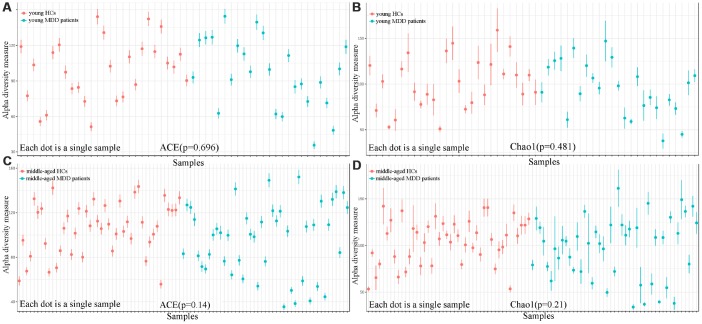
Comparison of alpha diversity between HCs and MDD patients. (A, B) ACE and Chao1 indexes showed no significant differences between young HCs (n=27) and young MDD patients (n=25); (C, D) ACE and Chao1 indexes showed no significant differences between middle-aged HCs (n=44) and middle-aged MDD patients (n=45).
Figure 2
Figure 2
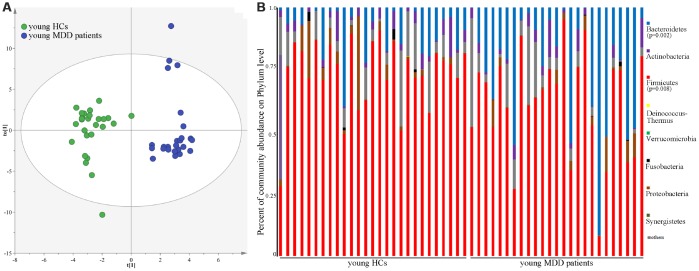
16S rRNA gene sequencing reveals changes to microbial abundances in young MDD patients. (A) OPLS-DA model showed an obvious difference in microbial abundances between the two groups (HCs, n=27; MDD, (n=25); (B) the relative abundances of Firmicutes and Bacteroidetes were significantly changed in young MDD patients (n=25) as compared with young HCs (n=27).
Figure 3
Figure 3
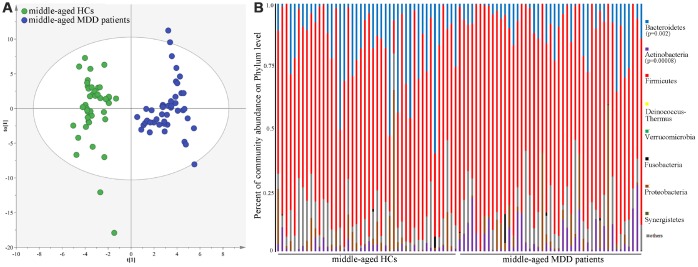
16S rRNA gene sequencing reveals changes to microbial abundances in middle-aged MDD patients. (A) OPLS-DA model showed an obvious difference in microbial abundances between the two groups (HCs, n=44; MDD, (n=45); (B) the relative abundances of Bacteroidetes and Actinobacteria were significantly changed in middle-aged MDD patients (n=45) as compared with middle-aged HCs (n=44).
Figure 4
Figure 4
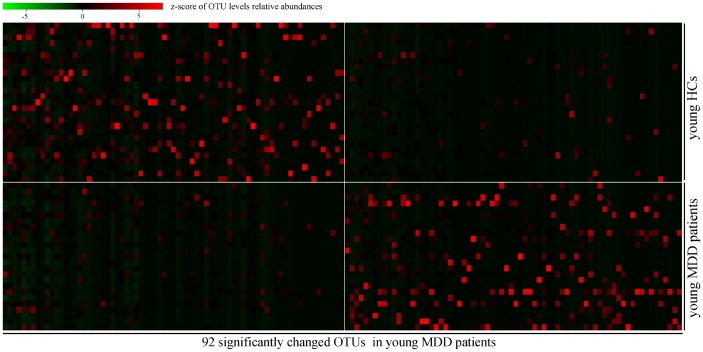
Heatmap of discriminative OTUs abundances between young HCs (n=27) and young MDD patients (n=25).
Figure 5
Figure 5
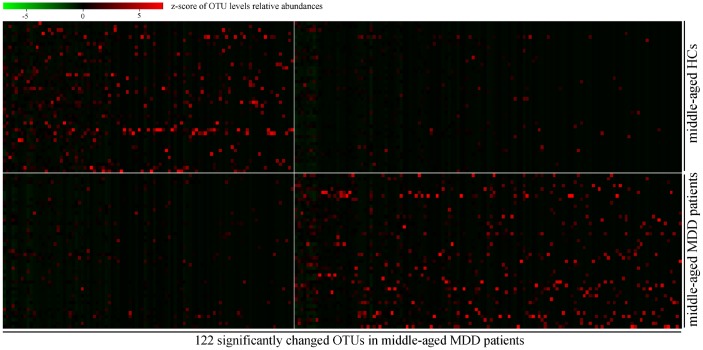
Heatmap of discriminative OTUs abundances between middle-aged HCs (n=44) and middle-aged MDD patients (n=45).
Figure 6
Figure 6
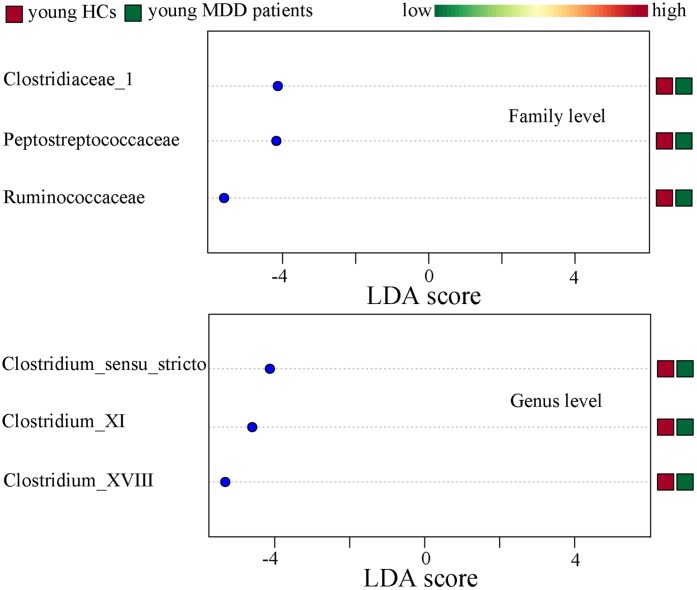
Differentially abundant features identified by LEfSe that characterize significant differences between young HCs (n=27) and young MDD patients (n=25).
Figure 7
Figure 7
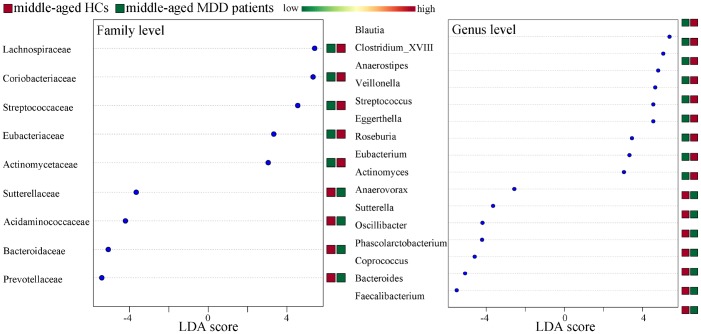
Differentially abundant features identified by LEfSe that characterize significant differences between middle-aged HCs (n=44) and middle-aged MDD patients (n=45).
Figure 8
Figure 8
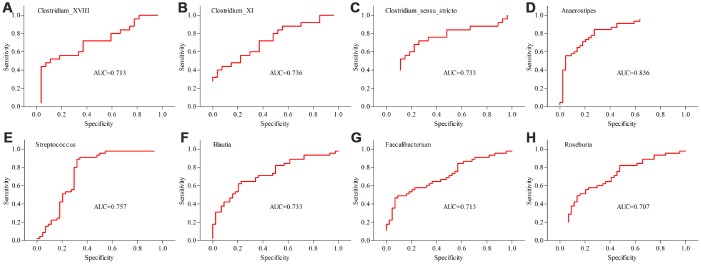
Differential taxa (at the genus level) with AUC>0.7 in diagnosing MDD patients from HCs. (AC) the diagnostic performances of three taxa in diagnosing young MDD patients (n=25) from young HCs (n=27); (DH) the diagnostic performances of five taxa in diagnosing middle-aged MDD patients (n=45) from middle-aged HCs (n=44).
Figure 9
Figure 9
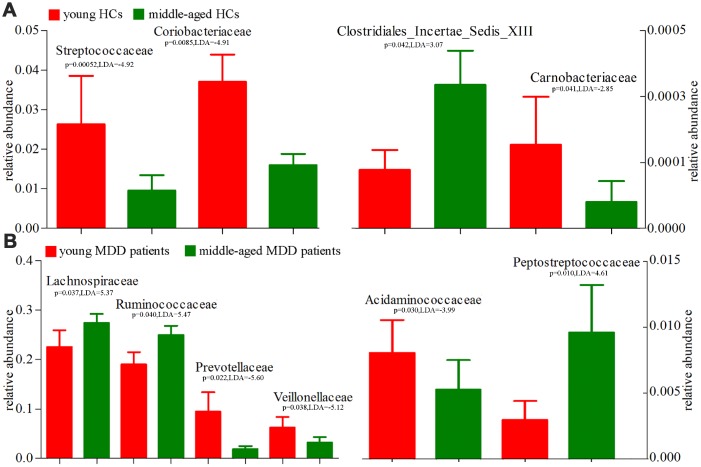
16S rRNA gene sequencing reveals changes to microbial abundances at family level (Mean±SEM). (A) the abundances of four taxonomic levels were significantly changed between young HCs (n=27) and middle-aged HCs (n=44); (B) the abundances of six taxonomic levels were significantly changed between young MDD patients (n=25) and middle-aged MDD patients (n=45).
Figure 10
Figure 10
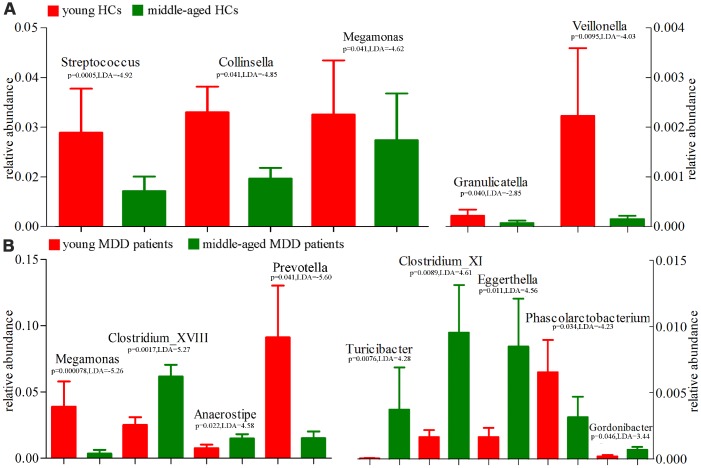
16S rRNA gene sequencing reveals changes to microbial abundances at genus level (Mean±SEM). (A) the abundances of five taxonomic levels were significantly changed between young HCs (n=27) and middle-aged HCs (n=44); (B) the abundances of nine taxonomic levels were significantly changed between young MDD patients (n=25) and middle-aged MDD patients (n=45).
Figure 11
Figure 11
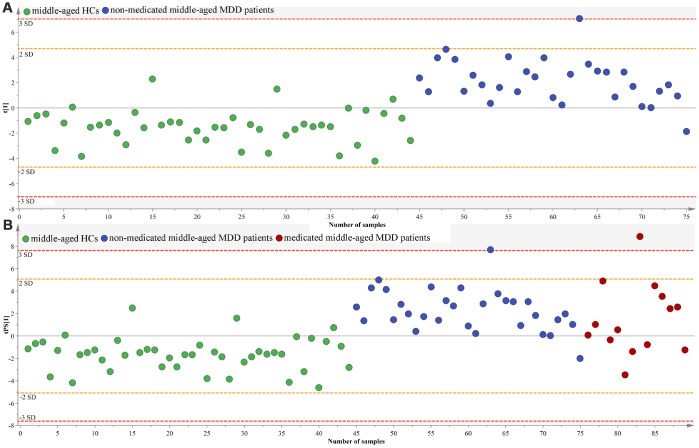
Assessment of gut microbiota composition in non-medicated and medicated middle-aged MDD patients. (A) middle-aged HCs (n=44) and non-medicated middle-aged MDD patients (n=31) were effectively separated by the built OPLS-DA model; (B) 14 medicated middle-aged MDD patients were correctly predicted by the model.

References

    1. Yirmiya R, Rimmerman N, Reshef R. Depression as a microglial disease. Trends Neurosci. 2015; 38:637–58. 10.1016/j.tins.2015.08.001 - DOI - PubMed
    1. Pan JX, Xia JJ, Deng FL, Liang WW, Wu J, Yin BM, Dong MX, Chen JJ, Ye F, Wang HY, Zheng P, Xie P. Diagnosis of major depressive disorder based on changes in multiple plasma neurotransmitters: a targeted metabolomics study. Transl Psychiatry. 2018; 8:130. 10.1038/s41398-018-0183-x - DOI - PMC - PubMed
    1. Zhao H, Du H, Liu M, Gao S, Li N, Chao Y, Li R, Chen W, Lou Z, Dong X. Integrative proteomics–metabolomics strategy for pathological mechanism of vascular depression mouse model. J Proteome Res. 2018; 17:656–69. 10.1021/acs.jproteome.7b00724 - DOI - PubMed
    1. Stringaris A. Editorial: what is depression? J Child Psychol Psychiatry. 2017; 58:1287–89. 10.1111/jcpp.12844 - DOI - PubMed
    1. Luscher B, Shen Q, Sahir N. The GABAergic deficit hypothesis of major depressive disorder. Mol Psychiatry. 2011; 16:383–406. 10.1038/mp.2010.120 - DOI - PMC - PubMed

Publication types