Review
. 2020 Jun;139(6-7):795-799.
doi: 10.1007/s00439-020-02129-3. Epub 2020 Feb 10.

New approaches to the study of immune responses in humans

Affiliations
Review

New approaches to the study of immune responses in humans

Petter Brodin. Hum Genet. 2020 Jun.

Abstract

The human immune system consists of multiple, layered mechanisms of sensing and responding to cellular stress, infection and tissue damage to ensure defense from pathogens, maintenance of tissue homeostasis, and the integrity of the holobiont. Every single cell in the body has a role to play, but a few dozen, specialized white blood cells are particularly important in this respect. Understanding the overall state of this multifaceted system in a single individual is challenging, and we are only beginning to do this across populations of individuals, to understand the vast range of inter-individual variation, and the influences of genes and environmental factors that collectively shape the immune system in a given individual. We are also only beginning to understand the changes occurring within this system over time, and how this relates to health and disease susceptibility. Several technological breakthroughs in recent years have enabled these developments and the emergence of a new, complementary approach to studying human immune systems, namely systems immunology. In this paradigm, the focus is shifted from the understanding of individual immune system components and their mechanisms of action, towards analyses of cell-cell interactions, and mechanisms of coordination and regulation within the human immune system.


Figures
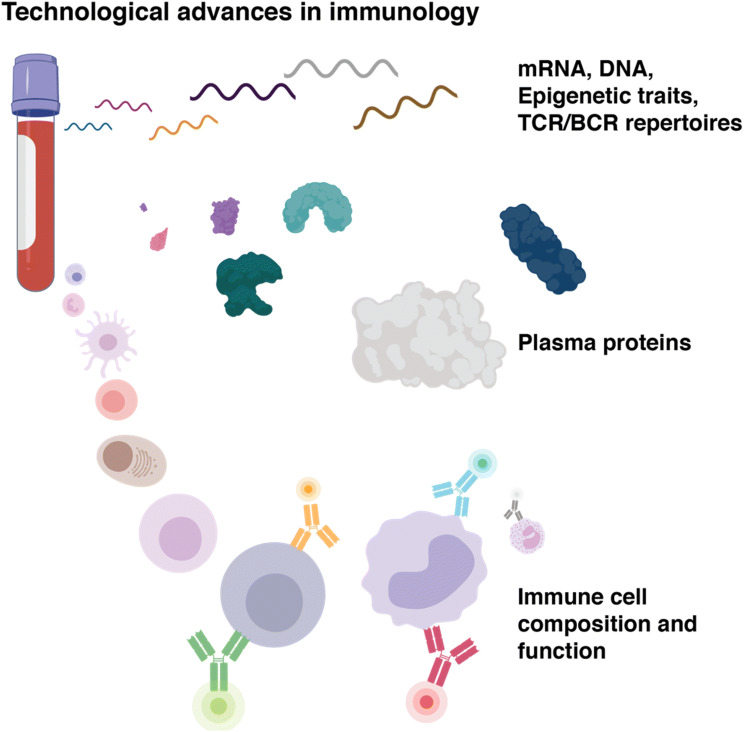
Fig. 1
Fig. 1
Technological advances in human immunology. Sequencing-based methods are rapidly evolving and now enable single-cell analyses of mRNA, DNA, epigenetics and variable lymphocyte receptor sequences and clonality. High-dimensional plasma protein analyses allow for hundreds of proteins to be quantified in a sample, and cytometric advances enable characterization and sorting of all possible subpopulations of immune cells
Fig. 2
Fig. 2
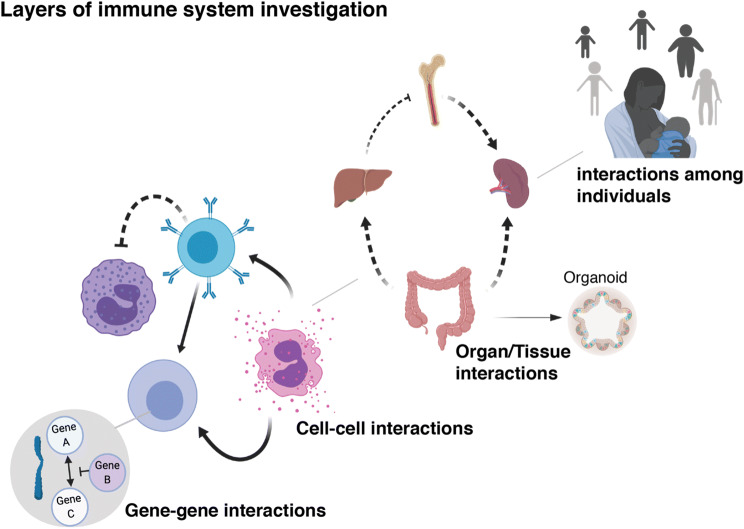
The human immune system can be investigated at multiple levels. Most studies to date have involved gene–gene regulation within populations, but more and more attention is also shifting towards cell–cell interactions within the system. The organismal level of interactions is still limited by technical challenges of longitudinal tissue sampling in humans. Population studies and analyses of inter-personal relationships have long been investigated in the field of epidemiology

References

    1. Austin MR, Birdsong GG, Sidawy MK, et al. Fine needle aspiration is a feasible and accurate technique in the diagnosis of lymphoma. J Clin Oncol. 2005;23:9029–9030. doi: 10.1200/jco.2005.01.5248. - DOI - PubMed
    1. Bendall SC, Nolan GP, Roederer M, Chattopadhyay PK. A deep profiler’s guide to cytometry. Trends Immunol. 2012;33:323–332. doi: 10.1016/j.it.2012.02.010. - DOI - PMC - PubMed
    1. Brodin P. The biology of the cell—insights from mass cytometry. Febs J. 2018 doi: 10.1111/febs.14693. - DOI - PubMed
    1. Brodin P, Jojic V, Gao T, et al. Variation in the human immune system is largely driven by non-heritable influences. Cell. 2015;160:37–47. doi: 10.1016/j.cell.2014.12.020. - DOI - PMC - PubMed
    1. Brodin P, Duffy D, Quintana-Murci L. A call for blood—in human immunology. Immunity. 2019;50:1335–1336. doi: 10.1016/j.immuni.2019.05.012. - DOI - PubMed