


Training deep quantum neural networks
- PMID: 32041956
- PMCID: PMC7010779
- DOI: 10.1038/s41467-020-14454-2
Training deep quantum neural networks
Abstract
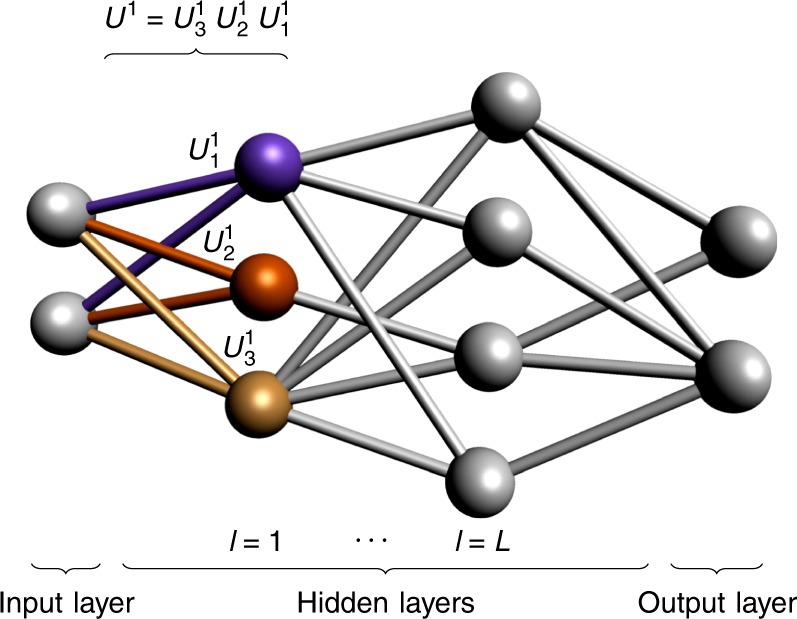
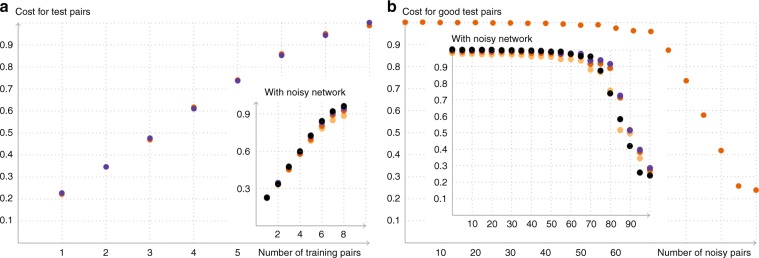
Neural networks enjoy widespread success in both research and industry and, with the advent of quantum technology, it is a crucial challenge to design quantum neural networks for fully quantum learning tasks. Here we propose a truly quantum analogue of classical neurons, which form quantum feedforward neural networks capable of universal quantum computation. We describe the efficient training of these networks using the fidelity as a cost function, providing both classical and efficient quantum implementations. Our method allows for fast optimisation with reduced memory requirements: the number of qudits required scales with only the width, allowing deep-network optimisation. We benchmark our proposal for the quantum task of learning an unknown unitary and find remarkable generalisation behaviour and a striking robustness to noisy training data.
Conflict of interest statement
The authors declare no competing interests.
Figures
References
-
- Goodfellow, I., Bengio, Y. & Courville, A. Deep Learning (MIT Press, 2016).
-
- Nielsen, M. A. Neural Networks and Deep Learning (Determination Press, 2015).
-
- Bishop, C. Pattern Recognition and Machine Learning. Information Science and Statistics (Springer-Verlag, 2006).
-
- Prati, E., Rotta, D., Sebastiano, F. & Charbon, E. From the quantum Moore’s law toward silicon based universal quantum computing. in 2017 IEEE ICRC (2017).
Publication types
LinkOut - more resources
Full Text Sources
Other Literature Sources
