. 2020 Feb 10;10(1):2292.
doi: 10.1038/s41598-020-59120-1.

The endocannabinoid hydrolase FAAH is an allosteric enzyme

Affiliations

The endocannabinoid hydrolase FAAH is an allosteric enzyme

Enrico Dainese et al. Sci Rep. .

Erratum in

Abstract

Fatty acid amide hydrolase (FAAH) is a membrane-bound homodimeric enzyme that in vivo controls content and biological activity of N-arachidonoylethanolamine (AEA) and other relevant bioactive lipids termed endocannabinoids. Parallel orientation of FAAH monomers likely allows both subunits to simultaneously recruit and cleave substrates. Here, we show full inhibition of human and rat FAAH by means of enzyme inhibitors used at a homodimer:inhibitor stoichiometric ratio of 1:1, implying that occupation of only one of the two active sites of FAAH is enough to fully block catalysis. Single W445Y substitution in rat FAAH displayed the same activity as the wild-type, but failed to show full inhibition at the homodimer:inhibitor 1:1 ratio. Instead, F432A mutant exhibited reduced specific activity but was fully inhibited at the homodimer:inhibitor 1:1 ratio. Kinetic analysis of AEA hydrolysis by rat FAAH and its F432A mutant demonstrated a Hill coefficient of ~1.6, that instead was ~1.0 in the W445Y mutant. Of note, also human FAAH catalysed an allosteric hydrolysis of AEA, showing a Hill coefficient of ~1.9. Taken together, this study demonstrates an unprecedented allosterism of FAAH, and represents a case of communication between two enzyme subunits seemingly controlled by a single amino acid (W445) at the dimer interface. In the light of extensive attempts and subsequent failures over the last decade to develop effective drugs for human therapy, these findings pave the way to the rationale design of new molecules that, by acting as positive or negative heterotropic effectors of FAAH, may control more efficiently its activity.


Conflict of interest statement

The authors declare no competing interests.

Figures
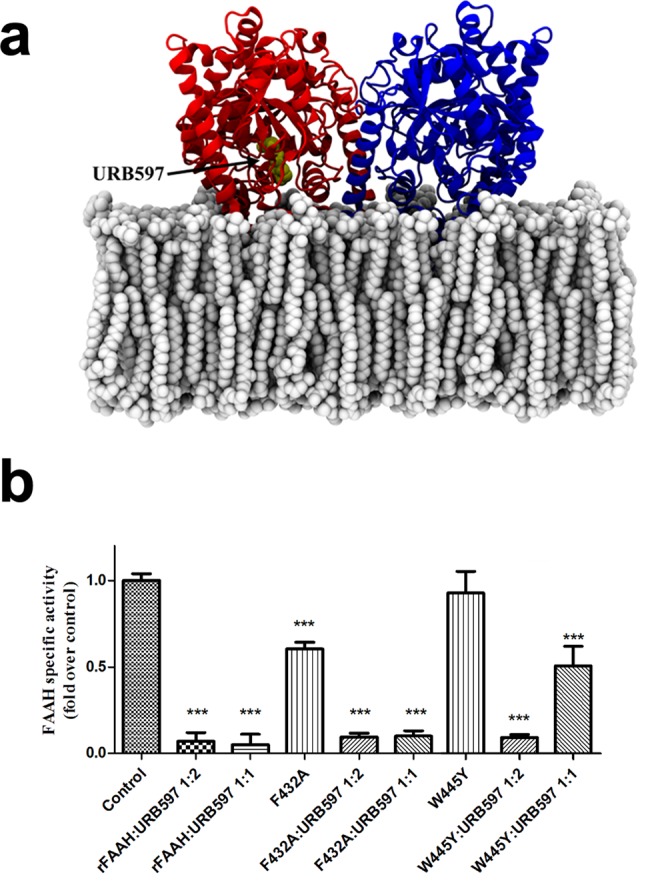
Figure 1
Figure 1
Inhibition of rFAAH and its mutants by URB597 at different molar ratio. (a) Schematic model of rFAAH where the URB597 molecule is highlighted in balls and stick within the active site of one subunit of the enzyme; (b) from left to right: wild-type rFAAH, rFAAH F432A mutant, and rFAAH W445Y mutant specific activities in the presence of URB597 at 1:2 and 1:1 homodimer:inhibitor molar ratios. ***p < 0.0001.
Figure 2
Figure 2
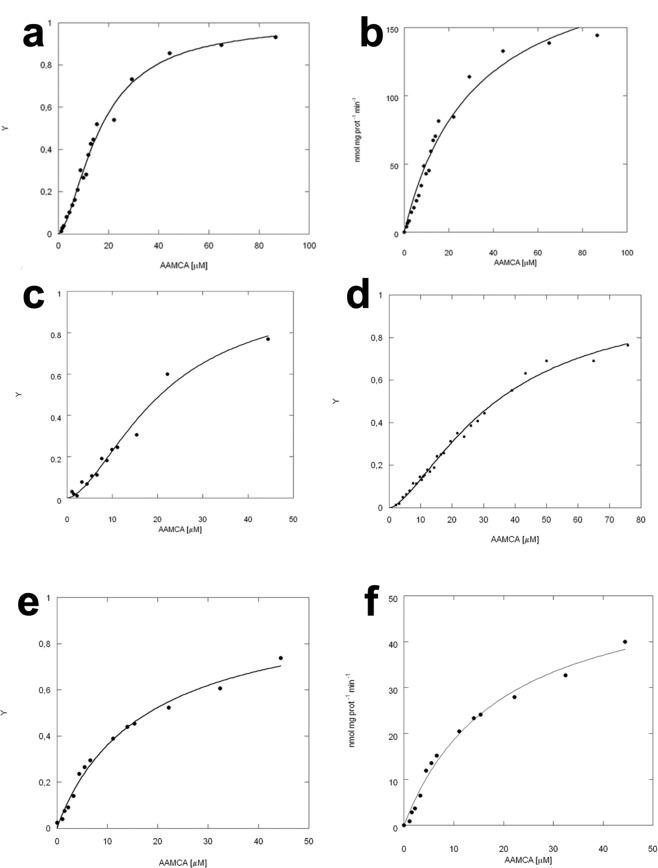
Dependence of rFAAH activity on substrate concentration. (a) Dependence of rFAAH activity on substrate concentration, interpolated through the Hill equation; (b) rFAAH shows a canonical sigmoidal curve in the presence of increasing concentration of the AAMCA substrate, that is not fitted equally well by non-linear regression through the Michaelis-Menten equation; (c) rFAAH in the presence of URB597 at a homodimer:inhibitor 1:0.5 molar ratio shows a sigmoidal behaviour; (d) Kinetic analysis of rFAAH F432A mutant indicates that P432 residue is involved in the catalytic activity of the enzyme, but not in the modulation of cooperativity; (e) Kinetic analysis of rFAAH W445Y mutant interpolated through the Hill formalism; (f) Kinetic analysis of rFAAH W445Y mutant shows loss of the sigmoidal behaviour, leading to a canonical hyperbolic Michaelis-Menten enzyme without any cooperativity.
Figure 3
Figure 3
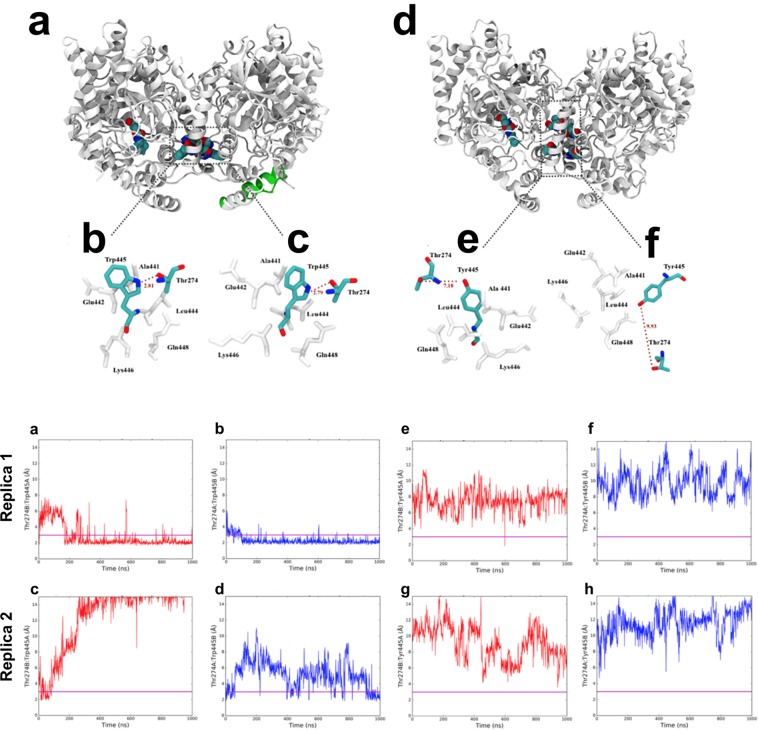
Molecular dynamics of rFAAH and its W445Y mutant. Upper Panel: Last frame snaphots of MD simulations of the URB597/rFAAH (a) and the URB597/W445Y-rFAAH complexes (d), where the URB597 molecule is covalently bound in the active site of one monomer only (monomer A). Schematic representation of most frequent W445:T274 interactions (b,c) and Y445:T274 interactions (e,f) over the simulation is reported; related residues are also depicted in the dotted squares (a,d). Distances between residues are indicated with red broken lines (b,c,e,f). Lower Panel: The HB plots URB/rFAAH complex (ad), where distances (expressed in Å) between the OH group of T274 and the W445’s sidechain nitrogen over all the trajectory length, are shown. These simulations indicate that the T274 of monomer A of wild type rFAAH establishes a hydrogen bond with the W445 of monomer B (and viceversa) in 3 cases of the 4 analyzed trajectories length. The HB Plots of URB/W445Y-rFAAH complex (eh) show that in the rFAAH mutant the distances between the OH group of T274 and Y445’s sidechain hydroxyl in both monomers and all replicas (eh) are not compatible with the formation of a hydrogen bond. These MD simulations suggest that the hydrogen bond is more likely to form in the wild-type rFAAH. A line y = 3 highlights peaks over 3 Å for each of the plot.

References

    1. Piomelli D. The molecular logic of endocannabinoid signalling. Nat. Rev. Neurosci. 2003;4:873–84. doi: 10.1038/nrn1247. - DOI - PubMed
    1. Maccarrone M, Guzmán M, Mackie K, Doherty P, Harkany T. Programming of neural cells by (endo)cannabinoids: from physiological rules to emerging therapies. Nat. Rev. Neurosci. 2014;15:786–801. doi: 10.1038/nrn3846. - DOI - PMC - PubMed
    1. Lu H-C, Mackie K. An Introduction to the Endogenous Cannabinoid System. Biol. Psychiatry. 2016;79:516–525. doi: 10.1016/j.biopsych.2015.07.028. - DOI - PMC - PubMed
    1. Maccarrone Mauro, Gasperi Valeria, Catani Maria Valeria, Diep Thi Ai, Dainese Enrico, Hansen Harald S., Avigliano Luciana. The Endocannabinoid System and Its Relevance for Nutrition. Annual Review of Nutrition. 2010;30(1):423–440. doi: 10.1146/annurev.nutr.012809.104701. - DOI - PubMed
    1. Ahn K, McKinney MK, Cravatt BF. Enzymatic pathways that regulate endocannabinoid signaling in the nervous system. Chem. Rev. 2008;108:1687–707. doi: 10.1021/cr0782067. - DOI - PMC - PubMed

Publication types

MeSH terms