


Advanced fibrosis is associated with incident cardiovascular disease in patients with non-alcoholic fatty liver disease
- PMID: 32043602
- PMCID: PMC7069774
- DOI: 10.1111/apt.15660
Advanced fibrosis is associated with incident cardiovascular disease in patients with non-alcoholic fatty liver disease
Abstract
Background: Non-alcoholic fatty liver disease (NAFLD) is associated with an increased risk of cardiovascular disease. It is not well understood, however, which individuals with NAFLD are at highest risk for cardiovascular disease.
Aims: To determine the factors associated with incident cardiovascular events in a prospective cohort of individuals with biopsy-proven NAFLD without pre-existing cardiovascular disease.
Methods: From 2011 to 2018, adults with biopsy-proven NAFLD without cardiovascular disease were enrolled in a tissue repository and were followed prospectively to the first recorded date of incident cardiovascular disease, death or the end of follow-up (11/1/2018). Competing risks analysis was performed to identify predictors of incident cardiovascular disease.
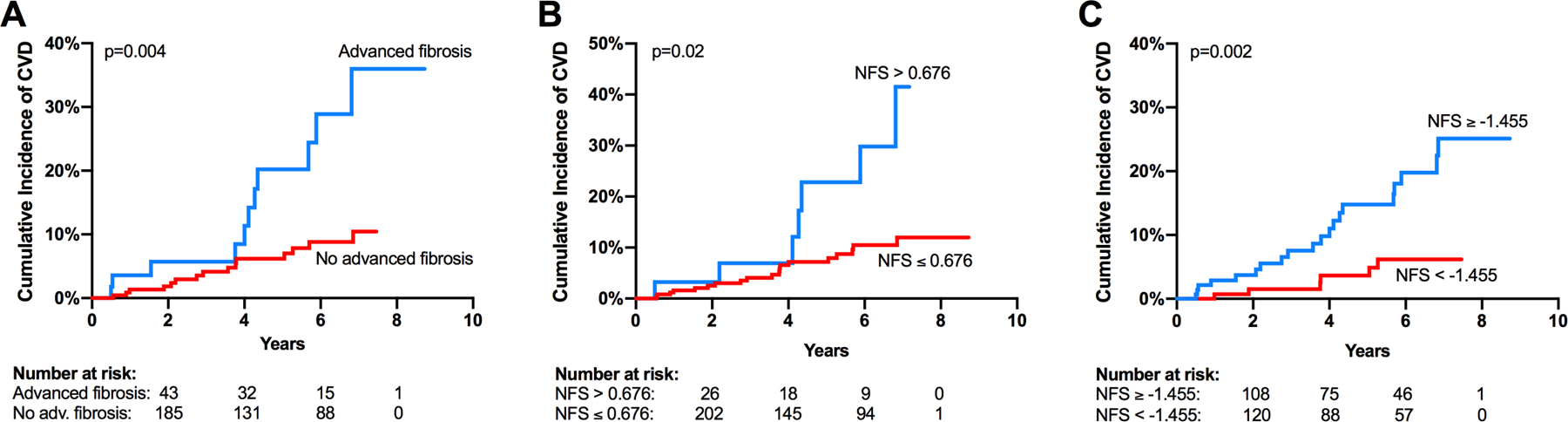
Results: After a median follow-up time of 5.2 years, 26/285 (9.1%) individuals experienced an incident cardiovascular event. Advanced fibrosis (stage 3-4) on biopsy was a significant predictor of incident cardiovascular disease, and this persisted on multivariable analysis (SHR 2.86, 95% CI 1.36-6.04) after considering relevant covariates, including cardiovascular risk scores, which were not independent predictors. Of the non-invasive indicators of fibrosis, the NAFLD fibrosis score was the only independent predictor of cardiovascular disease. Other histologic features, including steatohepatitis, were not associated with incident cardiovascular disease.
Conclusions: In adults with biopsy-proven NAFLD, advanced fibrosis on biopsy and higher NAFLD fibrosis score were significant and independent predictors of incident cardiovascular disease, even after considering traditional risk factors and cardiovascular risk scores. These findings should be considered when evaluating NAFLD patients for primary prevention of cardiovascular disease, and further evaluation into the link between advanced fibrosis and cardiovascular disease is needed.
© 2020 John Wiley & Sons Ltd.
Conflict of interest statement
Figures
Comment in
-
Editorial: re-thinking cardiovascular risk factors in NAFLD with advanced fibrosis? Authors' reply.Aliment Pharmacol Ther. 2020 May;51(10):988-989. doi: 10.1111/apt.15696. Aliment Pharmacol Ther. 2020. PMID: 32338780 No abstract available.
-
Editorial: re-thinking cardiovascular risk factors in NAFLD with advanced fibrosis?Aliment Pharmacol Ther. 2020 May;51(10):987-988. doi: 10.1111/apt.15682. Aliment Pharmacol Ther. 2020. PMID: 32338785 No abstract available.
References
-
- Younossi ZM, Koenig AB, Abdelatif D, et al. Global epidemiology of nonalcoholic fatty liver disease-Meta-analytic assessment of prevalence, incidence, and outcomes. Hepatology. 2016;64(1):73–84. - PubMed
-
- Ekstedt M, Hagstrom H, Nasr P, et al. Fibrosis stage is the strongest predictor for disease-specific mortality in NAFLD after up to 33 years of follow-up. Hepatology. 2015;61(5):1547–54. - PubMed
-
- Targher G, Byrne CD, Lonardo A, et al. Non-alcoholic fatty liver disease and risk of incident cardiovascular disease: A meta-analysis. Journal of Hepatology. 2016;65:589–600. - PubMed
Publication types
MeSH terms
Grants and funding
LinkOut - more resources
Full Text Sources
Medical