


Association between CD47 expression, clinical characteristics and prognosis in patients with advanced non-small cell lung cancer
- PMID: 32043750
- PMCID: PMC7131854
- DOI: 10.1002/cam4.2882
Association between CD47 expression, clinical characteristics and prognosis in patients with advanced non-small cell lung cancer
Abstract
Objective: CD47 is an antiphagocytic molecule that contributes to tumor cell resistance in host immune surveillance. CD47 overexpression correlated with tumor progression and shorter survival in lung cancer. However, the expression and functional significance of CD47 in Non-Small Cell Lung Cancer (NSCLC) has not been completely understood.
Materials and methods: In this retrospective study, CD47 expression was immunohistochemically examined in tumor biopsies from 169 NSCLC patients. The association of CD47 levels (H-score) with clinicopathological characteristics and survival outcomes was evaluated.
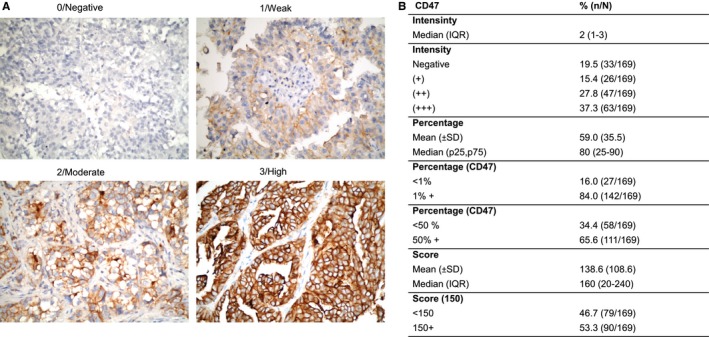
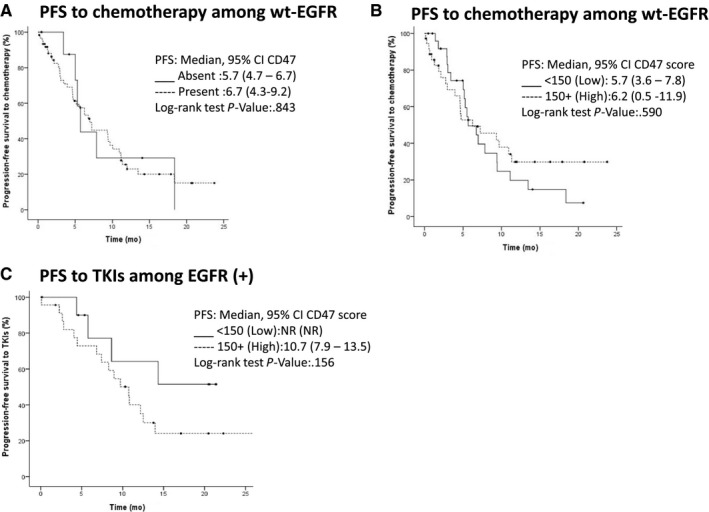
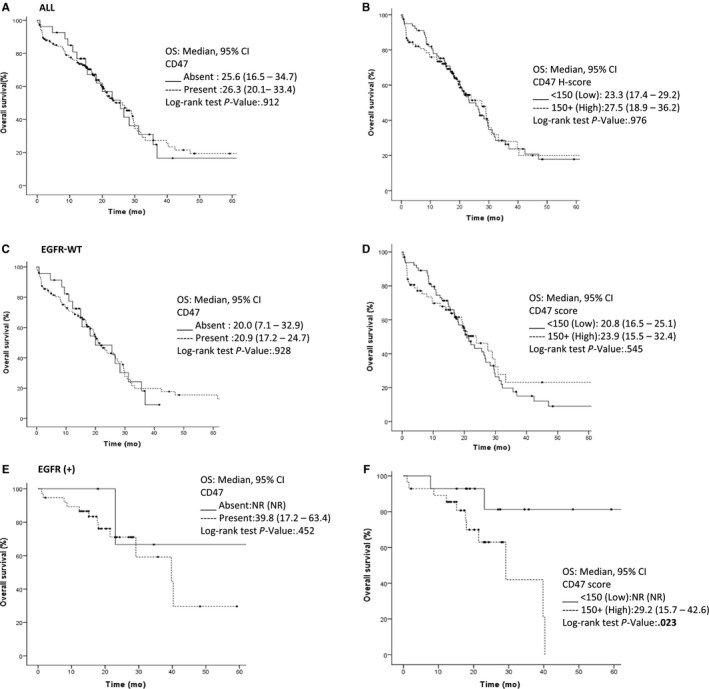
Results: CD47 protein was detected in 84% of patients with a median expression of 80% (0-100). Tumor CD47 levels above 1% and 50% were found in 84% and 65.7% of patients, respectively. While, median CD47 staining index was 160 (0-300). Patients were divided into two groups according to CD47 expression (high or low), using a cutoff value of 150. High CD47 expression was associated with wood smoke exposure (71.1% vs 28.9%, P = .013) and presence of EGFR (+) mutations (66.7% vs 33.3%, P = .04). Survival analysis carried out in the whole population did not show any association of CD47 expression and survival outcome. However, in patients with EGFR (+) mutations, CD47 expression was associated with higher progression-free survival (PFS) (12.2 vs. 4.4 months, P = .032). When the survival analysis was performed according to CD47 levels (cut off value: 150), both, PFS and overall survival (OS) were shortened in patients with a high expression of CD47 (10.7 vs. NR, P = .156) and (29.2 vs. NR months P = .023), respectively.
Conclusions: CD47 overexpression is not a prognostic factor for PFS and OS in NSCLC patients. However, the presence of EGFR mutations and high expression of CD47 were associated with shortened PFS and OS. Coexpression of these markers represents a potential biomarker and characterizes a therapeutic niche for lung cancer.
Keywords: CD47; EGFR; immune checkpoint; lung adenocarcinoma; phagocytosis.
© 2020 The Authors. Cancer Medicine published by John Wiley & Sons Ltd.
Figures
References
-
- Ferlay J, Colombet M, Soerjomataram I, et al. Estimating the global cancer incidence and mortality in 2018: GLOBOCAN sources and methods. Int J Cancer. 2019;144(8):1941‐1953. - PubMed
-
- Gandhi L, Rodríguez‐Abreu D, Gadgeel S, et al. Pembrolizumab plus chemotherapy in metastatic non‐small‐cell lung cancer. New Engl J Med. 2018;378:2078‐2092. - PubMed
-
- Ettinger DS, Wood DE, Aisner DL, et al. Non‐small cell lung cancer, Version 5.2017, NCCN clinical practice guidelines in oncology. J Natl Compr Cancer Network. 2017;15:504‐535. - PubMed
MeSH terms
Substances
LinkOut - more resources
Full Text Sources
Other Literature Sources
Medical
Research Materials
Miscellaneous
