


The vacuole guard hypothesis: how intravacuolar pathogens fight to maintain the integrity of their beloved home
- PMID: 32044688
- PMCID: PMC8714320
- DOI: 10.1016/j.mib.2020.01.008
The vacuole guard hypothesis: how intravacuolar pathogens fight to maintain the integrity of their beloved home
Abstract
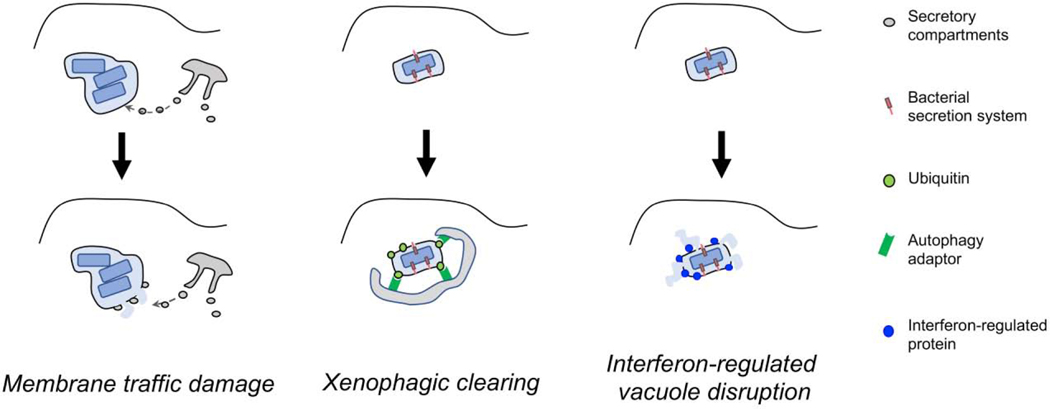
Intravacuolar bacterial pathogens establish intracellular niches by constructing membrane-encompassed compartments. The vacuoles surrounding the bacteria are remarkably stable, facilitating microbial replication and preventing exposure to host cytoplasmically localized innate immune sensing mechanisms. To maintain integrity of the membrane compartment, the pathogen is armed with defensive weapons that prevent loss of vacuole integrity and potential exposure to host innate signaling. In some cases, the microbial components that maintain vacuolar integrity have been identified, but the basis for why the compartment degrades in their absence is unclear. In this review, we point out that lessons from the microbial-programmed degradation of the vacuole by the cytoplasmically localized Shigella flexneri provide crucial insights into how degradation of pathogen vacuoles occurs. We propose that in the absence of bacterial-encoded guard proteins, aberrant trafficking of host membrane-associated components results in a dysfunctional pathogen compartment. As a consequence, the vacuole is poisoned and replication is terminated.
Copyright © 2020 Elsevier Ltd. All rights reserved.
Figures
References
-
- Liss V, Hensel M: Take the tube: remodelling of the endosomal system by intracellular Salmonella enterica. Cell Microbiol 2015, 17:639–647. - PubMed
Publication types
MeSH terms
Substances
Grants and funding
LinkOut - more resources
Full Text Sources
Research Materials
