


Surface Enhanced Raman Spectroscopy for Quantitative Analysis: Results of a Large-Scale European Multi-Instrument Interlaboratory Study
- PMID: 32045217
- PMCID: PMC7997108
- DOI: 10.1021/acs.analchem.9b05658
Surface Enhanced Raman Spectroscopy for Quantitative Analysis: Results of a Large-Scale European Multi-Instrument Interlaboratory Study
Abstract
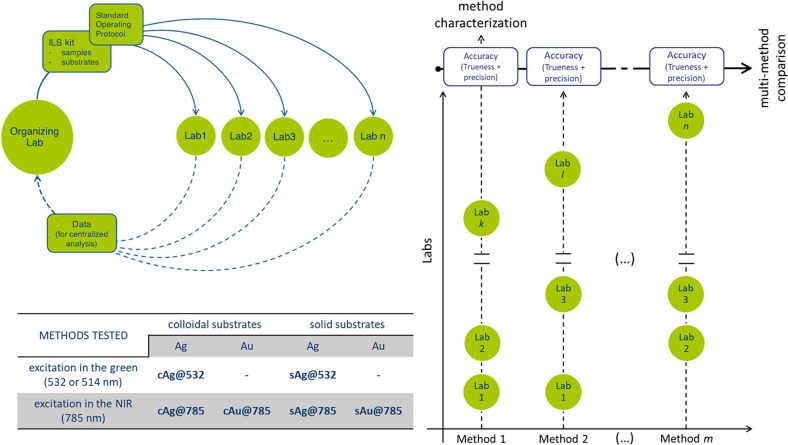
Surface-enhanced Raman scattering (SERS) is a powerful and sensitive technique for the detection of fingerprint signals of molecules and for the investigation of a series of surface chemical reactions. Many studies introduced quantitative applications of SERS in various fields, and several SERS methods have been implemented for each specific application, ranging in performance characteristics, analytes used, instruments, and analytical matrices. In general, very few methods have been validated according to international guidelines. As a consequence, the application of SERS in highly regulated environments is still considered risky, and the perception of a poorly reproducible and insufficiently robust analytical technique has persistently retarded its routine implementation. Collaborative trials are a type of interlaboratory study (ILS) frequently performed to ascertain the quality of a single analytical method. The idea of an ILS of quantification with SERS arose within the framework of Working Group 1 (WG1) of the EU COST Action BM1401 Raman4Clinics in an effort to overcome the problematic perception of quantitative SERS methods. Here, we report the first interlaboratory SERS study ever conducted, involving 15 laboratories and 44 researchers. In this study, we tried to define a methodology to assess the reproducibility and trueness of a quantitative SERS method and to compare different methods. In our opinion, this is a first important step toward a "standardization" process of SERS protocols, not proposed by a single laboratory but by a larger community.
Conflict of interest statement
The authors declare no competing financial interest.
Figures
References
-
- Langer J.; Jimenez de Aberasturi D.; Aizpurua J.; Alvarez-Puebla R. A.; Auguie B.; Baumberg J. J.; Bazan G. C.; Bell S. E. J.; Boisen A.; Brolo A. G.; Choo J.; Cialla-May D.; Deckert V.; Fabris L.; Faulds K.; Garcia de Abajo F. J.; Goodacre R.; Graham D.; Haes A. J.; Haynes C. L.; Huck C.; Itoh T.; Kall M.; Kneipp J.; Kotov N. A.; Kuang H.; Le Ru E. C.; Lee H. K.; Li J.-F.; Ling X. Y.; Maier S. A.; Mayerhofer T.; Moskovits M.; Murakoshi K.; Nam J.-M.; Nie S.; Ozaki Y.; Pastoriza-Santos I.; Perez-Juste J.; Popp J.; Pucci A.; Reich S.; Ren B.; Schatz G. C.; Shegai T.; Schlucker S.; Tay L.-L.; Thomas K. G.; Tian Z.-Q.; Van Duyne R. P.; Vo-Dinh T.; Wang Y.; Willets K. A.; Xu C.; Xu H.; Xu Y.; Yamamoto Y. S.; Zhao B.; Liz-Marzan L. M. Present and Future of Surface Enhanced Raman Scattering. ACS Nano 2020, 14, 28.10.1021/acsnano.9b04224. - DOI - PMC - PubMed
-
- Graham D.; Goodacre R.; Arnolds H.; Masson J. F.; Schatz G.; Baumberg J.; Kim D. H.; Aizpurua J.; Lum W.; Silvestri A.; de Nijs B.; Xu Y.; Di Martino G.; Natan M.; Schlucker S.; Wuytens P.; Bruzas I.; Kuttner C.; Hardy M.; Chikkaraddy R.; Martin Sabanes N.; Delfino I.; Dawson P.; Gawinkowski S.; Bontempi N.; Mahajan S.; Reich S.; Hourahine B.; Bell S.; Krolikowska A.; Porter M.; Keeler A.; Kamp M.; Fountain A.; Fasolato C.; Giorgis F.; Otero J. C.; Matricardi C.; Van Duyne R.; Lombardi J.; Deckert V.; Velleman L. Theory of SERS enhancement: general discussion. Faraday Discuss. 2017, 205, 173–211. 10.1039/C7FD90095C. - DOI - PubMed
-
- Sackmann M.; Materny A. Surface enhanced Raman scattering (SERS)—a quantitative analytical tool?. J. Raman Spectrosc. 2006, 37, 305–310. 10.1002/jrs.1443. - DOI
-
- Bell S. E. J.; Stewart A. In Surface Enhanced Raman Spectroscopy; Schlücker S., Ed.; Wiley-VCH Verlag GmbH & Co. KGaA, 2010; pp 71–86.
-
- Aitchison H.; Aizpurua J.; Arnolds H.; Baumberg J.; Bell S.; Bonifacio A.; Chikkaraddy R.; Dawson P.; de Nijs B.; Deckert V.; Delfino I.; Di Martino G.; Eremina O.; Faulds K.; Fountain A.; Gawinkowski S.; Gomez Castano M.; Goodacre R.; Gracie J.; Graham D.; Guicheteau J.; Hardwick L.; Hardy M.; Heck C.; Jamieson L.; Kamp M.; Keeler A.; Kuttner C.; Langer J.; Mahajan S.; Martin Sabanes N.; Murakoshi K.; Porter M.; Schatz G.; Schlucker S.; Tian Z.; Tripathi A.; Van Duyne R.; Vikesland P. Analytical SERS: general discussion. Faraday Discuss. 2017, 205, 561–600. 10.1039/C7FD90096A. - DOI - PubMed
Publication types
LinkOut - more resources
Full Text Sources
Research Materials
Miscellaneous
