. 2020 Feb 27;5(4):e132997.
doi: 10.1172/jci.insight.132997.

Differential decay of intact and defective proviral DNA in HIV-1-infected individuals on suppressive antiretroviral therapy

Affiliations

Differential decay of intact and defective proviral DNA in HIV-1-infected individuals on suppressive antiretroviral therapy

Michael J Peluso et al. JCI Insight. .

Abstract

BACKGROUNDThe relative stabilities of the intact and defective HIV genomes over time during effective antiretroviral therapy (ART) have not been fully characterized.METHODSWe used the intact proviral DNA assay (IPDA) to estimate the rate of change of intact and defective proviruses in HIV-infected adults on ART. We used linear spline models with a knot at seven years and a random intercept and slope up to the knot. We estimated the influence of covariates on rates of change.RESULTSWe studied 81 individuals for a median of 7.3 (IQR 5.9-9.6) years. Intact genomes declined more rapidly from initial suppression through seven years (15.7% per year decline; 95% CI -22.8%, -8.0%) and more slowly after seven years (3.6% per year; 95% CI -8.1%, +1.1%). The estimated half-life of the reservoir was 4.0 years (95% CI 2.7-8.3) until year seven and 18.7 years (95% CI 8.2-infinite) thereafter. There was substantial variability between individuals in the rate of decline until year seven. Intact provirus declined more rapidly than defective provirus (P < 0.001) and showed a faster decline in individuals with higher CD4+ T cell nadirs.CONCLUSIONThe biology of the replication-competent (intact) reservoir differs from that of the replication-incompetent (non-intact) pool of proviruses. The IPDA will likely be informative when investigating the impact of interventions targeting the reservoir.FUNDINGDelaney AIDS Research Enterprise, UCSF/Gladstone Institute of Virology & Immunology CFAR, CFAR Network of Integrated Systems, amfAR Institute for HIV Cure Research, I4C and Beat-HIV Collaboratories, Howard Hughes Medical Institute, Gilead Sciences, Bill and Melinda Gates Foundation.

Keywords: AIDS/HIV; Molecular biology.


Conflict of interest statement

Conflict of interest: AccelevirDx is a for-profit company; aspects of the IPDA are the subject of patent application PCT/US16/28822 filed by Johns Hopkins University and AccelevirDx holds an exclusive license for this patent application. MJP, SB, and JL have nothing to disclose. PB, JNM, and SGD report grants from the NIH during the conduct of the study. KDR is an employee of AccelevirDx. PWH reports grants and/or personal fees from Gilead Sciences, Viiv, Janssen, and Biotron, outside the submitted work. TJH reports grants and/or personal fees from Merck & Co. and Gilead Sciences, outside the submitted work. JDS reports personal fees from Gilead Sciences, outside the submitted work. RFS is an inventor on the IPDA patent application. He holds no equity interest in AccelevirDx. GML is an employee of and equity holder in AccelevirDx. SGD reports grants and/or personal fees from Gilead Sciences, Merck & Co., Viiv, AbbVie, Eli Lilly, ByroLogyx, and Enochian Biosciences outside the submitted work.

Figures

Figure 1
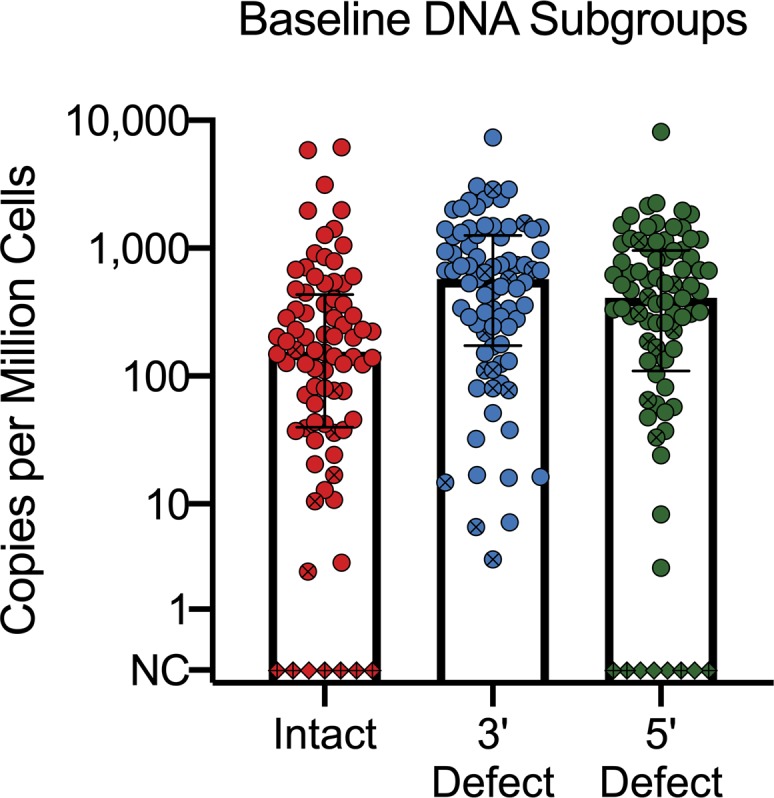
Figure 1. Baseline proviral DNA in participants at the first study time point.
Note that the preceding duration of suppressive ART differs between participants. NC; no copies detected. Circles indicate participants with detectable provirus. Diamonds indicate participants without detectable provirus. Crossed circles and diamonds indicate participants who did not exhibit decay of intact provirus over the first 7 years in longitudinal analyses.
Figure 2
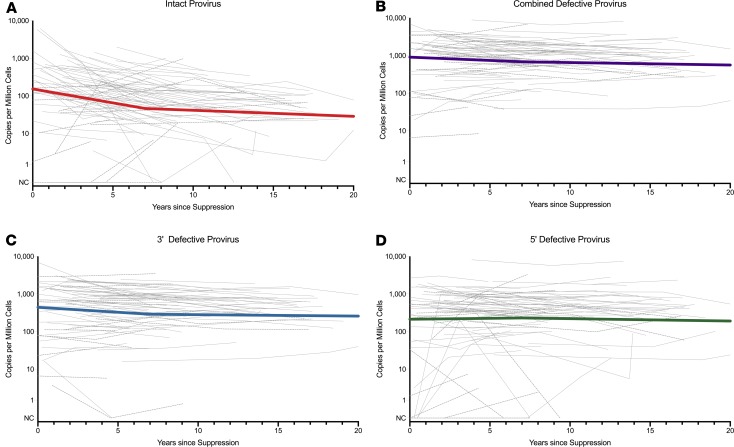
Figure 2. Longitudinal dynamics of proviral populations measured using IPDA.
Light gray lines indicate each participant; dashed lines denote participants who did not exhibit decay of intact provirus over the first 7 years in longitudinal analyses. Thick, colored lines indicate the fitted model. Note the knot (cut point where slope can change) at 7 years in the fitted models. (A) Intact virus declines at –15.7% (95% CI, –22.8, –8.0) per year to year 7 (P = 0.0002), after which it declines at –3.6% per year (95% CI, –8.1, +1.1; P = 0.13). (B) Combined defective virus declines at –4.0% (95% CI, –7.0, –0.9) per year to year 7 (P = 0.013), after which it declines at –1.5% per year (95% CI, –3.2, +0.2; P = 0.085). (C) The 3′ defective virus declines at –5.9% (95% CI, –9.3, –2.3) per year to year 7 (P = 0.0018), after which it declines at –0.9% per year (95% CI, –2.8, +1.1; P = 0.37). (D) The 5′ defective virus increases at +1.2% (95% CI, –6.4, +9.3) per year to year 7 (P = 0.76), after which it declines at –1.5% per year (95% CI, –7.1, +4.5; P = 0.62).
Figure 3
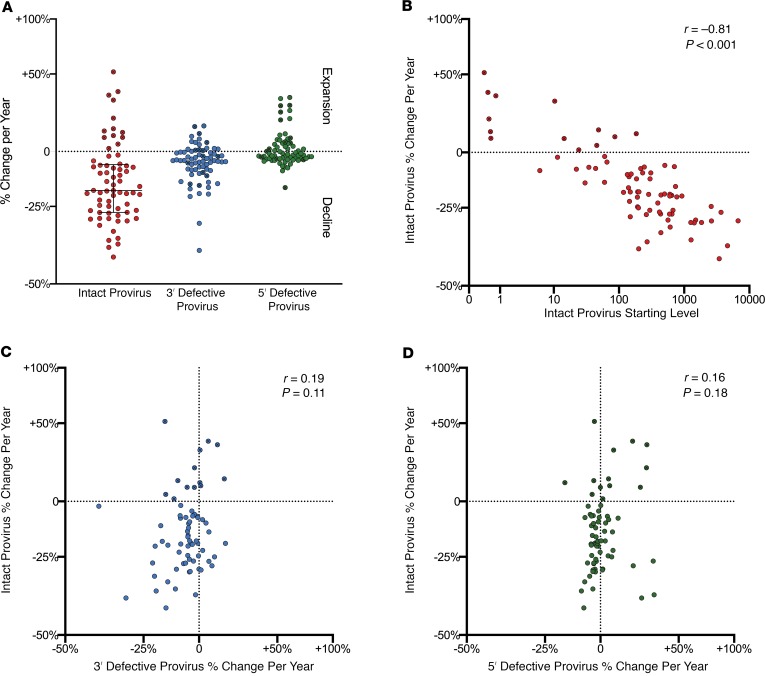
Figure 3. Proviral decay rates in study participants.
(A) Percent change per year in intact and defective provirus measured in study participants using IPDA. Note these slopes correspond to the first 7 years of virologic suppression. Values are estimated person-specific random slope from a mixed effects model plus the overall fixed-effect slope. (B) Intact proviral decay rate as a function of intact provirus at baseline. Note that intact provirus at baseline is the fitted random intercept plus the overall fixed-effect intercept, corresponding to the level at the start of viral suppression. (C) Intact proviral decay rate does not substantially correlate with 3′ provirus decay rate. (D) Intact proviral decay rate does not substantially correlate with 5′ provirus decay rate. Crossed circles indicate participants who did not exhibit decay of intact provirus over the first 7 years in longitudinal analyses.
Figure 4
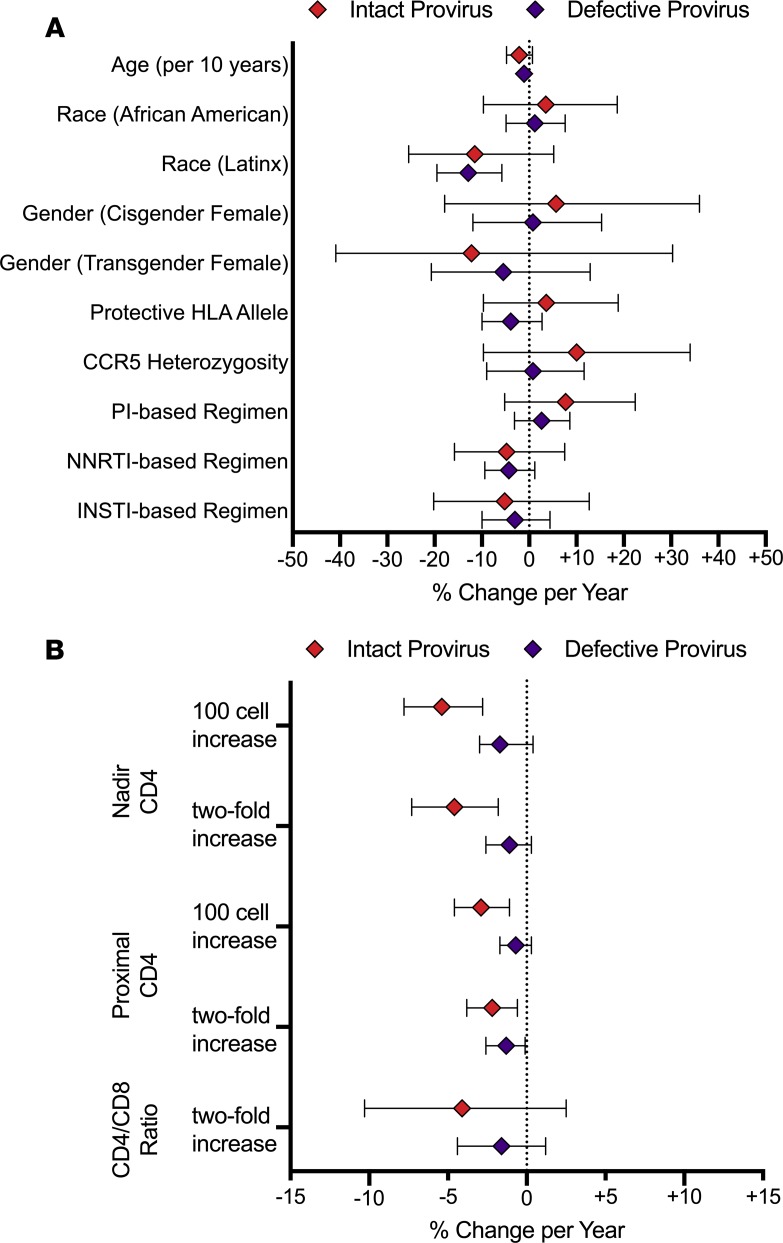
Figure 4. Estimated effects of covariates on the rate of decline of intact and combined defective provirus during the first 7 years of suppression.
(A) Effect of demographic characteristics on rate of decline. (B) Effect of immunologic parameters on rate of decline. Note that these effects are from models that do not include the effect of the covariate on the level of provirus at the start of viral suppression. NNRTI, nonnucleoside reverse transcriptase inhibitor; PI, protease inhibitor; INSTI, integrase strand transfer inhibitor.

References

    1. Chun TW, et al. Presence of an inducible HIV-1 latent reservoir during highly active antiretroviral therapy. Proc Natl Acad Sci USA. 1997;94(24):13193–13197. doi: 10.1073/pnas.94.24.13193. - DOI - PMC - PubMed
    1. Finzi D, et al. Identification of a reservoir for HIV-1 in patients on highly active antiretroviral therapy. Science. 1997;278(5341):1295–1300. doi: 10.1126/science.278.5341.1295. - DOI - PubMed
    1. Wong JK, et al. Recovery of replication-competent HIV despite prolonged suppression of plasma viremia. Science. 1997;278(5341):1291–1295. doi: 10.1126/science.278.5341.1291. - DOI - PubMed
    1. Finzi D, et al. Latent infection of CD4+ T cells provides a mechanism for lifelong persistence of HIV-1, even in patients on effective combination therapy. Nat Med. 1999;5(5):512–517. doi: 10.1038/8394. - DOI - PubMed
    1. Deeks SG, et al. International AIDS Society global scientific strategy: towards an HIV cure 2016. Nat Med. 2016;22(8):839–850. doi: 10.1038/nm.4108. - DOI - PMC - PubMed

Publication types