


Water for preventing urinary stones
- PMID: 32045491
- PMCID: PMC7012319
- DOI: 10.1002/14651858.CD004292.pub4
Water for preventing urinary stones
Abstract
Background: Urinary stone disease is a common condition characterised by increasing prevalence and high rates of recurrence. Observational studies have reported that increased water intake played a role in the prevention of urinary stone formation but with limited strength of evidence.
Objectives: To compare the effects of increased water intake with standard water intake for the prevention of urinary stone formation in participants with or without a history of urinary stones.
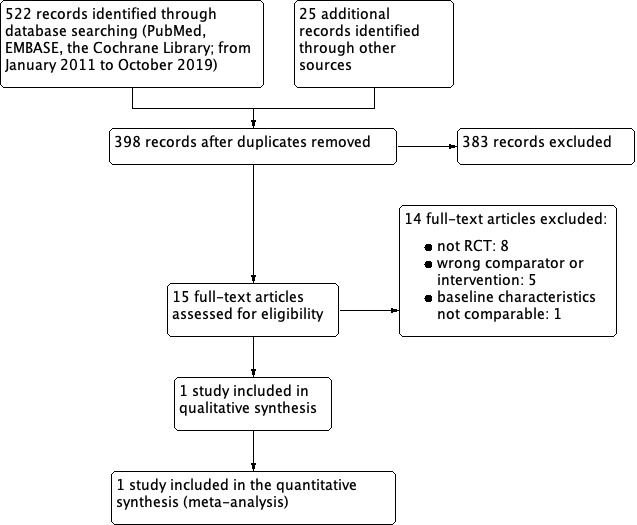
Search methods: We performed a systematic search of PubMed (MEDLINE), EMBASE (Ovid) and the Cochrane Library to 15 October 2019. We handsearched review articles, clinical trial registries, and reference lists of retrieved articles. We did not apply any restrictions to publication language or publication status.
Selection criteria: We included randomised controlled trials (RCTs) and quasi-RCTs looking at the benefits and harms of increased water intake versus standard water intake for the prevention of urinary stone formation in participants with or without a history of urinary stones.
Data collection and analysis: We used standard methodological procedures expected by Cochrane. Two review authors independently extracted data and assessed the risk of bias of included studies. We pooled dichotomous outcomes (e.g. incidence/recurrence rate of urinary stones; adverse events) using risk ratios (RRs) with 95% confidence intervals (CIs). We calculated hazard ratio (HRs) and corresponding 95% CIs to assess the intervention effect for time-to-event outcomes. We assessed the certainty of the evidence by using the GRADE criteria.
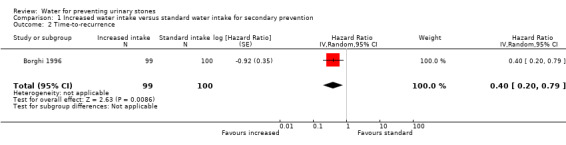
Main results: Our search identified no RCTs investigating the role of increased water intake for the prevention of urinary stone formation in participants with no history of urinary stones (primary prevention). We found one RCT assessing the effects of increased water intake versus standard water intake for the prevention of urinary stone formation in people with a history of urinary stones (secondary prevention). This trial randomised 220 participants (110 participants in the intervention group with increased water intake and 110 in the control group with standard water intake). Increased water intake was defined as achieving a urine volume of at least 2.0 L per day by drinking water. Based on this study, increased water intake may decrease stone recurrences (RR 0.45, 95% CI 0.24 to 0.84; 199 participants; low-certainty evidence); this corresponds to 149 fewer (43 fewer to 205 fewer) stone recurrences per 1000 participants with 270 stone recurrence per 1000 participants over five years in the control group. Increased water intake may also prolong the time to urinary stone recurrence compared to standard water intake (HR 0.40, 95% CI 0.20 to 0.79; 199 participants; low-certainty evidence); based on a stone recurrence rate of 270 per 1000 participants over five years, this corresponds to 152 fewer (209 fewer to 50 fewer) recurrences per 1000 participants. For both outcomes we downgraded the certainty of evidence for study limitations and imprecision. We found no evidence for the outcome of adverse events AUTHORS' CONCLUSIONS: We found no RCT evidence on the role of increased water intake for primary prevention of urinary stones. For secondary prevention, increased water intake achieving a urine volume of at least 2.0 L/day may reduce urinary stone recurrence and prolong time to recurrence for people with a history of urinary stone disease. However, our confidence in these findings is limited. We did not find evidence for adverse events.
Copyright © 2020 The Cochrane Collaboration. Published by John Wiley & Sons, Ltd.
Conflict of interest statement
BY: none known TX: none known WQ: none known
Figures

Update of
-
Water for preventing urinary stones.Cochrane Database Syst Rev. 2012 Jun 13;(6):CD004292. doi: 10.1002/14651858.CD004292.pub3. Cochrane Database Syst Rev. 2012. Update in: Cochrane Database Syst Rev. 2020 Feb 11;2:CD004292. doi: 10.1002/14651858.CD004292.pub4. PMID: 22696340 Updated.
References
References to studies included in this review
Borghi 1996 {published data only}
-
- Borghi L, Meschi T, Amato F, Briganti A, Novarini A, Giannini A. Urinary volume, water and recurrences in idiopathic calcium nephrolithiasis: a 5‐year randomized prospective study. Journal of Urology 1996;155(3):839‐43. [MEDLINE: ] - PubMed
References to studies excluded from this review
Cheungpasitporn 2016a {published data only}
Cheungpasitporn 2016b {published data only}
de La Guéronnière 2011 {published data only}
-
- Guéronnière V, Bellego L, Jimenez IB, Dohein O, Tack I, Daudon M. Increasing water intake by 2 liters reduces crystallization risk indexes in healthy subjects. Archivio Italiano di Urologia, Andrologia 2011; Vol. 83, issue 1:43‐50. [MEDLINE: ] - PubMed
Ferraro 2017 {published data only}
-
- Ferraro PM, Curhan GC, D'Addessi A, Gambaro G. Risk of recurrence of idiopathic calcium kidney stones: analysis of data from the literature. Journal of Nephrology 2017;30(2):227‐33. [PMID: 26969574] - PubMed
Fink 2013 {published data only}
-
- Fink HA, Wilt TJ, Eidman KE, Garimella PS, Macdonald R, Rutks IR, et al. Medical management to prevent recurrent nephrolithiasis in adults: a systematic review for an American College of Physicians Clinical Guideline. Annals of Internal Medicine 2013;158(7):535‐43. [PMID: 23546565] - PubMed
Khan 2015 {published data only}
-
- Khan MM, Khan MW, Qadir I, Ch Z Ali, Liaquat H. A study regarding Citrus juices effect (lemonade & orange juices only) in urolithiasis when compared to plain drinking water. Pakistan Journal of Medical & Health Sciences 2015;9(1):239‐42.
Lotan 2013 {published data only}
-
- Lotan Y, Buendia Jiménez I, Lenoirwijnkoop I, Daudon M, Molinier L, Tack I, et al. Increased water intake as a prevention strategy for recurrent urolithiasis: major impact of compliance on cost‐effectiveness. Journal of Urology 2013;189(3):935‐9. [PMID: 23017509] - PubMed
Lotan 2016 {published data only}
Maughan 2016 {published data only}
-
- Maughan RJ, Watson P, Cordery PA, Walsh NP, Oliver SJ, Dolci A, et al. A randomized trial to assess the potential of different beverages to affect hydration status: development of a beverage hydration index. American Journal of Clinical Nutrition 2016;103(3):717‐23. [PMID: 26702122] - PubMed
Prasetyo 2013 {published data only}
-
- Prasetyo T, Birowo P, Rasyid N. The influence of increased fluid intake in the prevention of urinary stone formation: a systematic review. Acta Medica Indonesiana 2013;45(4):253‐8. [PMID: 24448328] - PubMed
Sarica 2006 {published data only}
-
- Sarica K, Inal Y, Erturhan S, Yağci F. The effect of calcium channel blockers on stone regrowth and recurrence after shock wave lithotripsy. Urological Research 2006;34(3):184‐9. [PMID: 16463053] - PubMed
Ticinesi 2015 {published data only}
-
- Ticinesi A, Nouvenne A, Borghi L, Meschi T. Water and other fluids in nephrolithiasis: State of the art and future challenges. Critical Reviews in Food Science and Nutrition 2017;57(5):963‐74. [PMID: 25975220] - PubMed
Tsang 2012 {published data only}
-
- Tsang C, Smail NF, Almoosawi S, Davidson I, Al‐Dujaili EA. Intake of polyphenol‐rich pomegranate pure juice influences urinary glucocorticoids, blood pressure and homeostasis model assessment of insulin resistance in human volunteers. Journal of Nutritonal Science 2012;1:e9. [DOI: 10.1017/jns.2012.10] - DOI - PMC - PubMed
References to ongoing studies
NCT01100580 {published data only}
-
- NCT01100580. The links between water and salt intake, body weight, hypertension and kidney stones: a difficult puzzle. clinicaltrials.gov/ct2/show/NCT01100580 (accessed 18 April 2012).
Additional references
Assimos 2016
Brikowski 2008
Curhan 1996
-
- Curhan GC, Willett WC, Rimm EB, Spiegelman D, Stampfer MJ. Prospective study of beverage use and the risk of kidney stones. American Journal of Epidemiology 1996;143(3):240‐7. [PMID: 8561157] - PubMed
Curhan 1997a
-
- Curhan GC, Willett WC, Rimm EB, Stampfer MJ. Family history and risk of kidney stones. Journal of the American Society of Nephrology: JASN 1997;8(10):1568‐73. [PMID: 9335385] - PubMed
Curhan 1997b
-
- Curhan GC, Willett WC, Speizer FE, Spiegelman D, Stampfer MJ. Comparison of dietary calcium with supplemental calcium and other nutrients as factors affecting the risk for kidney stones in women. Annals of Internal Medicine 1997;126(7):497‐504. [PMID: 9092314] - PubMed
Curhan 1998
-
- Curhan GC, Willett WC, Speizer FE, Stampfer MJ. Beverage use and risk for kidney stones in women. Annals of Internal Medicine 1998;128(7):534‐40. [PMID: 9518397] - PubMed
Curhan 2004
Dai 2013
-
- Dai M, Zhao A, Liu A, You L, Wang P. Dietary factors and risk of kidney stone: a case‐control study in southern China. Journal of Renal Nutrition: the Official Journal of the Council on Renal Nutrition of the National Kidney Foundation 2013;23(2):e21‐8. [DOI: 10.1053/j.jrn.2012.04.003; PMID: 22658934] - DOI - PubMed
Daudon 2005
Deeks 2011
-
- Deeks JJ, Higgins JP, Altman DG, editor(s). Chapter 9: Analysing data and undertaking meta‐analyses. In: Higgins JP, Green S, editor(s). Cochrane Handbook for Systematic Reviews of Interventions Version 5.1.0 (updated March 2011). The Cochrane Collaboration, 2011. Available from handbook.cochrane.org. The Cochrane Collaboration.
Dussol 2008
Embon 1990
-
- Embon OM, Rose GA, Rosenbaum T. Chronic dehydration stone disease. BJU International 1990;66(4):357‐62. [PMID: 2224429] - PubMed
Escribano 2009
Frank 1966
-
- Frank M, Vries A. Prevention of urolithiasis. Education to adequate fluid intake in a new town situated in the Judean Desert Mountains. Archives of Environmental Health 1966;13(5):625‐30. [PMID: 5925636] - PubMed
Fwu 2013
Golder 2011
GRADEpro GDT 2015 [Computer program]
-
- McMaster University (developed by Evidence Prime). GRADEpro GDT. Hamilton (ON): McMaster University (developed by Evidence Prime), accessed prior to 20 January 2020.
Guyatt 2008
-
- Guyatt GH, Oxman AD, Vist GE, Kunz R, Falck‐Ytter Y, Schünemann HJ, et al. What is 'quality of evidence' and why is it important to clinicians?. BMJ (Clinical Research Ed.) 2008;336(7651):995‐8. [DOI: 10.1136/bmj.39490.551019.BE; PMID: 18456631] - DOI - PMC - PubMed
Guyatt 2011
Higgins 2002
-
- Higgins JP, Thompson SG. Quantifying heterogeneity in a meta‐analysis. Statistics in Medicine 2002;21(11):1539‐58. - PubMed
Higgins 2003
Higgins 2011a
-
- Higgins JP, Green S, editor(s). Cochrane Handbook for Systematic Reviews of Interventions Version 5.1.0 (updated March 2011). The Cochrane Collaboration, 2011. Available from handbook.cochrane.org. The Cochrane Collaboration.
Higgins 2011b
-
- Higgins JP, Altman DG, Sterne JA, editor(s). Chapter 8: Assessing risk of bias in included studies. In: Higgins JP, Green S, editor(s). Cochrane Handbook for Systematic Reviews of Interventions Version 5.1.0 (updated March 2011). The Cochrane Collaboration, 2011. Available from handbook.cochrane.org. The Cochrane Collaboration.
Higgins 2011c
-
- Higgins JP, Deeks JJ, Altman DG, editor(s). Chapter 16: Special topics in statistics. In: Higgins JP, Green S, editor(s). Cochrane Handbook for Systematic Reviews of Interventions Version 5.1.0 (updated March 2011). The Cochrane Collaboration, 2011. Available from handbook.cochrane.org. The Cochrane Collaboration.
Hosking 1983
-
- Hosking DH, Erickson SB, Berg CJ, Wilson DM, Smith LH. The stone clinic effect in patients with idiopathic calcium urolithiasis. Journal of Urology 1983;130(6):1115‐8. [PMID: 6644890] - PubMed
Kirkali 2015
Liberati 2009
-
- Liberati A, Altman DG, Tetzlaff J, Mulrow C, Gøtzsche PC, Ioannidis JP, et al. The PRISMA statement for reporting systematic reviews and meta‐analyses of studies that evaluate healthcare interventions: explanation and elaboration. BMJ (Clinical Research Ed.) 2009;339:b2700. [DOI: 10.1136/bmj.b2700; PMID: 19622552] - DOI - PMC - PubMed
Litwin 2012
-
- Litwin MS, Saigal CS, National Institute of Diabetes and Digestive and Kidney Diseases, National Institutes of Health, Public Health Service, US Department of Health and Human Services. Table 14‐47: Economic impact of urologic disease. Urologic Diseases in America. Vol. 486, Washington, DC: NIH publication, 2012:12‐7865.
Medina‐Escobedo 2002
-
- Medina‐Escobedo M, Zaidi M, Real‐de León E, Orozco‐Rivadeneyra S. Urolithiasis prevalence and risk factors in Yucatan, Mexico. Salud Pública De Mexico 2002;44(6):541‐5. [PMID: 20383456] - PubMed
Muldowney 2002
-
- Muldowney FP. Prevention of recurrent stones in idiopathic hypercalciuria. New England Journal of Medicine 2002;346(21):1667‐9. [PMID: 12030262] - PubMed
Pak 1980
-
- Pak CY, Sakhaee K, Crowther C, Brinkley L. Evidence justifying a high fluid intake in treatment of nephrolithiasis. Annals of Internal Medicine 1980;93(1):36‐9. [PMID: 7396311] - PubMed
Pearle 2014
-
- Pearle MS, Goldfarb DS, Assimos DG, Curhan G, Denu‐Ciocca CJ, Matlaga BR, et al. Medical management of kidney stones: AUA guideline. Journal of Urology 2014;192(2):316‐24. - PubMed
Pinduli 2006
Pradere 2018
Qaseem 2014
-
- Qaseem A, Dallas P, Forciea MA, Starkey M, Denberg TD. Dietary and pharmacologic management to prevent recurrent nephrolithiasis in adults: a clinical practice guideline from the American College of Physicians. Annals of Internal Medicine 2014;161(9):659‐67. [DOI: 10.7326/M13-2908; PMID: 25364887] - DOI - PubMed
Qaseem 2015
-
- Qaseem A, Fink HA, Denberg TD. Prevention of recurrent nephrolithiasis in adults. Annals of Internal Medicine 2015;162(7):529. - PubMed
Ramello 2000
Review Manager 2014 [Computer program]
-
- Nordic Cochrane Centre, The Cochrane Collaboration. Review Manager 5 (RevMan 5). Version 5.3. Copenhagen: Nordic Cochrane Centre, The Cochrane Collaboration, 2014.
Rukin 2017
Rule 2014
Scales 2012
Schünemann 2011
-
- Schünemann HJ, Oxman AD, Higgins JP, Vist GE, Glasziou P, Guyatt GH. Chapter 11: Presenting results and 'Summary of findings' tables. In: Higgins JP, Green S, editor(s). Cochrane Handbook for Systematic Reviews of Interventions Version 5.1.0 (updated March 2011). The Cochrane Collaboration, 2011. Available from handbook.cochrane.org. The Cochrane Collaboration.
Skolarikos 2015
-
- Skolarikos A, Straub M, Knoll T, Sarica K, Seitz C, Petrik A, et al. Metabolic evaluation and recurrence prevention for urinary stone patients: EAU guidelines. European Urology 2015;67(4):750‐63. - PubMed
Strauss 1982
-
- Strauss AL, Coe FL, Deutsch L, Parks JH. Factors that predict relapse of calcium nephrolithiasis during treatment: a prospective study. American Journal of Medicine 1982;72(1):17‐24. [PMID: 7058820] - PubMed
Taylor 2004
Taylor 2006
Ticinesi 2017
-
- Ticinesi A, Nouvenne A, Borghi L, Meschi T. Water and other fluids in nephrolithiasis: State of the art and future challenges. Critical Reviews in Food Science and Nutrition 2017;57(5):963‐74. - PubMed
Tierney 2007
Türk 2018
-
- Türk C, Neisius A, Petřík A, Seitz C, Thomas K, Skolarikos A. EAU Guidelines on Urolithiasis 2018. www.uroweb.org/guideline/urolithiasis (accessed 2 January 2019). [ISBN: 978‐94‐92671‐01‐1]
References to other published versions of this review
Bao 2012
Ke 2004
Wei 2003
-
- Wei Q, Zhang K. Water for preventing urinary calculi. Cochrane Database of Systematic Reviews 2003, Issue 3. [DOI: 10.1002/14651858.CD004292] - DOI
Publication types
MeSH terms
Substances
LinkOut - more resources
Full Text Sources
Medical
