


Circadian rhythm and its association with birth and infant outcomes: research protocol of a prospective cohort study
- PMID: 32046676
- PMCID: PMC7014629
- DOI: 10.1186/s12884-020-2797-2
Circadian rhythm and its association with birth and infant outcomes: research protocol of a prospective cohort study
Abstract
Background: Circadian rhythm plays an important role as our internal body's clock that synchronizes behavior and physiology according to the external 24-h light-dark cycle. Past studies have associated disrupted circadian rhythm with higher risk of miscarriages, preterm birth and low birth weights. This paper described the protocol of a prospective cohort study which aims to determine the circadian rhythm in pregnant women, identify its association with maternal factors during pregnancy, gestational weight gain, birth and infant outcomes.
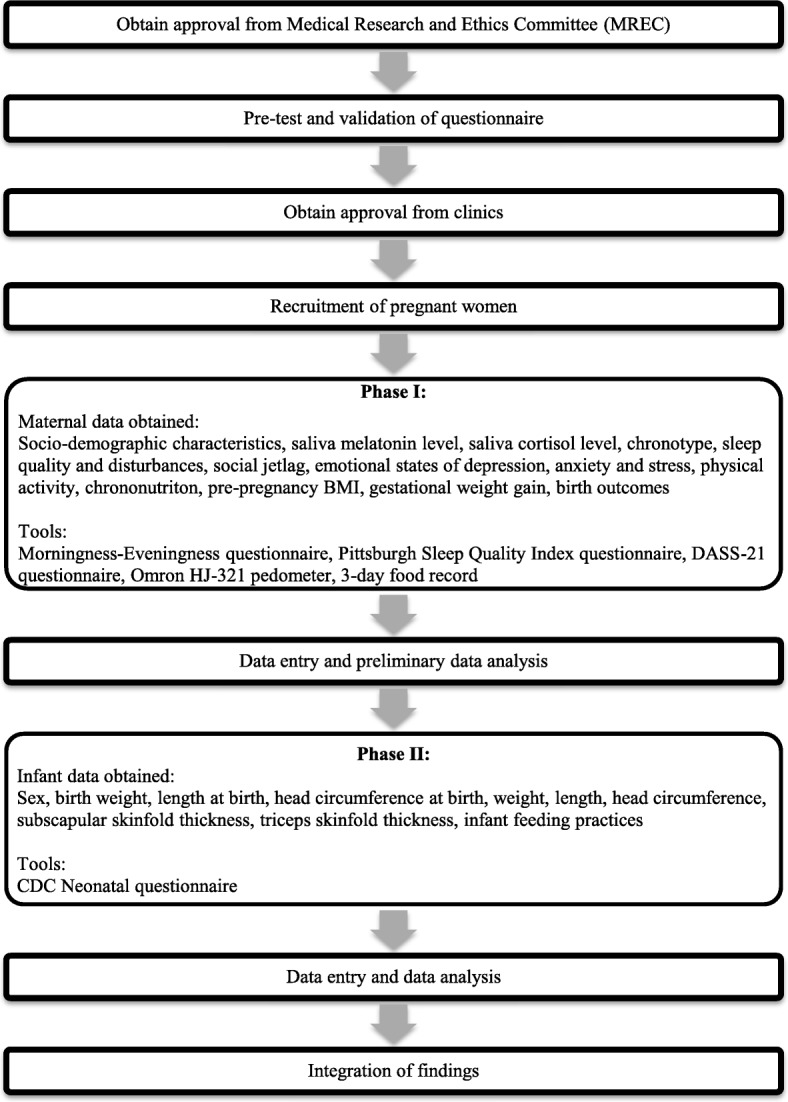
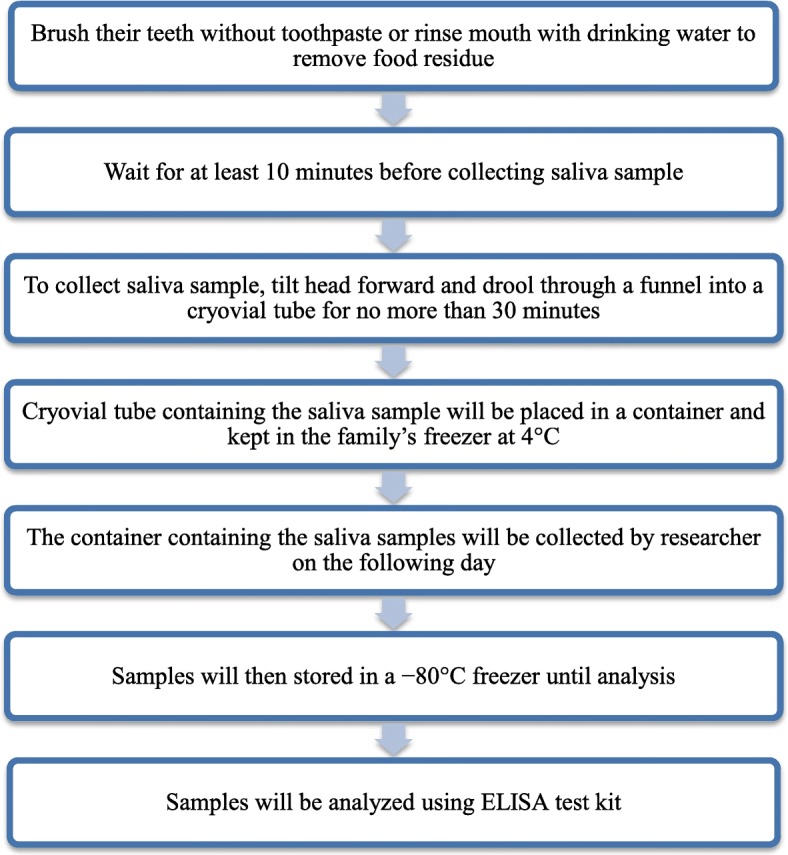
Methods: Ten government maternal and child health clinics in Kuala Lumpur, Malaysia will be randomly selected. Sample size of 438 first-trimester pregnant women will be followed-up until the birth of their infant. Salivary melatonin and cortisol concentration among subsample will be determined using enzyme-linked immunosorbent assay. Data on sleep quality, psychological distress and morningness/eveningness chronotype of pregnant women will be collected using validated questionnaires. Pedometer will be used to measure 5-day physical activity data. Total gestational weight gain will be determined at the end of pregnancy. Utilization of 3-day food record is to capture meal timing and nutrient intake. All measurements will be done in 2nd and 3rd trimester. Birth outcomes will be collected through clinic records and Centers for Disease Control and Prevention (CDC) Neonatal questionnaire. Infants will be followed-up at 6 and 12 months old to obtain anthropometric measurements.
Discussion: There is a growing recognition of the role of maternal circadian rhythm, which entrains fetal circadian rhythms that may subsequently have long-term health consequences. The present study will identify the effect of circadian rhythm on pregnancy outcomes and infant growth in the first year of life.
Keywords: Chrononutrition; Circadian system; Cortisol; Infant growth; Melatonin; Pregnancy.
Conflict of interest statement
The authors declare that they have no competing interests.
Figures
Similar articles
-
Maternal dietary and environmental factors associated with infant circadian rhythm, growth, and temperament: Research protocol for a prospective cohort study.Nutr Health. 2024 Dec;30(4):645-654. doi: 10.1177/02601060241246354. Epub 2024 Apr 7. Nutr Health. 2024. PMID: 38584399
-
Diurnal cortisol throughout pregnancy and its association with maternal depressive symptoms and birth outcomes.Psychoneuroendocrinology. 2024 Mar;161:106930. doi: 10.1016/j.psyneuen.2023.106930. Epub 2023 Dec 19. Psychoneuroendocrinology. 2024. PMID: 38142606
-
Mental health, sleep quality, and hormonal circadian rhythms in pregnant women with threatened preterm labor: a prospective observational study.BMC Pregnancy Childbirth. 2023 Jul 7;23(1):501. doi: 10.1186/s12884-023-05801-4. BMC Pregnancy Childbirth. 2023. PMID: 37420176 Free PMC article.
-
The effect of gestational period on the association between maternal prenatal salivary cortisol and birth weight: A systematic review and meta-analysis.Psychoneuroendocrinology. 2018 Aug;94:49-62. doi: 10.1016/j.psyneuen.2018.04.023. Epub 2018 Apr 24. Psychoneuroendocrinology. 2018. PMID: 29754005
-
Melatonin and stable circadian rhythms optimize maternal, placental and fetal physiology.Hum Reprod Update. 2014 Mar-Apr;20(2):293-307. doi: 10.1093/humupd/dmt054. Epub 2013 Oct 16. Hum Reprod Update. 2014. PMID: 24132226 Review.
Cited by
-
Chrononutrition is associated with melatonin and cortisol rhythm during pregnancy: Findings from MY-CARE cohort study.Front Nutr. 2023 Jan 6;9:1078086. doi: 10.3389/fnut.2022.1078086. eCollection 2022. Front Nutr. 2023. PMID: 36687684 Free PMC article.
-
The interlink between chrono-nutrition and stunting: current insights and future perspectives.Front Nutr. 2023 Dec 12;10:1303969. doi: 10.3389/fnut.2023.1303969. eCollection 2023. Front Nutr. 2023. PMID: 38192646 Free PMC article.
-
Associations Between Maternal Meal Frequency Patterns During Pregnancy and Neonatal Anthropometric Outcomes: A Quantitative Cross-Sectional Study.Nutrients. 2025 Jul 25;17(15):2437. doi: 10.3390/nu17152437. Nutrients. 2025. PMID: 40806021 Free PMC article.
-
The effect of low birth weight as an intrauterine exposure on the early onset of sarcopenia through possible molecular pathways.J Cachexia Sarcopenia Muscle. 2024 Jun;15(3):770-780. doi: 10.1002/jcsm.13455. Epub 2024 Mar 29. J Cachexia Sarcopenia Muscle. 2024. PMID: 38553412 Free PMC article. Review.
-
Mini review: Bidirectional Regulation of Circadian Rhythm by Suprachiasmatic Nucleus and Nuclear Receptors in Female Mammals.J Circadian Rhythms. 2025 Apr 8;23:4. doi: 10.5334/jcr.245. eCollection 2025. J Circadian Rhythms. 2025. PMID: 40225034 Free PMC article. Review.
References
MeSH terms
Substances
Grants and funding
LinkOut - more resources
Full Text Sources
Medical
Miscellaneous
