. 2020 Jan 28:10:1599.
doi: 10.3389/fphar.2019.01599. eCollection 2019.

Variable in Vivo and in Vitro Biological Effects of Cerium Oxide Nanoparticle Formulations

Affiliations

Variable in Vivo and in Vitro Biological Effects of Cerium Oxide Nanoparticle Formulations

Karin L Heckman et al. Front Pharmacol. .

Abstract

Cerium oxide nanoparticles (CeNPs) exhibit redox capacity in vitro with efficacy in in vivo disease models of oxidative stress. Here we compare, in parallel, three CeNP formulations with distinct chemical stabilizers and size. In vitro assays revealed antioxidant activity from all the CeNPs, but when administered to mice with a reactive oxygen species (ROS) mediated model of multiple sclerosis, only custom-synthesized Cerion NRx (CNRx) citrate-EDTA stabilized CeNPs provided protection against disease. Detectable levels of ceria and reduced ROS levels in the brains of CNRx CeNP-treated mice imply that these CeNPs' unique properties influence tissue distribution and subsequent biological activity, suggesting why differing CeNP formulations yield different in vivo effects in various models. Further, the variation in in vivo vs in vitro results with these CeNP formulations highlights the necessity for in vivo studies that confirm whether the inherent catalytic activity of CeNPs is maintained after transport and distribution within intact biological systems.

Keywords: antioxidants; cerium oxide nanoparticles; experimental autoimmune encephalomyelitis; macrophages; oxidative stress.


Figures

Figure 1
Figure 1
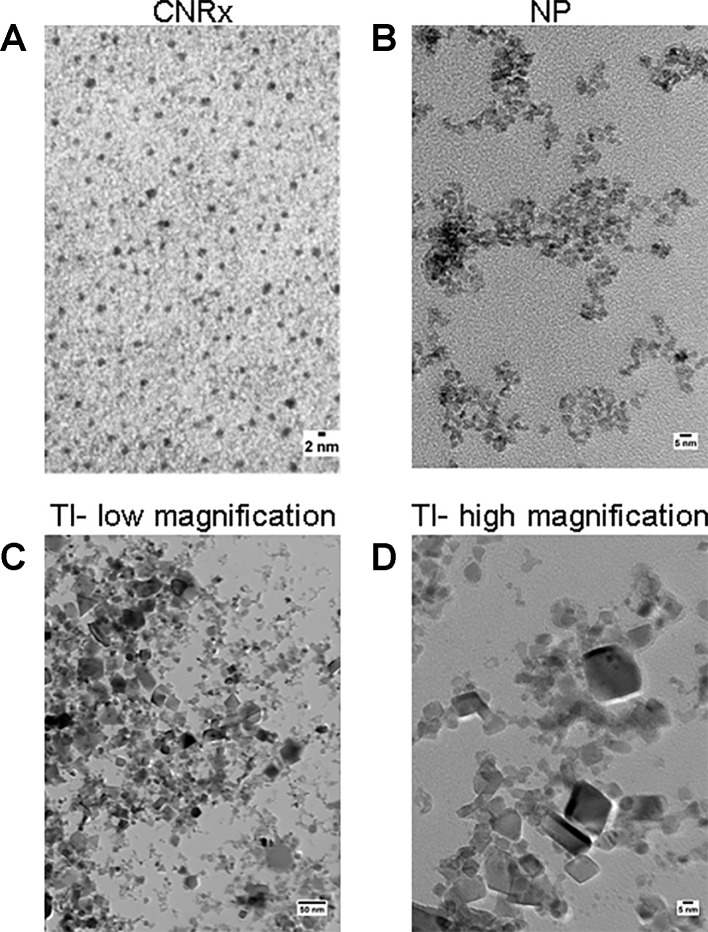
TEM characterization. Cerion NRx (CNRx) (A), Nanophase (NP) (B), and Treibacher Industrie (TI) (C, D) cerium oxide nanoparticles (CeNPs) were analyzed by TEM. Low (C) and high (D) magnification images of the TI CeNPs illustrate the aggregation tendency of this CeNP formulation.
Figure 2
Figure 2
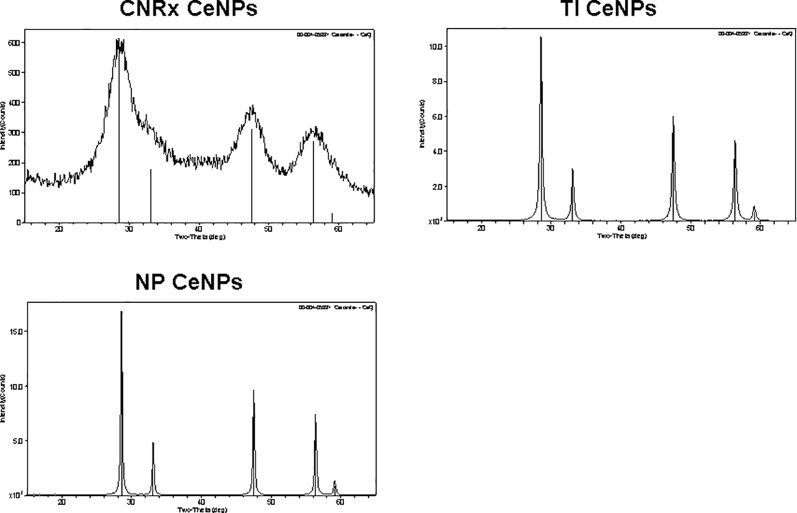
Cerium oxide nanoparticles (CeNPs) crystallinity. Cerion NRx (CNRx), Treibacher Industrie (TI), and Nanophase (NP) CeNPs were assessed by XRD; cerianite reference is shown in each plot as vertical lines.
Figure 3
Figure 3
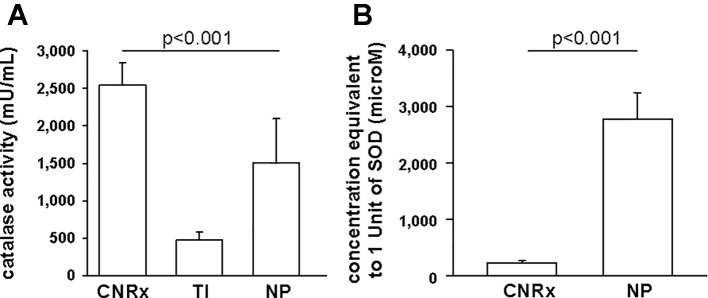
Antioxidant activity of Cerion NRx (CNRx), Treibacher Industrie (TI), and Nanophase (NP) cerium oxide nanoparticles (CeNPs). Cell-free assays were performed to assess relative catalase (A) and superoxide dismutase (B) activity. (A) Catalase-mimetic activity of 60 µM of each type of CeNPs (per reaction) was measured. p < 0.001 among groups (one-way ANOVA for main effect). p < 0.05 CNRx vs each TI, NP (Dunnett's post-hoc analysis). (B) CeNP formulations (6 µM–5 mM) were assayed for SOD activity, to find the concentration of each that produced a 50% inhibition in the rate of absorbance change, indicative of 1 unit of superoxide dismutase (SOD) activity. p < 0.001 (Student's t-test). Data are presented as mean ± SD of 4 (A) or 3 (B) independent experiments.
Figure 4
Figure 4
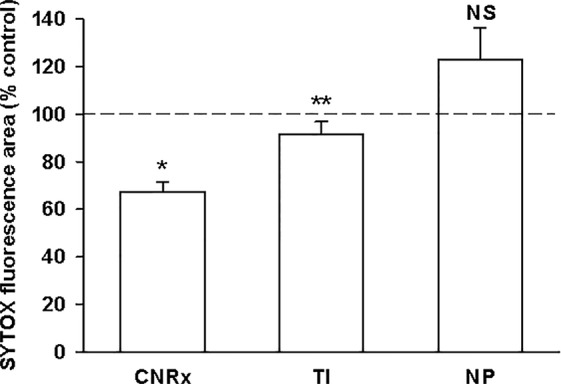
Cerion NRx (CNRx) and Treibacher Industrie (TI) cerium oxide nanoparticles (CeNPs) improve cell viability in brain slices under ischemic stress conditions. Hippocampal brain slices harvested from healthy CD1 mice were exposed to hypoglycemic, acidic, and ischemic conditions for 30 minutes simultaneously with 5.8 µM CNRx, TI, or Nanophase (NP) CeNPs or vehicle (artificial cerebrospinal fluid). Samples were returned to standard non-ischemic conditions and incubated for 24 hours. Cell viability was assessed by SYTOX Green staining. Values less than 100% (control) indicate greater viability. n = 12 age-matched, anatomically paired sections (CNRx), 9 (TI), 7 (NP). CNRx, TI, and NP significantly different than each other p < 0.001 (one-way ANOVA). * p< 0.001 CNRx vs control; ** p = 0.014 TI vs control; NS, not significant NP vs control (Student's t-test).
Figure 5
Figure 5
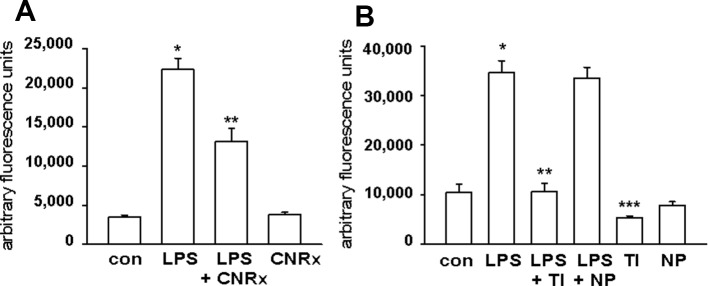
Cerion NRx (CNRx), Treibacher Industrie (TI), and Nanophase (NP) cerium oxide nanoparticles (CeNPs) decrease reactive oxygen species (ROS) levels in activated macrophages. RAW264.7 cells were treated with media as a control (con) or lipopolysaccharide (LPS) with or without 5 μM CNRx (A) or 5 μM TI or NP CeNPs (B) in cell culture media for 6 hours. The ROS indicator dye H2CM-DCFDA was added for the last 20 minutes of incubation, and fluorescence was measured. (A) mean +/− SEM of 10–12 samples from four experiments. Main effect: p < 0.001 (one-way ANOVA); * control vs LPS and **LPS vs LPS+CNRx p < 0.05 (Tukey's test). (B) mean +/− SEM of 8–9 samples from 3 experiments. LPS main effect p < 0.001 (one-way ANOVA); *control vs LPS and **LPS vs LPS+TI p < 0.05 (Tukey's test). ***control vs TI p < 0.05 (Tukey's test).
Figure 6
Figure 6
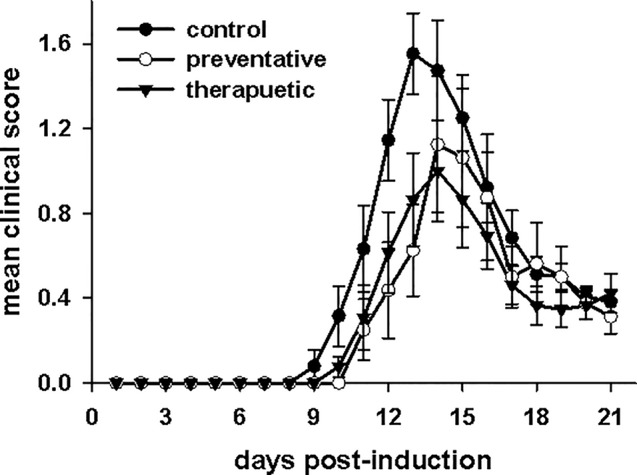
Cerion NRx (CNRx) cerium oxide nanoparticles (CeNPs) lessen disease symptoms in a murine model of multiple sclerosis in both preventative and therapeutic dosage regimens. Female SJL/J mice were induced with experimental autoimmune encephalomyelitis (EAE) and intravenously treated with CNRx CeNPs or vehicle in a preventative dosage (days −1, 0, 3, 7, 14, 21 relative to induction on day 0) or a therapeutic dosage (days 3, 7, 14, 21 relative to induction on day 0). Preventative doses were 15 mg/kg on days−1 and 0, followed by 6 mg/kg on remaining days. All therapeutic doses were 6 mg/kg. Daily mean clinical scores for each group are depicted. The preventative and therapeutic regimens are different than control (p < 0.05, repeated measures ANOVA on Ranks with Holm-Sidak post hoc analysis), but are not different from each other (p = 0.658, t-test). n = 8–17 mice per group.
Figure 7
Figure 7
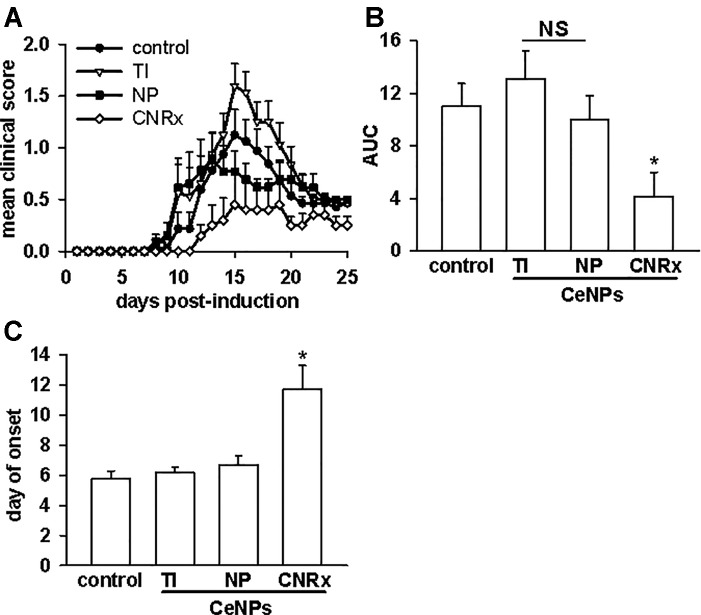
Only Cerion NRx (CNRx) cerium oxide nanoparticles (CeNPs) alleviate disease severity in a murine model of multiple sclerosis. Female SJL/J mice were induced with experimental autoimmune encephalomyelitis (EAE) and intravenously treated with 6 mg/kg Treibacher Industrie (TI), Nanophase (NP), or CNRx CeNPs or vehicle on days 3, 7, 14, 21, and 28 post-induction. (A) Daily mean clinical scores for each group are depicted (main effect: p < 0.001, Friedman's repeated measures ANOVA on Ranks). Area under the curve (AUC) analysis of clinical scores over the disease course (B) indicates cumulative disease severity (main effect: p = 0.017, Kruskal-Wallis One-Way ANOVA; *CNRx vs control p < 0.05, Dunn's Method). (C) Mean day of symptom onset (main effect: p < 0.001, Factorial ANOVA; *CNRx vs control p < 0.001, Holm-Sidak test). n = 10–16 mice per group. NS, not significant.
Figure 8
Figure 8
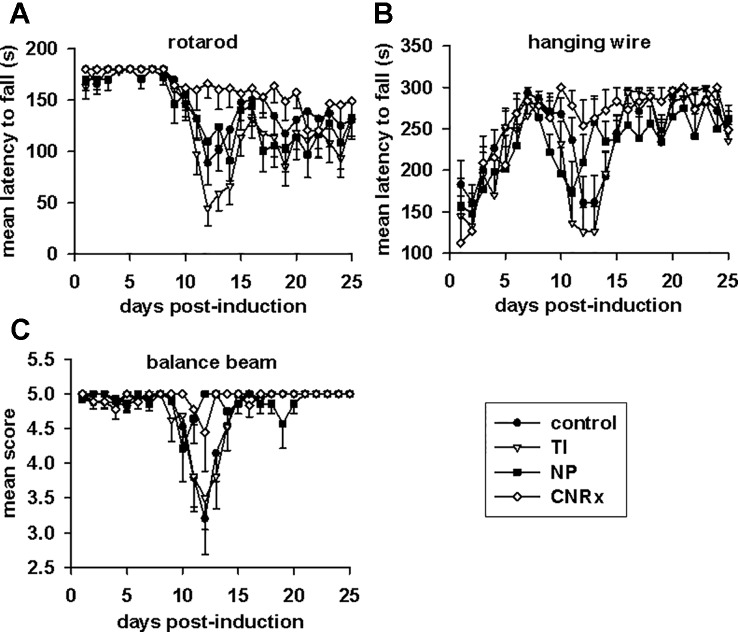
Motor function in experimental autoimmune encephalomyelitis (EAE) mice is preserved by Cerion NRx (CNRx) cerium oxide nanoparticle (CeNP) treatment, but worsened by Treibacher Industrie (TI) and Nanophase (NP) CeNP treatment. EAE mice were tested daily in the rotarod (A), hanging wire (B), and balance beam (C) tasks. Higher mean latency to fall from the rotarod and hanging wire and higher mean balance beam score indicate better motor function. See Results for statistical comparison. n = 10–16 per group. s, seconds.
Figure 9
Figure 9
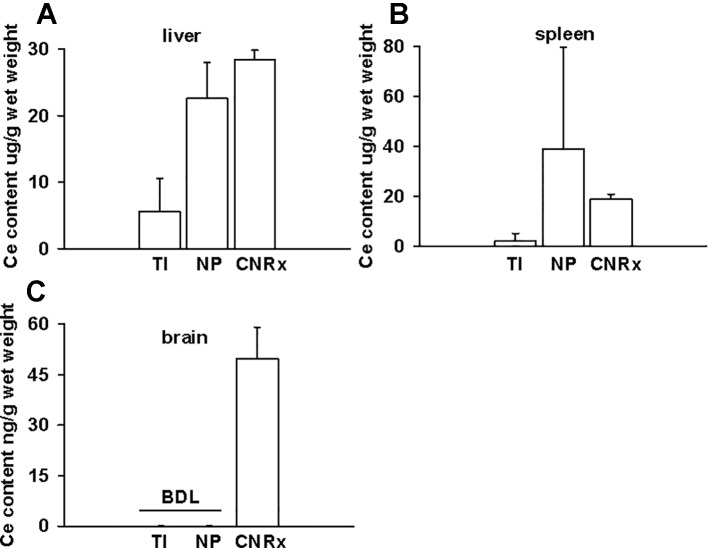
Only Cerion NRx (CNRx) cerium oxide nanoparticles (CeNPs) distribute to the brains of experimental autoimmune encephalomyelitis (EAE) mice. On day 35 post-induction, EAE mice were euthanized and perfused with PBS. Liver (A), spleen (B), and brain (C) tissues were harvested, and ceria content was analyzed by ICP-MS. Results are presented as mean + SEM in µg ceria/g wet weight. BDL, below detection limit.
Figure 10
Figure 10
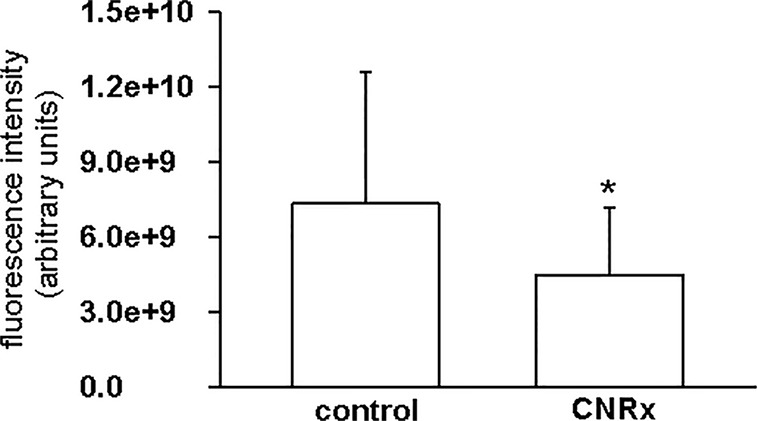
Cerion NRx (CNRx) cerium oxide nanoparticles (CeNPs) exhibit prolonged in vivo antioxidant activity. Experimental autoimmune encephalomyelitis (EAE) mice treated with CNRx CeNPs or vehicle control (15 mg/kg days −1 and 0 followed by 6 mg/kg days 3, 7, 14, 21, 28) were euthanized 5 weeks after their final treatment dose. Brains were harvested and reactive oxygen species (ROS) levels were measured by H2CM-DCFDA staining. Results represent 20 matched pairs of brain slices from four control and four CNRx treated mice. * p = 0.007 (Student's t-test).

References

    1. Asati A., Santra S., Kaittanis C., Nath S., Perez J. M. (2009). Oxidase-like activity of polymer-coated cerium oxide nanoparticles. Angew. Chem. Int. Ed. Engl. 48 (13), 2308–2312. 10.1002/anie.200805279 - DOI - PMC - PubMed
    1. Bailey Z. S., Nilson E., Bates J. A., Oyalowo A., Hockey K. S., Sajja V. S., et al. (2016). Cerium oxide nanoparticles improve outcome after in vitro and in vivo mild traumatic brain injury. J. Neurotrauma. 33, 1–11. 10.1089/neu.2016.4644 - DOI - PMC - PubMed
    1. Baldim V., Bedioui F., Mignet N., Margaill I., Berret J. -F. (2018). The enzyme-like catalytic activity of cerium oxide nanoparticles and its dependency on Ce3+ surface area concentration. Nanoscale 10, 6971–6980. 10.1039/C8NR00325D - DOI - PubMed
    1. Brooks S. P., Dunnett S. B. (2009). Tests to assess motor phenotype in mice: a user's guide. Nat. Rev. Neurosci. 10 (7), 519–529. 10.1038/nrn2652 - DOI - PubMed
    1. Cimini A., D'Angelo B., Das S., Gentile R., Benedetti E., Singh V., et al. (2012). Antibody-conjugated PEGylated cerium oxide nanoparticles for specific targeting of Aβ aggregates modulate neuronal survival pathways. Acta Biomater. 8 (6), 2056–2067. 10.1016/j.actbio.2012.01.035 - DOI - PubMed

LinkOut - more resources