Precision medicine in inflammatory bowel disease: concept, progress and challenges
- PMID: 32047622
- PMCID: PMC6993839
- DOI: 10.12688/f1000research.20928.1
Precision medicine in inflammatory bowel disease: concept, progress and challenges
Abstract
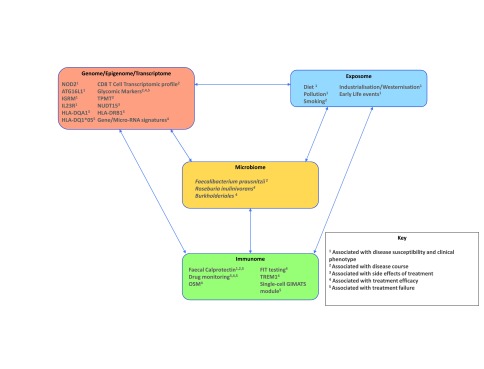
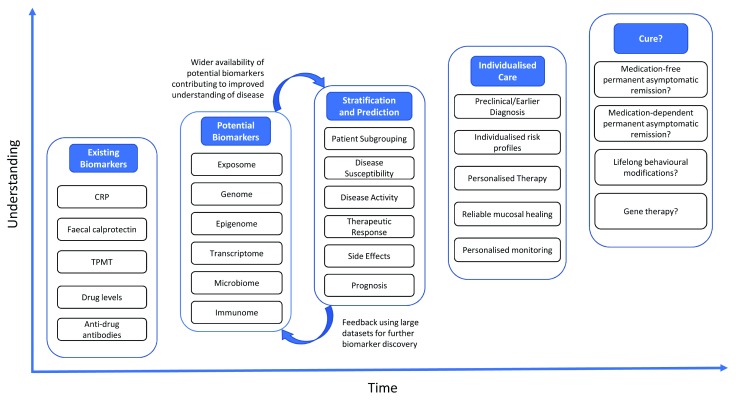
Crohn's disease and ulcerative colitis are increasingly prevalent, relapsing and remitting inflammatory bowel diseases (IBDs) with variable disease courses and complications. Their aetiology remains unclear but current evidence shows an increasingly complex pathophysiology broadly centring on the genome, exposome, microbiome and immunome. Our increased understanding of disease pathogenesis is providing an ever-expanding arsenal of therapeutic options, but these can be expensive and patients can lose response or never respond to certain therapies. Therefore, there is now a growing need to personalise therapies on the basis of the underlying disease biology and a desire to shift our approach from "reactive" management driven by disease complications to "proactive" care with an aim to prevent disease sequelae. Precision medicine is the tailoring of medical treatment to the individual patient, encompassing a multitude of data-driven (and multi-omic) approaches to foster accurate clinical decision-making. In IBD, precision medicine would have significant benefits, enabling timely therapy that is both effective and appropriate for the individual. In this review, we summarise some of the key areas of progress towards precision medicine, including predicting disease susceptibility and its course, personalising therapies in IBD and monitoring response to therapy. We also highlight some of the challenges to be overcome in order to deliver this approach.
Keywords: Crohn's disease; biomarkers; genomics; inflammatory bowel disease; microbiome; precision medicine; prognosis; therapeutics; ulcerative colitis.
Copyright: © 2020 Borg-Bartolo SP et al.
Conflict of interest statement
No competing interests were disclosed.No competing interests were disclosed.No competing interests were disclosed.
Figures
References
Publication types
MeSH terms
Grants and funding
LinkOut - more resources
Full Text Sources