


Nonalcoholic fatty liver disease burden: Australia, 2019-2030
- PMID: 32048317
- PMCID: PMC7540570
- DOI: 10.1111/jgh.15009
Nonalcoholic fatty liver disease burden: Australia, 2019-2030
Abstract
Background and aim: Nonalcoholic fatty liver disease (NAFLD) and nonalcoholic steatohepatitis (NASH) account for a large and growing proportion of liver disease burden globally. The burden of NAFLD/NASH manifests in increasing levels of advanced liver disease and primary liver cancer in Australia. A Markov model was used to forecast NAFLD burden in Australia through 2030.
Methods: A model was used to estimate fibrosis progression, primary liver cancer, and liver deaths among the Australian NAFLD population, with changes in incident NAFLD cases based on long-term trends for changes in the prevalence of obesity. Published estimates and surveillance data were applied to build and validate the model projections, including surveillance data for the incidence of liver cancer.
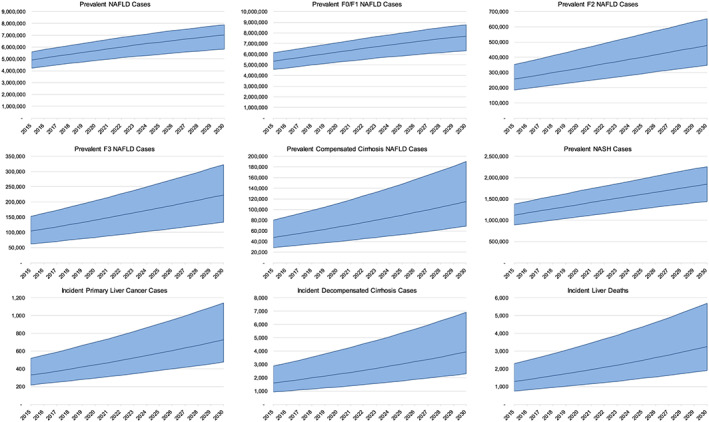
Results: Prevalent NAFLD cases were projected to increase 25% from the current burden (5 551 000 [4 748 000-6 306 000] cases in 2019) to 7 024 000 [5 838 000-7 886 000] cases in 2030. The projected increase in the number of NASH cases (40%) was greater than that of NAFLD cases. Incident cases of advanced liver disease are projected to increase up to 85% by 2030, and incident NAFLD liver deaths are estimated to increase 85% from 1900 (1100-3300) deaths in 2019 to 3500 (2100-6100) deaths in 2030.
Conclusions: Restraining growth of the obese and diabetic populations, along with potential therapeutic options, will be essential for mitigating disease burden.
Keywords: Fatty liver; Hepatocellular carcinoma; Liver cirrhosis; Liver neoplasms; Metabolic syndrome; Nonalcoholic fatty liver disease.
© 2020 The Authors. Journal of Gastroenterology and Hepatology published by Journal of Gastroenterology and Hepatology Foundation and John Wiley & Sons Australia, Ltd.
Figures
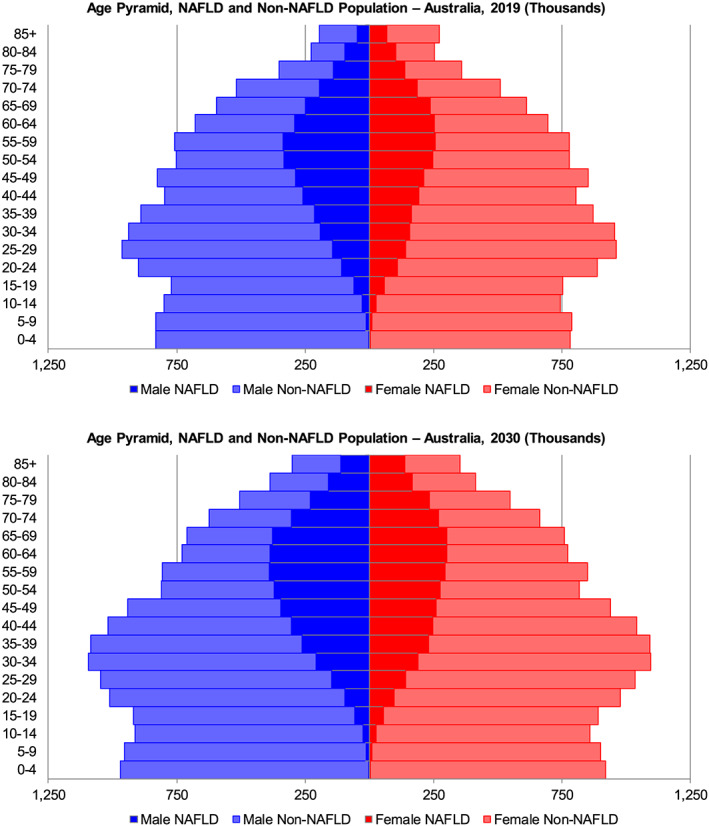
 , male NAFLD;
  , male non‐NAFLD;
  , female NAFLD;
  , female non‐NAFLD.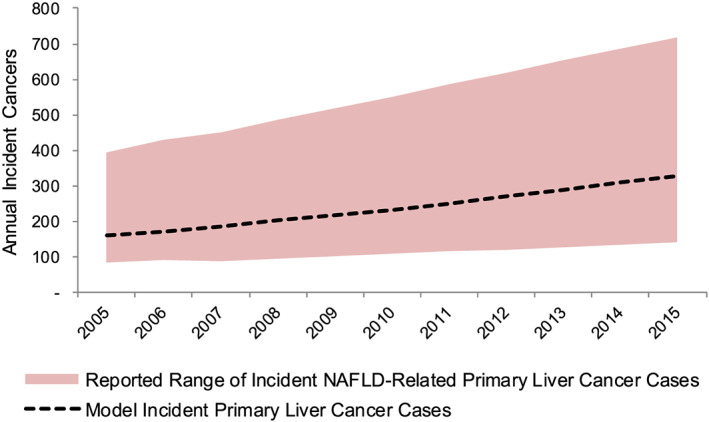
 , reported range of incident NAFLD‐related primary liver cancer cases;
  , model incident primary liver cancer cases.
References
-
- Younossi ZM, Otgonsuren M, Henry L et al Association of nonalcoholic fatty liver disease (NAFLD) with hepatocellular carcinoma (HCC) in the United States from 2004 to 2009. Hepatology 2015; 62: 1723–1730. - PubMed
-
- Sanyal A, Poklepovic A, Moyneur E, Barghout V. Population‐based risk factors and resource utilization for HCC: US perspective. Curr. Med. Res. Opin. 2010; 26: 2183–2191. - PubMed
-
- Loomba R, Sanyal AJ. The global NAFLD epidemic. Nat. Rev. Gastroenterol. Hepatol. 2013; 10: 686–690. - PubMed
-
- Hong TP, Gow P, Fink M et al Novel population‐based study finding higher than reported hepatocellular carcinoma incidence suggests an updated approach is needed. Hepatology 2016; 63: 1205–1212. - PubMed
-
- Australian Institute of Health and Welfare . Overweight & obesity 2018 [Available from: https://www.aihw.gov.au/reports‐statistics/behaviours‐risk‐factors/overw...].
MeSH terms
Grants and funding
LinkOut - more resources
Full Text Sources
Medical
