


Early versus late erythropoietin for preventing red blood cell transfusion in preterm and/or low birth weight infants
- PMID: 32048729
- PMCID: PMC7014632
- DOI: 10.1002/14651858.CD004865.pub4
Early versus late erythropoietin for preventing red blood cell transfusion in preterm and/or low birth weight infants
Abstract
Background: Low plasma levels of erythropoietin (EPO) in preterm infants provide a rationale for the use of EPO to prevent or treat anaemia.
Objectives: To assess the effectiveness and safety of early versus late initiation of EPO in reducing red blood cell (RBC) transfusions in preterm and/or low birth weight (LBW) infants.
Search methods: The standard search of the Cochrane Neonatal Review Group (CNRG) was performed in 2006 and updated in 2009. Updated search in September 2009 as follows: The Cochrane Library, MEDLINE (search via PubMed), CINAHL and EMBASE were searched from 2005 to September 2009. The searches were repeated in March 2012. The Pediatric Academic Societies' Annual meetings were searched electronically from 2000 to 2012 at Abstracts2ViewTM as were clinical trials registries (clinicaltrials.gov; controlled-trials.com; and who.int/ictrp).
Selection criteria: Randomised or quasi-randomised controlled trials enrolling preterm or LBW infants less than eight days of age.
Intervention: Early initiation of EPO (initiated at less than eight days of age) versus late initiation of EPO (initiated at eight to 28 days of age).
Data collection and analysis: The standard methods of the CNRG were followed. Weighted treatment effects included typical risk ratio (RR), typical risk difference (RD), number needed to treat to benefit (NNTB), number needed to treat to harm (NNTH) and mean difference (MD), all with 95% confidence intervals (CI). A fixed-effect model was used for meta-analyses and heterogeneity was evaluated using the I-squared (I2) test.
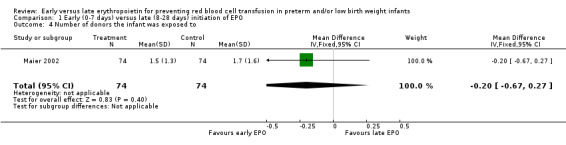
Main results: No new trials were identified in March of 2012. Two high quality randomised double-blind controlled studies enrolling 262 infants were identified. A non-significant reduction in the 'Use of one or more RBC transfusions' [two studies 262 infants; typical RR 0.91 (95% CI 0.78 to 1.06); typical RD -0.07 (95% CI -0.18 to 0.04; I2 = 0% for both RR and RD] favouring early EPO was noted. Early EPO administration resulted in a non-significant reduction in the "number of transfusions per infant" compared with late EPO [typical MD - 0.32 (95% CI -0.92 to 0.29)]. There was no significant reduction in total volume of blood transfused per infant or in the number of donors to whom the infant was exposed. Early EPO led to a significant increase in the risk of retinopathy of prematurity (ROP) (all stages) [two studies, 191 infants; typical RR 1.40 (95% CI 1.05 to 1.86); typical RD 0.16 (95% CI 0.03 to 0.29); NNTH 6 (95% CI 3 to 33)]. There was high heterogeneity for this outcome (I2 = 86% for RR and 81% for RD). Both studies (191 infants) reported on ROP stage > 3. No statistically significant increase in risk was noted [typical RR 1.56 (95% CI 0.71 to 3.41); typical RD 0.05 (-0.04 to 0.14)] There was no heterogeneity for this outcome (0% for both RR and RD). No other important favourable or adverse neonatal outcomes or side effects were reported.
Authors' conclusions: The use of early EPO did not significantly reduce the 'Use of one or more RBC transfusions' or the 'Number of transfusions per infant" compared with late EPO administration. The finding of a statistically significant increased risk of ROP (any grade) and a similar trend for ROP stage > 3 with early EPO treatment is of great concern.
Copyright © 2020 The Cochrane Collaboration. Published by John Wiley & Sons, Ltd.
Conflict of interest statement
None known.
Figures




Update of
-
Early versus late erythropoietin for preventing red blood cell transfusion in preterm and/or low birth weight infants.Cochrane Database Syst Rev. 2012 Oct 17;10:CD004865. doi: 10.1002/14651858.CD004865.pub3. Cochrane Database Syst Rev. 2012. Update in: Cochrane Database Syst Rev. 2020 Feb 11;2:CD004865. doi: 10.1002/14651858.CD004865.pub4. PMID: 23076909 Updated.
References
References to studies included in this review
Donato 2000 {published and unpublished data}
-
- Donato H, Vain N, Rendo P, Vivas N, Prudent L, Larguia M, et al. Effect of early versus late administration of human recombinant erythropoietin on transfusion requirements in premature infants: results of a randomized, placebo‐controlled, multicenter trial. Pediatrics 2000;105:1066‐72. - PubMed
Maier 2002 {published and unpublished data}
-
- Maier RF, Obladen M, Muller‐Hansen I, Kattner E, Merz U, Arlettaz R, et al. Early treatment with erythropoietin beta ameliorates anemia and reduces transfusion requirements in infants with birth weights below 1000 g. Journal of Pediatrics 2002;141:8‐15. - PubMed
References to studies excluded from this review
Rudzinska 2002 {published data only}
-
- Rudzinska IM, Kornacka MK, Pawluch R. Treatment with human recombinant erythropoietin and frequency of retinopathy of prematurity [Leczenie preparatami ludzkiej rekombinowanej erytropoetyny a czeztosc retinopatii u noworodkow przedwczesnie urodzonych (Polish)]. Prezglad Lekarski 2002;59 Supplement 1:83‐5. - PubMed
Additional references
Aher 2006a
Brown 1983
-
- Brown MS, Phibbs RH, Garcia JF, Dallman PR. Postnatal changes in erythropoietin levels in untransfused premature infants. Journal of Pediatrics 1983;103:612‐7. - PubMed
Dallman 1981
-
- Dallman PR. Anemia of prematurity. Annual Review of Medicine 1981;32:143‐60. - PubMed
Dame 2001
-
- Dame C, Juul SE, Christensen RD. The biology of erythropoietin in the central nervous system and its neurotrophic and neuroprotective potential. Biology of the Neonate 2001;79:228‐35. - PubMed
Finch 1982
-
- Finch CA. Erythropoiesis, erythropoietin and iron. Blood 1982;60:1241‐6. - PubMed
Garcia 2002
-
- Garcia MG, Hutson AD, Christensen RD. Effect of recombinant erythropoietin on "late" transfusions in the neonatal intensive care unit: a meta‐analysis. Journal of Perinatology 2002;22:108‐11. - PubMed
Genen 2004
-
- Genen LH, Klenoff H. Iron supplementation for erythropoietin‐treated preterm infants. Cochrane Database of Systematic Reviews 2001, Issue 1. [DOI: 10.1002/14651858.CD003061.pub2] - DOI
Hesse 1997
-
- Hesse L, Eberl W, Schlaud M, Poets CF. Blood transfusion. Iron load and retinopathy of prematurity. European Journal of Pediatrics 1997;156:465‐70. - PubMed
Higgins 2003
Higgins 2011 [Computer program]
-
- Higgins JPT, Green S. Cochrane Handbook for Systematic Reviews of Interventions 5.1.0. The Cochrane Collaboration, 2011.
Juul 2002
-
- Juul S. Erythropoietin in the central nervous system, and its use to prevent hypoxic‐ischemic brain damage. Acta Paediatrica Supplement 2002;91:36‐42. - PubMed
Kotto‐Kome 2004
-
- Kotto‐Kome AC, Garcia MG, Calhoun DA, Christensen RD. Effect of beginning recombinant erythropoietin treatment within the first week of life, among very‐low‐birth‐weight neonates, on "early" and "late" erythrocyte transfusions: a meta‐analysis. Journal of Perinatology 2004;24:24‐9. - PubMed
Ohls 2000
-
- Ohls RK. The use of erythropoietin in neonates. Clinics in Perinatology 2000;27:681‐96. - PubMed
Ohls 2002
-
- Ohls RK. Erythropoietin treatment in extremely low birth weight infants: blood in versus blood out. Journal of Pediatrics 2002;141:3‐6. - PubMed
Ohls 2004
-
- Ohls RK, Dai A. Long‐acting erythropoietin: clinical studies and potential uses in neonates. Clinics in Perinatology 2004;31:77‐89. - PubMed
Ohlsson 2006
RevMan 2011 [Computer program]
-
- The Nordic Cochrane Centre, The Cochrane Collaboration. Review Manager (RevMan) Version 5.1. Copenhagen: The Nordic Cochrane Centre, The Cochrane Collaboration, 2011.
Shannon 1995
-
- Shannon KM, Keith JF 3rd, Mentzer WC, Ehrenkranz RA, Brown MS, Widness JA, et al. Recombinant human erythropoietin stimulates erythropoiesis and reduces erythrocyte transfusions in very low birth weight infants. Pediatrics 1995;95:1‐8. - PubMed
Stockman 1978
-
- Stockman JA 3rd, Oski FA. Physiological anaemia of infancy and the anaemia of prematurity. Clinics in Hematology 1978;7:3‐18. - PubMed
Stockman 1986
-
- Stockman JA 3rd. Anemia of prematurity. Current concept in the issue of when to transfuse. Pediatric Clinics of North America 1986;33:111‐28. - PubMed
Strauss 1986
-
- Strauss RG. Current issues in neonatal transfusions. Vox Sanguinis 1986;51:1‐9. - PubMed
Vamvakas 2001
-
- Vamvakas EC, Strauss RG. Meta‐analysis of controlled clinical trials studying the efficacy of rHuEPO in reducing blood transfusions in the anemia of prematurity. Transfusion 2001;41:406‐15. - PubMed
Warwood 2005
-
- Warwood TL, Ohls RK, Wiedmeier SE, Lambert DK, Jones C, Scoffield SH, et al. Single‐dose darbepoetin administration to anemic preterm neonates. Journal of Perinatology 2005;25:725‐30. - PubMed
Widness 1996
-
- Widness JA, Seward VJ, Kromer IJ, Burmeiser LF, Bell EF. Changing patterns of red blood cell transfusion in very low birth weight infants. Journal of Pediatrics 1996;129:680‐7. - PubMed
Yu 2010
-
- Yu Z, Guo X, Han S, Lu J, Sun Q, Ohlsson A. Erythropoietin for term and later preterm infants with hypoxicischemic encephalopathy (protocol). Cochrane Database of Systematic Reviews 2010, Issue 2. [DOI: 10.1002/14651858.CD008316] - DOI
Zipursky 2000
-
- Zipursky A. Erythropoietin therapy for premature infants: cost without benefit?. Pediatric Research 2000;48:136. - PubMed
References to other published versions of this review
Aher 2004
-
- Aher SM, Ohlsson A. Early versus late erythropoietin for preventing red blood cell transfusion in preterm and/or low birth weight infants. Cochrane Database of Systematic Reviews 2004, Issue 3. [DOI: 10.1002/14651858.CD004865.pub2] - DOI
Publication types
MeSH terms
Substances
LinkOut - more resources
Full Text Sources
Medical
Research Materials
Miscellaneous
