


Hospital adoption of multiple health information exchange approaches and information accessibility
- PMID: 32049356
- PMCID: PMC7647262
- DOI: 10.1093/jamia/ocaa003
Hospital adoption of multiple health information exchange approaches and information accessibility
Abstract
Objective: Hospital engagement in electronic health information exchange (HIE) has increased over recent years. We aimed to 1) determine the change in adoption of 3 types of information exchange: secure messaging, provider portals, and use of an HIE; and 2) to assess if growth in each approach corresponded to increased ability to access and integrate patient information from outside providers.
Methods: Panel analysis of all nonfederal, acute care hospitals in the United States using hospital- and year-fixed effects. The sample consisted of 1917 hospitals that responded to the American Hospital Association Information Technology Supplement every year from 2014 to 2016.
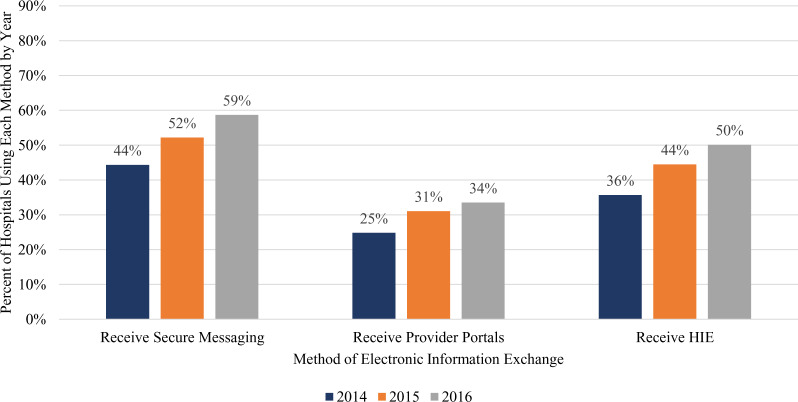
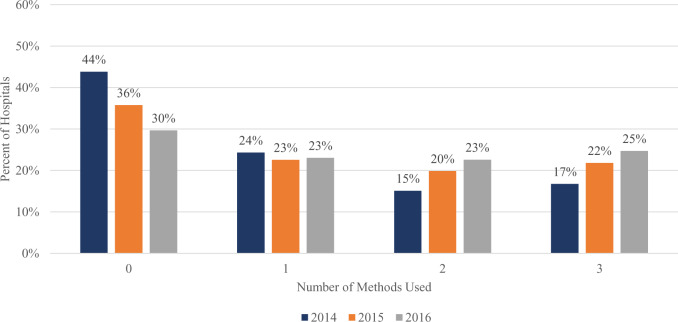
Results: Adoption of each approach increased by 9-15 percentage points over the study period. The average number of HIE approaches used by each hospital increased from 1.0 to 1.4. Adoption of each approach was associated with increased likelihood that providers routinely had necessary outside information of 4.2-12.7 percentage points and 4.5-13.3 percentage points increase in information integration. Secure messaging was associated with the largest increase in both. Adoption of 1 approach increased the likelihood of having outside information by 10.3 percentage points, while adopting a second approach further increased the likelihood by 9.5 percentage points. Trends in number of approaches and integration were similar.
Discussion/conclusion: No single HIE tool provided high levels of usable, integrated health information. Instead, hospitals benefited from adopting multiple tools. Policy initiatives that reduce the complexity of enabling high value HIE could result in broader adoption of HIE and use of information to inform care.
Keywords: health information exchange; health information technology adoption; hospitals; interoperability; secure messaging.
© The Author(s) 2020. Published by Oxford University Press on behalf of the American Medical Informatics Association. All rights reserved. For permissions, please email: journals.permissions@oup.com.
Figures
References
-
- Adler-Milstein J, Jha AK.. HITECH Act drove large gains in hospital electronic health record adoption. Health Aff 2017; 36 (8): 1416–22. - PubMed
-
- Blumenthal D. Stimulating the adoption of health information technology. N Engl J Med 2009; 360 (15): 1477–9. - PubMed
-
- Buntin MB, Jain SH, Blumenthal D.. Health information technology: laying the infrastructure for national health reform. Health Aff 2010; 29 (6): 1214–9. - PubMed
-
- Gabriel MH, Jones EB, Samy L, King J.. Progress and challenges: implementation and use of health information technology among critical-access hospitals. Health Aff 2014; 33 (7): 1262–70. - PubMed
-
- Holmgren AJ, Patel V, Adler-Milstein J.. Progress in interoperability: measuring US hospitals’ engagement in sharing patient data. Health Aff 2017; 36 (10): 1820–7. - PubMed
