


Comparison of the short-term outcomes between totally laparoscopic total gastrectomy and laparoscopic-assisted total gastrectomy for gastric cancer: a meta-analysis
- PMID: 32049863
- PMCID: PMC7035048
- DOI: 10.1097/MD.0000000000019225
Comparison of the short-term outcomes between totally laparoscopic total gastrectomy and laparoscopic-assisted total gastrectomy for gastric cancer: a meta-analysis
Abstract
Background: Totally laparoscopic total gastrectomy (TLTG) and laparoscopic-assisted total gastrectomy (LATG) are two common surgical approaches for upper and middle gastric cancer. Which surgical approach offers more advantages is still controversial due to a lack of evidence from randomized controlled trials (RCTs). This meta-analysis was conducted to compare the short-term outcomes between the two surgical approaches.
Methods: A systematic literature search was performed to evaluate short-term outcomes between TLTG and LATG, including overall postoperative complications, anastomosis-related complications, time for anastomosis, operation time, intraoperative blood loss, harvested lymph nodes, proximal margin, distal margin, time to first flatus, time to first diet, and postoperative hospital stay. Short-term outcomes were pooled and compared by meta-analysis using RevMan 5.3. Mean differences (MDs) or risk ratios (RRs) were calculated with 95% confidence intervals (CIs). P < .05 was considered statistically significant.
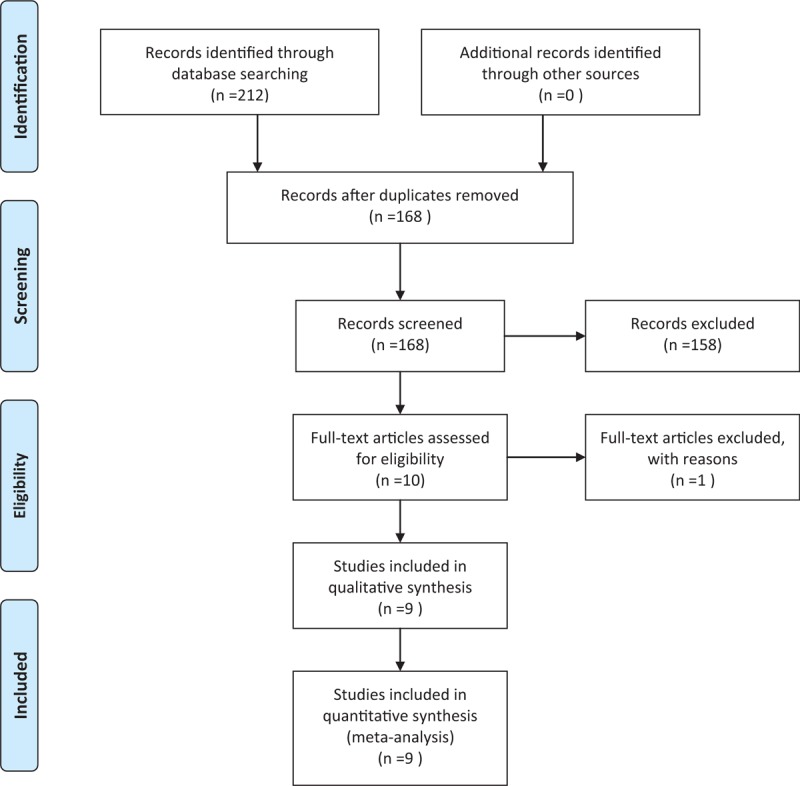
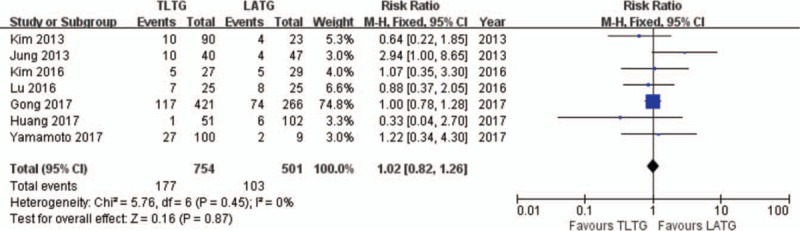
Results: A total of 9 cohort studies fulfilled the selection criteria. The total sample included 1671 cases. The meta-analysis showed no significant difference between the two surgical approaches in overall postoperative complications (RR = 1.02, 95% CI = 0.82 to 1.26, P = .87),anastomosis-related complications (RR = 0.64, 95%CI = 0.39 to 1.03, P = .06),time for anastomosis (MD = -5.13, 95% CI = -10.54 to 0.27, P = .06),operation time (MD = -10.68, 95% CI = -23.62 to 2.26, P = .11), intraoperative blood loss (MD = -25.58, 95% CI = -61.71 to 10.54, P = .17), harvested lymph nodes (MD = 1.61, 95% CI = -2.09 to 5.31, P = .39), proximal margin (MD = -0.37, 95% CI = -0.78 to 0.05, P = .09), distal margin (MD = 0.79, 95% CI = -0.57 to 2.14, P = .25), time to first flatus (MD = 0.01, 95% CI = -0.13 to 0.15, P = .87), time to first diet (MD = -0.22, 95% CI = -0.45 to 0.02, P = .07), and postoperative hospital stay (MD = -0.51, 95% CI = -1.10 to 0.07, P = .09).
Conclusions: TLTG is a safe and feasible surgical approach for upper and middle gastric cancer, with short-term outcomes that are similar to LATG. Nevertheless, high-quality, large-sample and multicenter RCTs are still required to further verify our conclusions.
Conflict of interest statement
The authors report no conflicts of interest.
Figures
References
-
- Ferlay J, Soerjomataram I, Dikshit R, et al. Cancer incidence and mortality worldwide: sources, methods and major patterns in GLOBOCAN 2012. Int J Cancer 2015;136:E359–86. - PubMed
-
- Torre LA, Bray F, Siegel RL, et al. Global cancer statistics, 2012. CA Cancer J Clin 2015;65:87–108. - PubMed
-
- Bray F, Ferlay J, Soerjomataram I, et al. Global cancer statistics 2018: GLOBOCAN estimates of incidence and mortality worldwide for 36 cancers in 185 countries. CA Cancer J Clin 2018;68:394–424. - PubMed
-
- Ajani JA, D’Amico TA, Almhanna K, et al. Gastric Cancer, Version 3.2016, NCCN Clinical Practice Guidelines in Oncology. J Natl Compr Canc Netw 2016;14:1286–312. - PubMed
Publication types
MeSH terms
LinkOut - more resources
Full Text Sources
Medical
Research Materials
Miscellaneous
